Mammals Guide
Hamadryas Baboon
What Is a Hamadryas Baboon? The hamadryas baboon (Papio hamadryas) is a large, ground-dwelling Old World monkey native to the dry lands of the Horn of Africa and the southwestern corner of the Arabian Peninsula. It is …
At a glance
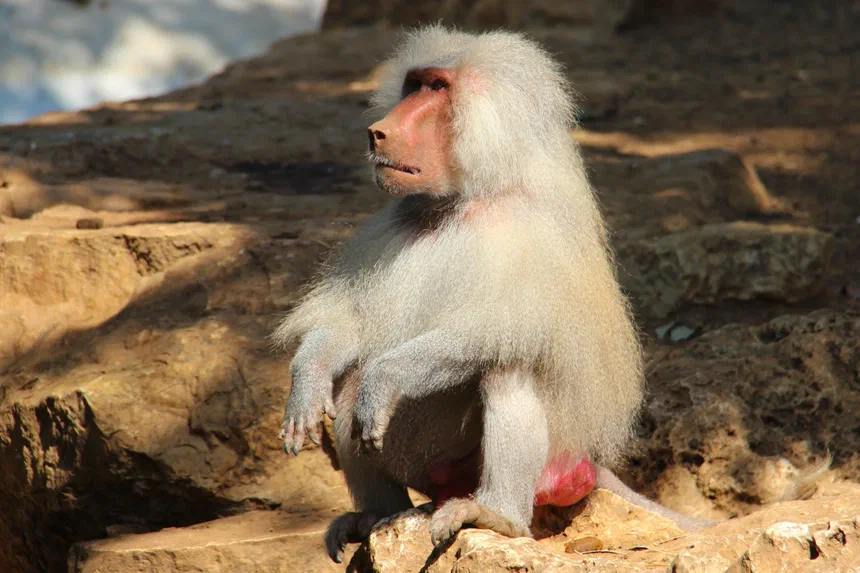
Image: مُعتز توفيق إغباريّة — CC BY-SA 4.0 · source
What Is a Hamadryas Baboon?
The hamadryas baboon (Papio hamadryas) is a large, ground-dwelling Old World monkey native to the dry lands of the Horn of Africa and the southwestern corner of the Arabian Peninsula. It is the most northerly of the baboon species and the only one whose natural range extends outside Africa. Ancient Egyptians revered the animal, associating it with the god Thoth, which is why it is sometimes called the sacred baboon.
Appearance and Identification
Adult males are strikingly different from females, a trait known as sexual dimorphism. Dominant males grow a long silvery-gray cape of hair over the shoulders and upper body, along with a pinkish, hairless face and rump. Females and juveniles are smaller and a plainer olive-brown, without the mane. Males typically weigh 40 to 45 pounds (around 18 to 20 kilograms), roughly twice the mass of females, and both sexes have powerful jaws with prominent canine teeth. Head-and-body length ranges from about 20 to 30 inches (50 to 75 centimeters), with a tufted tail adding further length.
Habitat and Range
Hamadryas baboons occupy some of the harshest environments used by any primate, including subdesert scrub, arid savanna, rocky outcrops, and steep cliffs. They are found in Ethiopia, Eritrea, Somalia, and Djibouti, and across the Red Sea in Saudi Arabia and Yemen. Access to water is a limiting factor, so troops rarely stray far from springs or seasonal streams. Sheer cliffs are essential to their survival, serving as safe sleeping sites where predators cannot easily reach them.
Diet
As opportunistic omnivores, hamadryas baboons eat a wide variety of foods depending on the season and location. Grasses, seeds, roots, tubers, acacia pods, fruits, and flowers make up much of the diet, supplemented by insects, bird eggs, and occasionally small vertebrates. During dry periods they dig for roots and rely on tough, fibrous vegetation that many other animals cannot process. Their cheek pouches let them gather food quickly and carry it to a safer spot to chew.
Behavior
Hamadryas baboons have one of the most complex social structures of any mammal. The basic unit is a one-male unit, in which a single adult male controls and herds a small group of females and their young. Several of these units join into clans, clans gather into bands, and multiple bands may congregate into troops of several hundred animals at cliffside sleeping sites. Males enforce cohesion by herding females with threats and neck bites, while grooming reinforces bonds throughout the group. Communication relies on a rich mix of grunts, barks, facial expressions, and posturing.
Life Cycle and Reproduction
Females reach sexual maturity at around four to five years, males somewhat later once they can compete for a unit of their own. Breeding occurs year-round, and after a gestation of about five to six months a female usually gives birth to a single infant. Newborns have black natal coats that gradually lighten, helping adults recognize their special status within the group. Young cling to the mother’s belly at first and later ride on her back. Mothers provide extended care, and in the wild individuals can live 20 to 30 years.
Conservation Status
The hamadryas baboon is listed as Least Concern by the IUCN, reflecting a wide range and generally stable population. Localized threats include habitat loss, competition with livestock for water, and conflict with farmers where the baboons raid crops. In parts of the Arabian Peninsula, human-provided food and garbage have allowed some populations to grow, occasionally bringing them into closer contact and conflict with people.
Frequently Asked Questions
Why are hamadryas baboons called sacred baboons? Ancient Egyptians linked the species to Thoth, the god of wisdom and writing, and frequently depicted and mummified the animals, giving rise to the nickname.
How is a one-male unit different from a harem? The male actively herds and defends his females rather than simply mating with them, and these units nest within larger clans, bands, and troops, forming a layered society.
Are hamadryas baboons dangerous to humans? They are wild animals with strong canines and can be aggressive, especially where they have grown bold around towns, but they generally avoid people unless food is involved.