Mammals Guide
Big Hairy Armadillo
What Is a Big Hairy Armadillo? The big hairy armadillo (Chaetophractus villosus) is a small, burrowing mammal of southern South America, named for the coarse hairs that sprout between and beneath the plates of its bony …
At a glance
What Is a Big Hairy Armadillo?
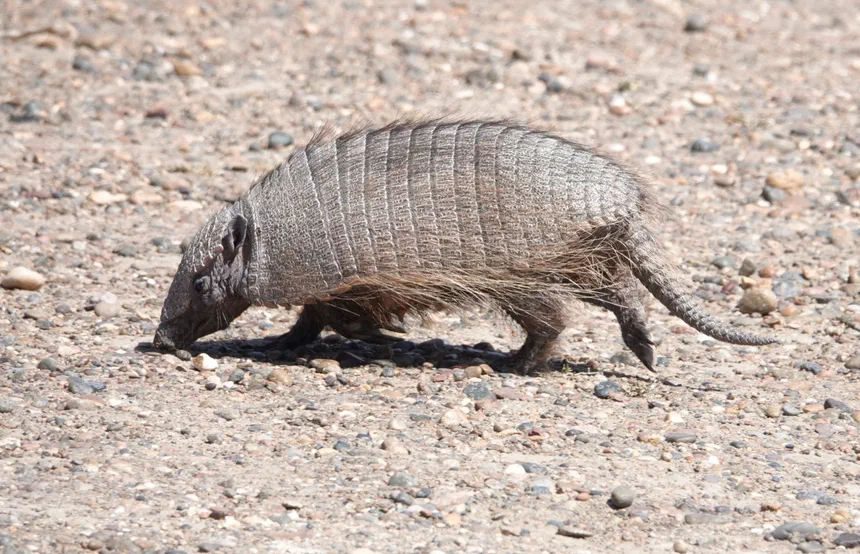
The big hairy armadillo (Chaetophractus villosus) is a small, burrowing mammal of southern South America, named for the coarse hairs that sprout between and beneath the plates of its bony shell. It is one of the most common and adaptable armadillos in its range, thriving across dry grasslands and scrub. Along with sloths and anteaters, armadillos belong to the ancient group of mammals known as xenarthrans.
Appearance and Identification
This armadillo is protected by a tough, segmented carapace of bony plates covered in horny skin, colored grayish-brown to pale yellow. A rigid shield covers the shoulders and another the hips, joined by a series of movable bands (usually around seven or eight) across the middle that give the body flexibility. Its common name comes from the abundant, wiry hairs that project from between the plates and cover the softer underside. The head is protected by a bony shield, the ears are short, and the snout is pointed. Strong, clawed forelimbs are built for digging. Adults typically measure roughly 22 to 40 centimeters in body length, with a tail of about 9 to 16 centimeters, and weigh in the region of 1 to 2 kilograms, occasionally more.
Habitat and Range
The big hairy armadillo occupies a broad swath of southern South America, including much of Argentina and reaching into Chile, Bolivia, and Paraguay. It favors open, dry environments such as grasslands, scrub, and semi-arid plains, and it also readily colonizes farmland and disturbed ground. A capable digger, it spends much of its time in burrows that provide shelter from temperature extremes and predators. Its tolerance for varied and modified landscapes has helped it remain widespread where other armadillos have declined.
Diet
The big hairy armadillo is an opportunistic omnivore with a wide-ranging appetite. Insects and other invertebrates make up much of its diet, and it also eats small vertebrates such as lizards and rodents, along with carrion, plant matter, seeds, and roots. It forages by rooting through soil and leaf litter with its snout and claws, relying heavily on a keen sense of smell to locate food underground. During cold or dry periods it can shift its diet toward whatever is most available, an adaptability that supports its success across diverse habitats.
Behavior
Largely solitary, the big hairy armadillo is a prolific digger that constructs burrows for resting, escaping heat, and evading danger. It tends to be nocturnal in hot weather but may become more active during the day in colder seasons, adjusting its schedule to avoid temperature extremes. When threatened, it can dig itself out of sight with remarkable speed, wedge itself into a burrow, or pull its limbs beneath its shell to protect its vulnerable underside. It is not known for tightly rolling into a ball the way some other armadillos can. Its physiology allows it to tolerate a wide range of temperatures, contributing to its hardiness.
Life Cycle and Reproduction
Breeding generally occurs in the warmer months, and after a gestation of roughly two months the female gives birth to a small litter, commonly two young. The offspring are born in the protection of a burrow with a soft shell that hardens as they grow. They develop relatively quickly, are nursed for a period of weeks, and become independent within a few months. Sexual maturity is reached within the first year or so of life. In the wild, big hairy armadillos are thought to live around 8 to 12 years, with well-cared-for captive individuals sometimes living longer.
Conservation Status
The big hairy armadillo is listed as Least Concern on the IUCN Red List, reflecting its wide distribution, large population, and ability to adapt to human-altered landscapes. It is hunted in parts of its range for meat and is sometimes regarded as an agricultural pest, and it faces localized pressures from habitat conversion and road traffic. Despite these threats, the species remains common and is not currently considered at risk of significant decline.
Frequently Asked Questions
Why is it called “hairy”? Unlike many armadillos with mostly bare shells, this species has abundant coarse hairs growing from between its bony plates and across its underside, giving it a distinctly bristly appearance.
Can it roll into a ball? No. Only certain armadillos, such as the three-banded armadillos, can seal themselves into a complete ball. The big hairy armadillo instead relies on rapid digging and tucking its soft parts beneath its shell.
Is the big hairy armadillo endangered? No. It is classified as Least Concern and remains one of the more common and adaptable armadillos across southern South America.