Mammals Guide
Groundhog
What Is a Groundhog? The groundhog (Marmota monax), also called the woodchuck, is a stout, burrowing rodent belonging to the squirrel family and the group of large ground squirrels known as marmots. It is one of the most …
At a glance
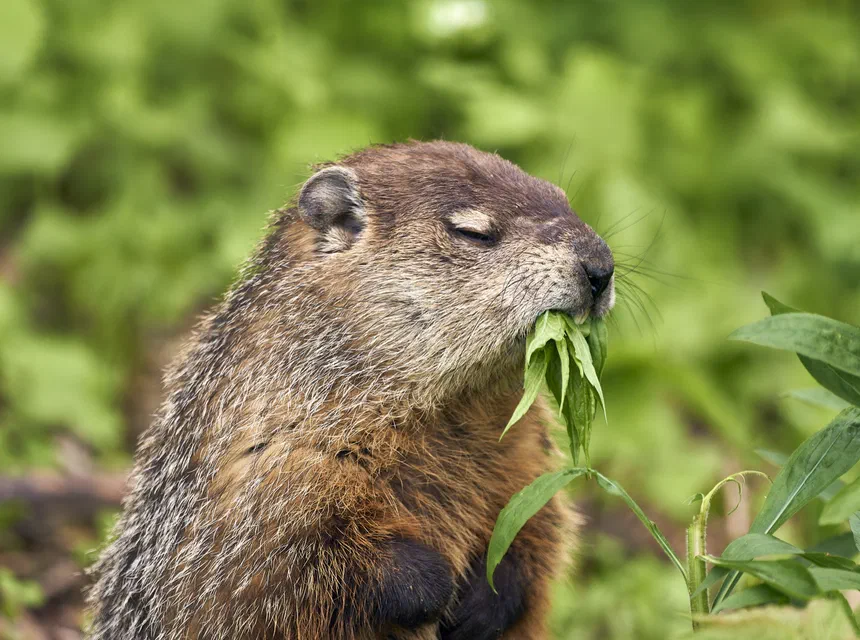
Image: Paul Danese — CC BY-SA 4.0 · source
What Is a Groundhog?
The groundhog (Marmota monax), also called the woodchuck, is a stout, burrowing rodent belonging to the squirrel family and the group of large ground squirrels known as marmots. It is one of the most familiar wild mammals across much of eastern and central North America, thriving in open fields and along the edges of forests. Groundhogs are best known in popular culture for Groundhog Day, but in nature they are accomplished diggers whose burrows shape the landscape around them.
Appearance and Identification
Groundhogs have a heavy, low-slung body covered in coarse fur that ranges from grizzled brown to grayish, often with a frosted or silvery appearance from lighter-tipped hairs. They have short, powerful legs equipped with strong, curved claws well suited to digging. The head is broad with small, rounded ears, a blunt muzzle, and prominent front incisors typical of rodents. Adults typically measure about 16 to 27 inches (40 to 68 cm) in total length, including a short, bushy tail, and weigh roughly 5 to 13 pounds (2 to 6 kg). Weight fluctuates dramatically over the year, peaking in late summer and autumn as the animal fattens for hibernation.
Habitat and Range
This species occupies a broad range across the eastern and central United States and much of Canada, extending north into Alaska. Groundhogs favor open and semi-open habitats such as meadows, pastures, agricultural fields, roadside embankments, and the transition zones between woodland and clearings. They are highly adaptable and often live near human activity, including suburban yards, parks, and farmland. Their burrow systems, dug into well-drained soil, can be extensive, with multiple entrances and separate chambers used for nesting, hibernation, and waste.
Diet
Groundhogs are primarily herbivorous, feeding on a wide variety of green vegetation. Grasses, clover, dandelions, alfalfa, and other leafy plants make up the bulk of their diet, and they readily raid gardens and crops for vegetables such as beans, peas, and lettuce. They occasionally eat fruits, bark, and, rarely, small insects. Groundhogs feed most actively in the morning and late afternoon, building up substantial fat reserves through the warmer months to survive their long winter dormancy.
Behavior
Groundhogs are generally solitary and territorial, most active during daylight hours. Their burrows serve as refuge from predators, shelter from weather, and sites for raising young. When alarmed, a groundhog may give a sharp, high-pitched whistle, which has earned it the nickname “whistle-pig.” They are strong diggers and capable, if reluctant, climbers and swimmers. As true hibernators, groundhogs enter a deep winter dormancy in which their body temperature, heart rate, and breathing drop dramatically, allowing them to pass the cold months without feeding.
Life Cycle and Reproduction
The breeding season begins in early spring, shortly after groundhogs emerge from hibernation. After a gestation of about a month, females give birth to a litter of typically two to six young, usually born blind and hairless in an underground nesting chamber. The mother nurses and cares for the pups, which grow quickly and are usually weaned and ready to disperse by mid to late summer. Young groundhogs establish their own burrows and territories before their first winter. In the wild, groundhogs commonly live around three to six years, though many die younger due to predation, road traffic, and harsh conditions.
Conservation Status
The groundhog is listed as Least Concern by the IUCN. It has a wide distribution, a large and stable population, and adapts well to human-altered landscapes. In many agricultural and suburban areas it is common and even considered a pest because of its burrowing and crop-feeding habits. No special conservation measures are needed for the species as a whole, though local control efforts sometimes target individual animals.
Frequently Asked Questions
Is a groundhog the same as a woodchuck? Yes. “Groundhog” and “woodchuck” are two common names for the same species, Marmota monax. It is also sometimes called a whistle-pig.
Do groundhogs really hibernate? Yes. Groundhogs are true hibernators. During winter they enter a deep dormancy in which body temperature and metabolism fall sharply, and they rely on fat reserves built up in autumn.
Are groundhogs dangerous to people? Groundhogs are not generally aggressive toward humans and prefer to flee into their burrows. They can become a nuisance, however, by digging burrows near structures and feeding on garden and farm crops.