Mammals Guide
Grizzly Bear
What Is a Grizzly Bear? The grizzly bear (Ursus arctos horribilis) is a North American subspecies of the brown bear, known for its powerful build, prominent shoulder hump, and long claws. It is one of the largest land …
At a glance
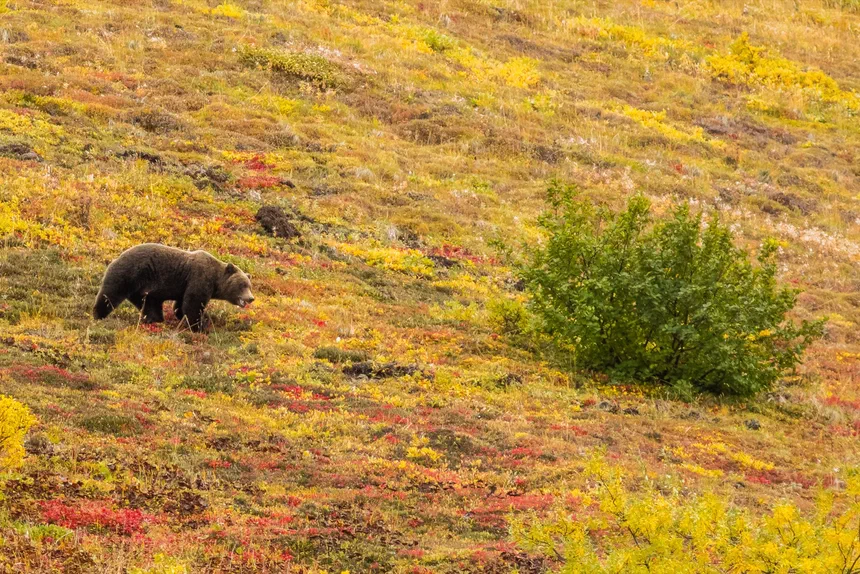
Image: Diego Delso — CC BY-SA 4.0 · source
What Is a Grizzly Bear?
The grizzly bear (Ursus arctos horribilis) is a North American subspecies of the brown bear, known for its powerful build, prominent shoulder hump, and long claws. It is one of the largest land predators on the continent and an icon of wilderness in the western United States and Canada.
Appearance and Identification
Grizzlies are heavy-bodied bears with a distinctive muscular hump over the shoulders, which powers their strong forelimbs for digging. Their fur ranges from pale blond to deep brown, often with silver or white-tipped guard hairs that give a frosted, “grizzled” appearance and the animal its name. They have a dished, concave facial profile, small rounded ears, and long, slightly curved front claws that can reach 2-4 inches (5-10 cm). Adult males are noticeably larger than females, and coastal populations with access to salmon tend to grow bigger than inland ones.
Habitat and Range
Grizzly bears occupy a wide variety of habitats, including dense forests, alpine meadows, river valleys, tundra, and mountainous terrain. Historically they roamed across much of western North America, from Alaska down into Mexico and east into the Great Plains. Today the largest populations survive in Alaska and western Canada, with smaller, protected populations in the lower 48 U.S. states, notably in and around Yellowstone and Glacier National Parks and the northern Rocky Mountains.
Diet
Despite their fearsome reputation, grizzlies are opportunistic omnivores, and plant matter often makes up the bulk of their diet. They feed heavily on berries, roots, tubers, grasses, and nuts, and they dig for ground squirrels, insects, and larvae. Where available, protein-rich foods such as spawning salmon, elk and deer calves, carrion, and moths are eagerly exploited. This flexible diet allows grizzlies to thrive across many different environments and seasons.
Behavior
Grizzly bears are largely solitary, except for mothers with cubs or temporary gatherings at rich food sources like salmon streams. They are most active in the cooler hours of morning and evening but can be seen at any time. Excellent diggers and strong swimmers, grizzlies have a keen sense of smell that they rely on more than sight or hearing to locate food. In autumn they enter a feeding frenzy called hyperphagia, consuming enormous amounts of food to build fat reserves before winter. During the coldest months they den and enter a deep sleep, lowering their metabolism to survive without eating or drinking.
Life Cycle and Reproduction
Grizzlies mate in late spring to early summer, but through delayed implantation the fertilized egg does not begin developing until the female dens in late fall. Cubs, usually one to three, are born tiny and helpless in the winter den, typically in January or February. They nurse and grow rapidly, emerging with their mother in spring. Young bears stay with their mother for about two to three years, learning to forage and survive before becoming independent. Females reproduce slowly, giving birth only every few years, which makes populations sensitive to losses.
Conservation Status
As a subspecies of the brown bear, the grizzly is part of a species classified as Least Concern globally by the IUCN, but its status varies sharply by region. In much of the contiguous United States it remains protected under the Endangered Species Act after historic hunting, trapping, and habitat loss reduced its range dramatically. Conservation efforts focus on protecting habitat, reducing human-bear conflicts, and maintaining connectivity between isolated populations so bears can move and breed safely.
Frequently Asked Questions
How fast can a grizzly bear run? Despite their bulk, grizzlies can sprint at speeds of around 30 mph (48 km/h) over short distances.
Are grizzly bears and brown bears the same animal? Grizzlies are a subspecies of brown bear. Inland North American brown bears are generally called grizzlies, while large coastal individuals are often referred to simply as brown bears.
Do grizzly bears truly hibernate? They enter a deep winter dormancy that is often called hibernation, during which heart rate and metabolism drop sharply, though their body temperature falls less than in smaller true hibernators.