Mammals Guide
Grey Seal
What Is a Grey Seal? The grey seal (Halichoerus grypus) is a large marine mammal of the true seal family, found along cool, rocky coastlines of the North Atlantic. Its scientific name translates roughly as “hook-nosed …
At a glance
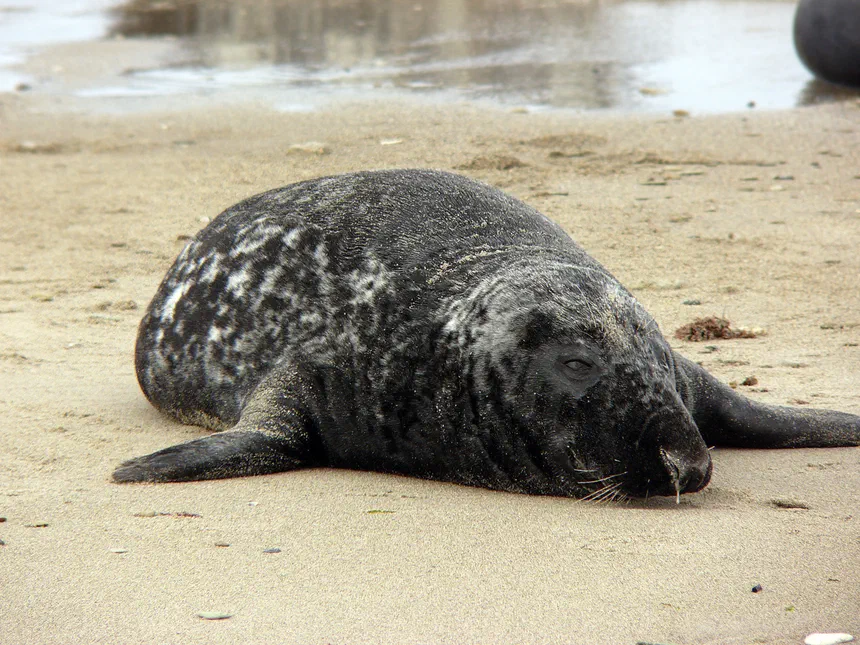
Image: Andreas Trepte — CC BY-SA 2.5 · source
What Is a Grey Seal?
The grey seal (Halichoerus grypus) is a large marine mammal of the true seal family, found along cool, rocky coastlines of the North Atlantic. Its scientific name translates roughly as “hook-nosed sea pig,” a nod to the long, arched muzzle that sets it apart from other seals. It is one of the most familiar seals in European and northeastern North American waters.
Appearance and Identification
Grey seals are robust, streamlined animals with short foreflippers and a broad, rounded body that tapers toward the hind flippers. The most reliable field mark is the head: adults have a long, straight or gently convex snout, often described as a “Roman nose,” with widely spaced nostrils that form a distinct “W” shape when viewed head-on. Coloration is variable, ranging from silvery gray to dark brown or almost black, overlaid with irregular darker blotches. Males are typically darker with a heavier, more heavily scarred neck, while females tend to be paler with a lighter background and darker spots. There is marked size difference between the sexes: adult males can reach roughly 2.3 to 2.6 meters and weigh up to about 300 kilograms, whereas females are usually smaller and lighter.
Habitat and Range
The species occupies temperate and subarctic waters of the North Atlantic. There are three main populations: the western Atlantic group along the coasts of eastern Canada and the northeastern United States; the eastern Atlantic group around the British Isles, Ireland, Iceland, and the coasts of northwestern Europe; and a separate population in the Baltic Sea. Grey seals spend much of their time at sea but haul out on rocky ledges, remote islands, sandbanks, and quiet beaches to rest, molt, and breed. They generally favor exposed, undisturbed coastlines with easy access to deep, food-rich waters.
Diet
Grey seals are opportunistic carnivores that feed mainly on fish. Their diet includes sand eels, cod, herring, flatfish, and many other species, and they will also take squid, octopus, and crustaceans when available. Prey choice shifts with season and local abundance. A foraging seal typically dives to the seabed, and although most dives are relatively shallow, the species is capable of reaching depths of several hundred meters and staying submerged for many minutes. Adults eat several kilograms of food per day, though they may fast for extended periods during the breeding and molting seasons.
Behavior
Outside the breeding season, grey seals are fairly solitary at sea but gather in loose groups at favored haul-out sites. They are strong, agile swimmers, using their hind flippers for propulsion and their sensitive whiskers to detect the water movements of prey, even in murky conditions. On land they move with an awkward caterpillar-like motion, since their hind flippers cannot rotate forward to support the body. Vocalizations include moans, hoots, and hisses, which become especially frequent during the breeding season when animals crowd together and competition intensifies.
Life Cycle and Reproduction
Breeding is highly seasonal and timing varies by region, generally falling in autumn and early winter in the eastern Atlantic and slightly later in some western populations. Females come ashore at traditional colonies to give birth to a single pup after a gestation that, including delayed implantation, spans close to a year. Newborn pups wear a fluffy white coat called lanugo and nurse on extremely rich milk for roughly two to three weeks, gaining weight rapidly before being weaned abruptly. Dominant males defend stretches of beach and mate with females near the end of nursing. Pups molt their white coat, then head to sea to learn to forage on their own. Individuals may live around 25 to 35 years, with females generally outliving males.
Conservation Status
The grey seal is listed as Least Concern by the IUCN, and many populations have grown substantially since the reduction of historical hunting. The species remains protected under national laws across much of its range. Ongoing concerns include entanglement in fishing gear, conflict with fisheries, marine pollution, and disturbance at breeding sites. Overall, the grey seal is considered one of the conservation success stories among North Atlantic marine mammals.
Frequently Asked Questions
How can you tell a grey seal from a harbor seal? Look at the head. Grey seals have a long, straight muzzle and nostrils that form a “W,” while harbor seals have a shorter, more concave “dog-like” face with V-shaped nostrils.
Are grey seals dangerous to people? They are wild animals and can bite if cornered or provoked, so observers should keep their distance, but they generally avoid humans and are not aggressive under normal circumstances.
Why are grey seal pups born white? The white lanugo coat helps insulate pups during their first weeks on land; it is shed after weaning as the young seal grows a sleeker, waterproof adult coat.