Mammals Guide
Gray Wolf
What Is a Gray Wolf? The gray wolf (Canis lupus) is the largest wild member of the dog family, Canidae, and the ancestor of the domestic dog. Highly social and intelligent, it lives and hunts in family groups called …
At a glance
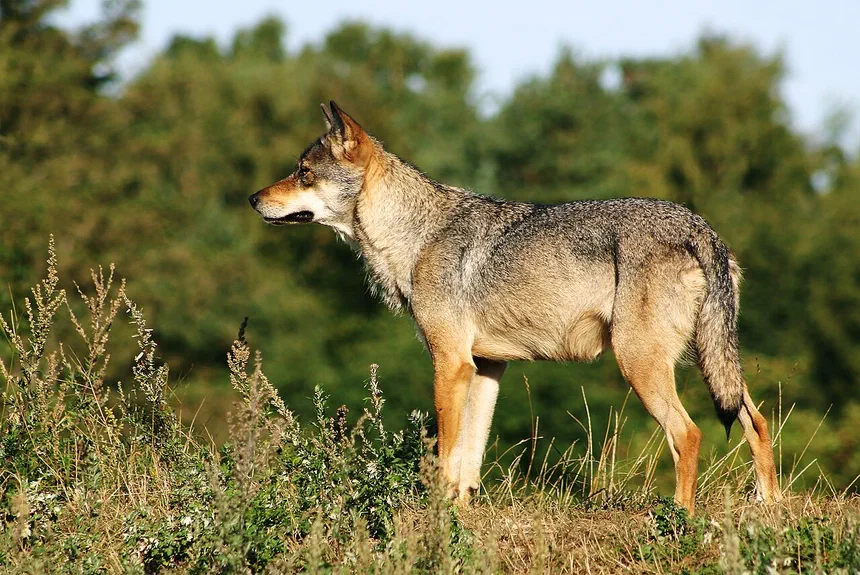
Image: Malene Thyssen — CC BY-SA 3.0 · source
What Is a Gray Wolf?
The gray wolf (Canis lupus) is the largest wild member of the dog family, Canidae, and the ancestor of the domestic dog. Highly social and intelligent, it lives and hunts in family groups called packs. Once found across most of the Northern Hemisphere, it remains one of the most widely studied of all large carnivores.
Appearance and Identification
Despite its name, the gray wolf’s coat ranges widely in color, from grizzled gray to black, brown, cream, and near-white, often blending several shades. Adults typically measure 3.3 to 5.2 feet (1 to 1.6 meters) in body length, plus a bushy tail, and stand roughly 26 to 32 inches (66 to 81 centimeters) at the shoulder. Weights generally fall between 50 and 110 pounds (23 to 50 kilograms), with males averaging larger than females and northern populations tending to be heavier. Compared with coyotes, wolves are noticeably larger, with longer legs, broader snouts, and rounder ears. Their powerful jaws, deep chest, and long limbs suit a life of endurance travel and taking down large prey.
Habitat and Range
Gray wolves are remarkably adaptable and occupy an unusually broad set of environments, including boreal and temperate forests, arctic tundra, grasslands, mountains, and semi-arid scrub. Historically they ranged across nearly all of North America, Europe, and Asia. Persecution, habitat loss, and declining prey shrank that range dramatically by the twentieth century, but legal protection and reintroduction efforts have allowed populations to recover in parts of the western United States, Canada, and Europe. Wolves require large territories with sufficient prey, and a single pack may roam an area spanning dozens to hundreds of square miles.
Diet
The gray wolf is a carnivore that specializes in hunting large hoofed mammals such as deer, elk, moose, caribou, and bison. When large prey is scarce, wolves readily take smaller animals including beavers, hares, and rodents, and they will also scavenge carrion. Hunting cooperatively as a pack lets them pursue prey much larger than any individual could subdue alone. A wolf can consume many pounds of meat in a single feeding, an adaptation to a feast-or-famine lifestyle in which meals may be days apart.
Behavior
Wolves are intensely social animals organized around the pack, typically a breeding pair and their offspring from one or more years. Packs cooperate to hunt, raise pups, and defend territory, which they mark with scent and advertise through howling. Howls help pack members locate one another, coordinate movement, and warn off rival packs. Communication also relies on a rich repertoire of body postures, facial expressions, and scent signals. Wolves may travel great distances each day and are capable of loping steadily for hours while patrolling their range.
Life Cycle and Reproduction
Usually only the dominant pair in a pack breeds. After a gestation of roughly two months, the female gives birth in a den to a litter of about four to six pups, typically in spring. Pups are born blind and helpless and depend entirely on the adults, with the whole pack often helping to feed and guard them. Young wolves are weaned within about two months and begin joining hunts as they mature. Many disperse from their birth pack at one to three years of age to seek mates and establish territories of their own. In the wild most wolves live six to eight years, though some reach their teens.
Conservation Status
The gray wolf is listed as Least Concern on the IUCN Red List, reflecting its wide global distribution and large total population. That broad picture, however, hides sharp regional differences: some local populations remain small, isolated, or legally protected, while others are stable or expanding. Conflict with livestock ranching, habitat fragmentation, and shifting legal protections continue to shape the species’ future, making wolves a frequent focus of conservation debate and management.
Frequently Asked Questions
Are gray wolves dangerous to people? Wild wolves generally avoid humans, and verified attacks are very rare. Most conflict involves livestock or occurs when wolves lose their natural wariness.
What is the difference between a wolf and a coyote? Wolves are substantially larger, with longer legs, broader muzzles, and shorter, rounder ears, and they hunt large prey in packs, whereas coyotes are smaller and more solitary.
Do wolves really howl at the moon? No. Wolves howl to communicate with pack members and rivals, not at the moon; howling simply tends to be more noticeable on quiet nights.