Mammals Guide
Gray Fox
What Is a Gray Fox? The gray fox (Urocyon cinereoargenteus) is a small, adaptable canid native to the Americas, easily recognized by its salt-and-pepper coat and reddish highlights. Unlike most members of the dog family, …
At a glance
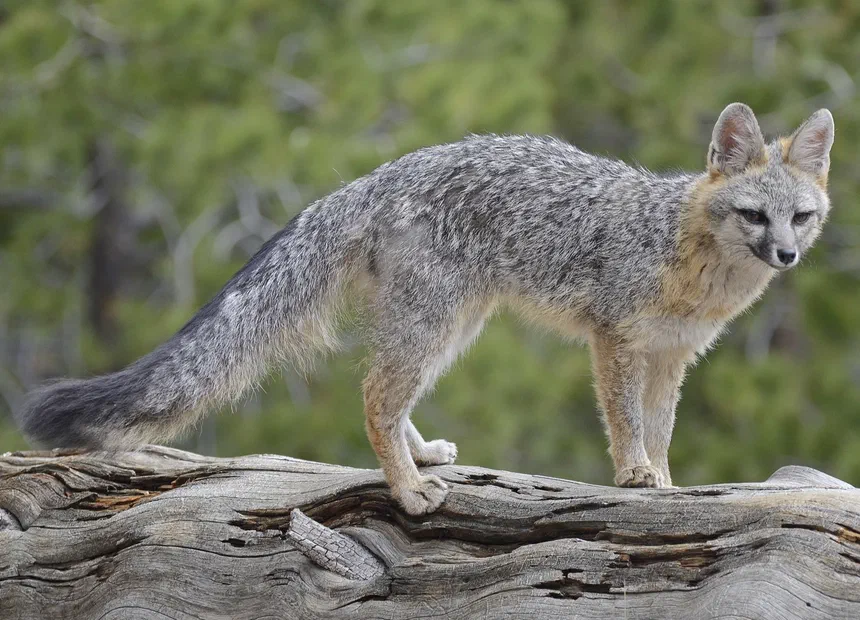
Image: VJAnderson — CC BY-SA 4.0 · source
What Is a Gray Fox?
The gray fox (Urocyon cinereoargenteus) is a small, adaptable canid native to the Americas, easily recognized by its salt-and-pepper coat and reddish highlights. Unlike most members of the dog family, it is a remarkable climber, able to scramble up trees to escape danger or reach food. It belongs to one of the most ancient lineages of living canids.
Appearance and Identification
The gray fox has a grizzled, silvery-gray back created by individual hairs banded with black, white, and gray. Its cheeks, flanks, chest, and the backs of its ears are washed with rusty or cinnamon tones, which sometimes leads people to confuse it with the red fox. The most reliable field mark is the tail: it is bushy with a distinct black stripe running along the top and a black tip, whereas the red fox’s tail ends in white. Adults typically weigh between 7 and 13 pounds and measure roughly 20 to 30 inches in body length, with a tail adding another foot or more. Its legs are relatively short, and its hooked, semi-retractable claws help it grip bark.
Habitat and Range
Gray foxes occupy a broad range stretching from southern Canada across much of the United States and Mexico, down through Central America to the northern edge of South America. They favor mixed woodlands, brushy thickets, chaparral, and rocky canyons, generally preferring more densely vegetated cover than the red fox. They tolerate a range of elevations and climates and have adapted well to suburban edges, orchards, and farmland where thickets and woodlots provide shelter.
Diet
As an opportunistic omnivore, the gray fox adjusts its menu to the season and location. Small mammals such as mice, voles, rabbits, and squirrels form a large part of its diet, supplemented by birds, insects, and other invertebrates. It also eats a substantial amount of plant matter, including fruits, berries, nuts, and grains. In some regions, seasonal fruits like persimmons and grapes can make up a major share of its intake, and its tree-climbing ability lets it reach food sources many other canids cannot.
Behavior
The gray fox is largely nocturnal and crepuscular, hunting most actively from dusk into the night. Its standout trait is arboreal skill: it climbs trees readily by gripping the trunk with its forelimbs and pushing with its hind feet, then descends backward or jumps between limbs. This behavior helps it evade predators such as coyotes and bobcats and lets it rest or forage above ground. Gray foxes are generally solitary or live in pairs, communicating through scent marking and a range of barks, yelps, and growls. They den in hollow logs, rock crevices, brush piles, and burrows.
Life Cycle and Reproduction
Gray foxes are largely monogamous, with pairs forming in winter. After a gestation of roughly 50 to 60 days, the female gives birth in spring to a litter usually numbering three to five pups, though larger litters occur. The pups are born blind and helpless and are nursed for several weeks before beginning to take solid food brought by both parents. By late summer, the young forage on their own, and they typically disperse in the fall to establish their own territories. Sexual maturity is reached at about ten months, in time for the next breeding season.
Conservation Status
The gray fox is listed as Least Concern by the IUCN, reflecting its wide distribution and stable overall population. It is not considered globally threatened, though local numbers can be affected by habitat loss, vehicle collisions, disease such as canine distemper and rabies, and competition with expanding coyote populations. In parts of its range it is legally trapped or hunted for fur. Its adaptability to varied habitats has helped it persist across a vast geographic area.
Frequently Asked Questions
Can gray foxes really climb trees? Yes. The gray fox is one of only a few canids capable of climbing, using strong, curved claws to grip bark and ascend trees to escape threats or find food.
How can I tell a gray fox from a red fox? Look at the tail: a gray fox has a black stripe and black tip, while a red fox has a white-tipped tail. Gray foxes also show a grizzled gray back rather than a uniform reddish coat.
Are gray foxes dangerous to people? No. Gray foxes are shy and avoid humans. They pose little threat, though like any wild mammal they should not be approached or fed, and can carry diseases such as rabies.