Mammals Guide
Golden Snub-Nosed Monkey
What Is a Golden Snub-Nosed Monkey? The golden snub-nosed monkey (Rhinopithecus roxellana) is a striking, cold-adapted primate native to the mountain forests of central China. It belongs to the Old World monkey family …
At a glance
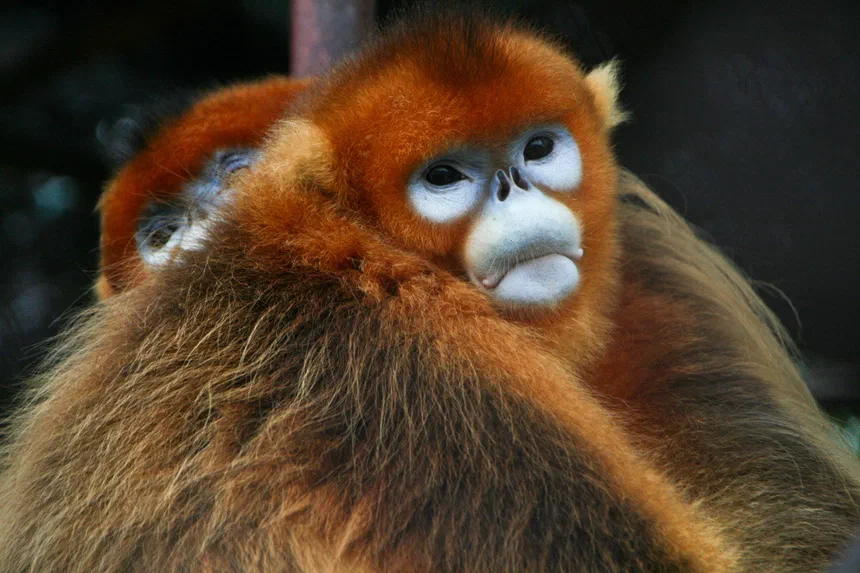
Image: Jack Hynes — CC BY-SA 2.0 · source
What Is a Golden Snub-Nosed Monkey?
The golden snub-nosed monkey (Rhinopithecus roxellana) is a striking, cold-adapted primate native to the mountain forests of central China. It belongs to the Old World monkey family and is one of several closely related snub-nosed monkeys, named for the short, upturned nose that gives the face its distinctive profile.
Appearance and Identification
This is one of the more visually memorable primates. Adults are cloaked in long, golden-orange fur across the shoulders, chest, and underparts, contrasting with a darker brown or black back and crown. The face is nearly hairless and tinted a pale blue, framed by a ruff of paler fur. The nose is flattened and upturned, with forward-facing nostrils. Males are noticeably larger than females and develop longer shoulder hair and larger lips. The tail is long, roughly equal to the body length, and helps with balance in the treetops. Thick fur insulates these monkeys against the freezing temperatures of their high-elevation home.
Habitat and Range
Golden snub-nosed monkeys live in temperate and subalpine forests in the mountains of central and southwestern China, including parts of Sichuan, Shaanxi, Gansu, and Hubei provinces. They occupy a range of elevations, often between about 1,500 and 3,400 meters, moving up and down the slopes seasonally. Their forests include mixed conifer and broadleaf stands, and the monkeys tolerate some of the coldest conditions faced by any non-human primate, enduring snow and subzero winters.
Diet
These monkeys are primarily herbivorous and are unusual among primates for relying heavily on lichens, especially during harsh winter months when other foods are scarce. Across the year their diet also includes young leaves, buds, bark, seeds, flowers, and fruit when available. This flexible, seasonally shifting diet lets them survive in a habitat where food quality changes dramatically between summer and winter. A specialized, chambered stomach helps them break down fibrous plant material.
Behavior
Golden snub-nosed monkeys are highly social and live in some of the largest groups known among primates. Their societies are built from small one-male, multi-female family units that gather into bands, which in turn can aggregate into troops sometimes numbering into the hundreds. They are active by day and spend much of their time in the trees, though they also travel and forage on the ground. Communication involves a varied repertoire of calls, and group members maintain bonds through grooming. In winter, huddling together helps conserve body heat.
Life Cycle and Reproduction
Breeding is seasonal, with most mating occurring in autumn and births concentrated in spring, timed so that infants arrive when conditions and food are improving. Females typically give birth to a single infant after a gestation of about six to seven months. Newborns are pale and cling to their mothers, gradually gaining independence over the following year or more. Females often help care for one another’s young, and full maturity comes at several years of age, later for males than females.
Conservation Status
The golden snub-nosed monkey is listed as Endangered by the IUCN. Its main threats are habitat loss and fragmentation from logging and agriculture, along with historical hunting. Because the species depends on specialized high-elevation forest, shrinking and disconnected habitat is a serious concern. Protected reserves in China, along with anti-poaching enforcement and habitat restoration, have helped stabilize some populations, but continued conservation attention is needed to secure the species’ future.
Frequently Asked Questions
Why is it called a snub-nosed monkey? The name refers to its short, flattened, upturned nose with forward-facing nostrils, a feature shared by its close relatives in the genus Rhinopithecus.
How do these monkeys survive freezing winters? They have thick, insulating fur, huddle together for warmth, and switch to eating lichens and bark when other foods disappear, allowing them to endure snow and subzero cold.
Are golden snub-nosed monkeys endangered? Yes. The IUCN lists them as Endangered, mainly because of habitat loss and fragmentation across their limited mountain range in China.