Mammals Guide
Golden Jackal
What Is a Golden Jackal? The golden jackal (Canis aureus) is a medium-sized wild canid found across southeastern Europe, the Middle East, and much of southern Asia. Closely related to wolves and coyotes, it is a highly …
At a glance
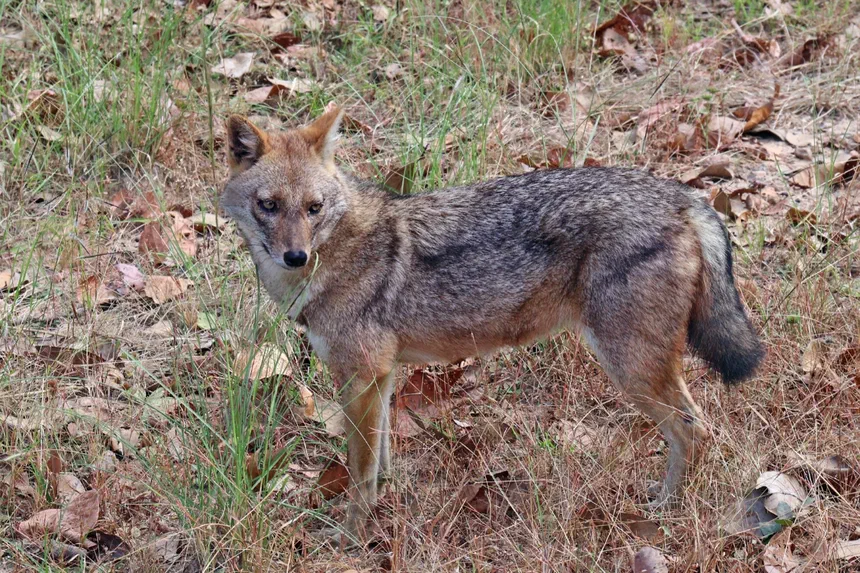
Image: Charles J. Sharp — CC BY-SA 4.0 · source
What Is a Golden Jackal?
The golden jackal (Canis aureus) is a medium-sized wild canid found across southeastern Europe, the Middle East, and much of southern Asia. Closely related to wolves and coyotes, it is a highly adaptable omnivore that thrives near people as readily as in the wild. Despite its name and jackal-like habits, genetic studies place it firmly within the wolf lineage.
Appearance and Identification
The golden jackal has a slender, dog-like build with long legs, a pointed muzzle, and upright, triangular ears. Its coat is typically a sandy gold to grayish-tan, often speckled with black and brown along the back, and fades to a paler cream on the underside and legs. The bushy tail is relatively short and usually tipped in black. Adults measure roughly 27 to 33 inches (70 to 85 cm) in head-and-body length, with a tail adding about another 10 inches (25 cm), and stand around 16 to 20 inches (40 to 50 cm) at the shoulder. Most weigh between 15 and 33 pounds (7 to 15 kg), with males slightly larger than females. Coat color varies with region and season, appearing brighter and more golden in some populations.
Habitat and Range
Golden jackals occupy an unusually broad range for a wild canid, extending from the Balkans and parts of central and eastern Europe through Turkey, the Middle East, the Caucasus, and across South and Central Asia into India, Sri Lanka, and Southeast Asia. They favor open and semi-open country, including grasslands, scrub, dry forests, semi-desert, river valleys, and agricultural land. The species tolerates human presence well and is frequently found on the edges of villages and towns, where food and shelter are plentiful. In recent decades their range has been expanding northward and westward into new parts of Europe.
Diet
As opportunistic omnivores, golden jackals eat almost anything they can find. Their diet includes rodents, hares, ground-nesting birds, reptiles, insects, and other small prey, along with carrion scavenged from larger predators’ kills. They also consume fruit, berries, and plant matter, and near settlements they readily raid crops, garbage, and livestock scraps. This flexible feeding strategy is a key reason the species does so well across such varied landscapes.
Behavior
Golden jackals are most active at dawn, dusk, and during the night, especially in areas where they share space with humans. The basic social unit is a mated pair, which defends a shared territory, though family groups sometimes include grown offspring that help raise the next litter. They are vocal animals, producing a distinctive howling chorus of yips and wails that helps pairs and family members stay in contact and advertise territory. Grown young known as “helpers” often stay with their parents to assist with pup-rearing before dispersing.
Life Cycle and Reproduction
Golden jackals form long-term monogamous pairs. Breeding usually occurs once a year, and after a gestation of roughly two months the female gives birth to a litter of about two to four pups, sometimes more, typically in a den dug into the ground or hidden in dense cover. Both parents, and often older siblings, help feed and guard the young. Pups are weaned over a couple of months and begin accompanying adults to forage as they mature. They reach breeding age at around one year and typically live about 8 to 12 years in the wild.
Conservation Status
The golden jackal is listed as Least Concern by the IUCN. It is widespread, adaptable, and in many regions increasing in numbers and expanding its range, in part because it benefits from human-altered landscapes and food sources. Localized threats include persecution, vehicle collisions, and disease such as rabies and canine distemper, but none currently endanger the species as a whole.
Frequently Asked Questions
Is the golden jackal the same as a coyote? No, but they are close relatives and look somewhat alike. Coyotes live in the Americas, while golden jackals occur across Eurasia; both belong to the same broader wolf lineage.
Are golden jackals dangerous to people? They generally avoid humans and rarely pose a threat, though like other wild canids they can carry rabies and may take small livestock or poultry near settlements.
Do golden jackals live in large packs? Not usually. They typically live as mated pairs or small family groups rather than the large packs associated with wolves.