Mammals Guide
Giraffe
What Is a Giraffe? The giraffe (Giraffa camelopardalis) is the tallest living land animal, an African hoofed mammal instantly recognized by its towering neck, long legs, and patterned coat. It belongs to the family …
At a glance
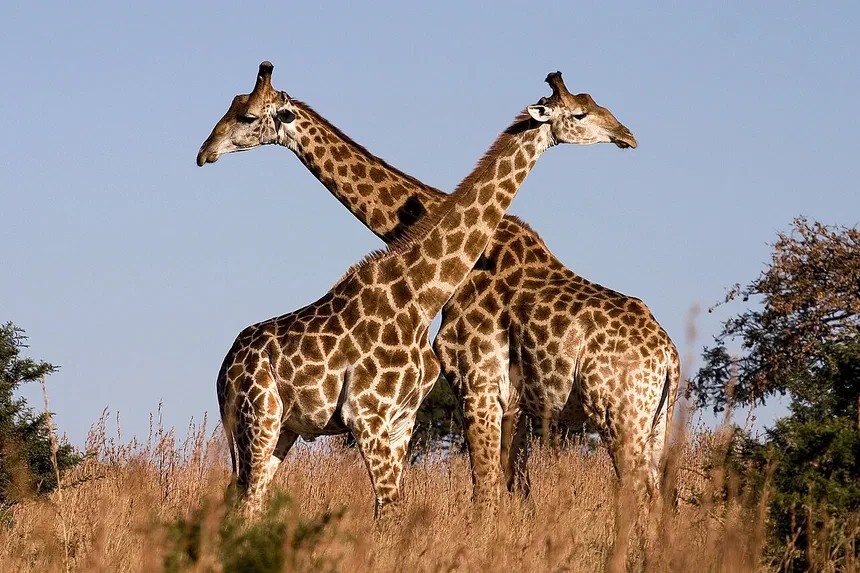
Image: Luca Galuzzi (Lucag) — CC BY-SA 2.5 · source
What Is a Giraffe?
The giraffe (Giraffa camelopardalis) is the tallest living land animal, an African hoofed mammal instantly recognized by its towering neck, long legs, and patterned coat. It belongs to the family Giraffidae, whose only other living member is the okapi. Several distinct populations across Africa are treated as subspecies, and some researchers argue a few may warrant status as separate species.
Appearance and Identification
A giraffe’s most striking feature is its neck, which can measure around 6 feet (1.8 m) and yet, like nearly all mammals, contains only seven vertebrae. Adult males stand roughly 16 to 18 feet (5 to 5.5 m) tall, while females are somewhat shorter. The coat is a background of cream to tan overlaid with brown blotches whose shape and spacing vary between subspecies, providing a kind of camouflage in dappled light. Both sexes carry a pair of skin-covered horns called ossicones; those of males are usually thicker and often bald on top from sparring. A long, dark, prehensile tongue helps strip leaves from thorny branches.
Habitat and Range
Giraffes live across a patchwork of sub-Saharan Africa, from the Sahel south to parts of southern Africa. They favor open savanna, dry woodland, and grassland where scattered trees provide browse. Populations are now fragmented, occurring mostly within national parks, reserves, and other protected areas rather than in one continuous range. Different subspecies are associated with different regions, from West Africa to the Horn of Africa and southward.
Diet
Giraffes are browsers, feeding primarily on the leaves, shoots, flowers, and fruit of trees and shrubs. Acacia species are a favored food, and the giraffe’s height lets it reach foliage well above the level most other herbivores can access. An adult may consume tens of pounds of vegetation a day, spending many hours feeding. Because their food holds considerable moisture, giraffes can go long periods without drinking; when they do drink, they must awkwardly splay their front legs to reach the water.
Behavior
Giraffes are social but loosely organized, forming fluid groups whose membership changes from day to day. They are generally quiet, communicating through posture, movement, and low-frequency sounds largely inaudible to humans. Males establish dominance through “necking,” swinging their heads and necks to strike rivals; the outcome influences mating access. Adult giraffes have few natural predators thanks to their size and a powerful kick, though lions may take individuals, and calves are far more vulnerable. Giraffes sleep only briefly and often remain standing.
Life Cycle and Reproduction
Females typically give birth to a single calf after a gestation of roughly 15 months. Birth occurs while the mother is standing, so the newborn drops a short distance to the ground; calves can stand and nurse within hours. A newborn is already around 6 feet (1.8 m) tall. Young giraffes are frequently left in loose “nursery” groups while mothers feed nearby. Mortality is high in the first months of life due to predation, but survivors may live around 20 to 25 years in the wild.
Conservation Status
The IUCN currently assesses the giraffe as Vulnerable, reflecting substantial population declines across much of its range over recent decades. Habitat loss and fragmentation, human population growth, poaching, and civil unrest are among the main pressures. Some subspecies are far more threatened than others, and several number only a few thousand individuals. Conservation efforts include protected-area management, translocations to re-establish populations, and ongoing research into how many species and subspecies the giraffe should be divided into.
Frequently Asked Questions
How tall can a giraffe get? Large males can reach about 16 to 18 feet (5 to 5.5 m), making the giraffe the tallest land animal alive today.
Why do giraffes have such long necks? The long neck helps them browse foliage out of reach of most other herbivores and plays a role in male combat and dominance displays.
Are giraffes endangered? The species as a whole is listed as Vulnerable by the IUCN, and some individual subspecies are considered much more threatened.