Mammals Guide
Lar Gibbon
What Is a Lar Gibbon? The lar gibbon (Hylobates lar), also called the white-handed gibbon, is a small ape native to the rainforests of Southeast Asia. Unlike the great apes, gibbons belong to the “lesser apes” and are …
At a glance
What Is a Lar Gibbon?
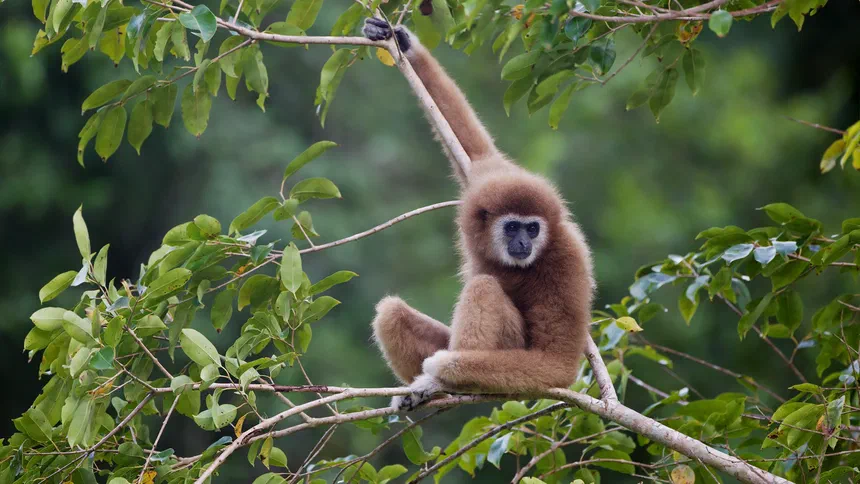
The lar gibbon (Hylobates lar), also called the white-handed gibbon, is a small ape native to the rainforests of Southeast Asia. Unlike the great apes, gibbons belong to the “lesser apes” and are famous for their acrobatic swinging through the treetops and their loud, musical calls that carry across the forest.
Appearance and Identification
Lar gibbons have long, dense fur that ranges from pale cream and buff to dark brown or black, with both color forms occurring within the same population regardless of sex. A distinctive white ring frames the dark face, and the hands and feet are almost always white, giving the species its common name. Their most striking feature is their extraordinarily long arms, which can span well beyond their body length and are perfectly adapted for swinging. Gibbons lack a tail, and they have a small, slender build compared to the great apes.
Habitat and Range
This species inhabits tropical and subtropical evergreen and semi-evergreen rainforests. Its range extends across parts of Thailand, peninsular Malaysia, the island of Sumatra in Indonesia, southern and eastern Myanmar, and northwestern Laos. Lar gibbons are highly arboreal and spend almost their entire lives in the forest canopy, rarely descending to the ground. They favor tall, mature forest where the interconnected treetops allow them to travel long distances without touching the earth.
Diet
Lar gibbons are primarily frugivores, and ripe fruit makes up the majority of their diet. Figs are an especially important food source. They supplement this with young leaves, flowers, buds, and shoots, and they will readily eat insects, spiders, and occasionally bird eggs for protein. By feeding on fruit and moving widely through the canopy, gibbons act as important seed dispersers, helping to regenerate the forests they depend on.
Behavior
Gibbons are best known for brachiation, a form of locomotion in which they swing hand over hand beneath branches. They can move with remarkable speed and cover several meters in a single swing, and they sometimes appear to fly between trees. Lar gibbons are diurnal and territorial, and mated pairs defend their home range with elaborate vocal displays. Their morning “great calls,” often performed as duets between a male and female, are among the most recognizable sounds of the Asian rainforest and serve to advertise territory and reinforce pair bonds.
Life Cycle and Reproduction
Lar gibbons typically live in small family groups made up of a mated pair and their offspring. They are largely monogamous, with pairs often remaining together for many years. Females usually give birth to a single infant after a gestation of roughly seven months, and births are spaced two to three years apart. The young cling to their mother in early life and are weaned at around one to two years, but they may remain with the family group for several more years before dispersing to establish territories of their own. Sexual maturity is reached at around six to eight years of age.
Conservation Status
The lar gibbon is classified as Endangered by the IUCN. Its populations have declined sharply due to widespread deforestation, logging, and the conversion of rainforest to agriculture, all of which fragment the continuous canopy these apes require. They are also threatened by hunting and the illegal pet trade, in which infants are captured after their mothers are killed. Protecting large, connected tracts of mature forest is considered essential to the species’ long-term survival.
Frequently Asked Questions
Are lar gibbons monkeys? No. Gibbons are apes, not monkeys. They lack tails and belong to the family Hylobatidae, sometimes called the “lesser apes.”
Why do lar gibbons sing? Their loud duets and calls advertise and defend territory, strengthen the bond between mated pairs, and signal their presence to neighboring groups.
How do gibbons move so fast through the trees? They use brachiation, swinging hand over hand beneath branches with their very long arms, which lets them travel quickly and efficiently through the canopy.