Mammals Guide
Giant Panda
What Is a Giant Panda? The giant panda (Ailuropoda melanoleuca) is a large, bamboo-eating bear native to the mountain forests of central China. Instantly recognizable for its bold black-and-white coat, it is a member of …
At a glance
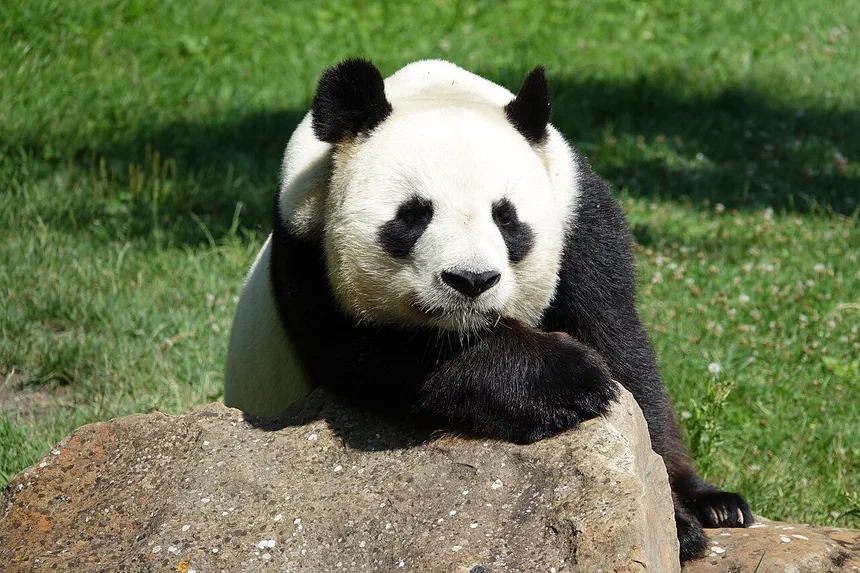
Image: Gzen92 — CC BY-SA 4.0 · source
What Is a Giant Panda?
The giant panda (Ailuropoda melanoleuca) is a large, bamboo-eating bear native to the mountain forests of central China. Instantly recognizable for its bold black-and-white coat, it is a member of the bear family (Ursidae) despite its highly specialized plant-based diet. The species has become one of the world’s most beloved animals and a global symbol of wildlife conservation.
Appearance and Identification
The giant panda has a rounded, heavyset body covered in thick, woolly fur that insulates it against cold, damp mountain climates. Its coat is mostly white, with striking black markings on the ears, around the eyes, across the shoulders, and on the legs. Adults typically measure about 1.2 to 1.9 meters (4 to 6 feet) in body length and weigh roughly 70 to 125 kilograms (150 to 275 pounds), with males generally larger than females. A distinctive feature is the “pseudo-thumb,” an enlarged wrist bone that works like an opposable digit, allowing the panda to grip bamboo stems with surprising dexterity. Its large head houses powerful jaw muscles and broad, flat molars adapted for crushing fibrous plant material.
Habitat and Range
Giant pandas live in a handful of mountain ranges in central China, chiefly in Sichuan Province and parts of Shaanxi and Gansu. They inhabit cool, moist temperate forests at elevations of roughly 1,200 to 3,500 meters, where dense stands of bamboo grow beneath a canopy of broadleaf and coniferous trees. These forests provide both food and cover. Historically, pandas ranged across much wider areas of southern and eastern China, but habitat loss and fragmentation have confined them to isolated pockets of highland forest.
Diet
Although classified as a carnivore by ancestry and digestive anatomy, the giant panda is overwhelmingly herbivorous. Bamboo makes up the vast majority of its diet, often well over 95 percent, and a single adult may consume roughly 10 to 20 kilograms of bamboo per day. Because bamboo is low in nutrients and pandas digest it inefficiently, they must eat large quantities and spend many hours a day feeding. They favor different bamboo species and plant parts depending on the season, switching between shoots, stems, and leaves. On rare occasions, pandas will eat other plants, small rodents, or carrion.
Behavior
Giant pandas are largely solitary animals that occupy overlapping home ranges and communicate through scent marking and vocalizations. They are most active during cooler parts of the day and dedicate a large share of their waking hours to feeding and resting. Unlike many bears, pandas do not hibernate; instead, they may move to lower elevations in winter to find milder conditions and available bamboo. They are capable climbers and can swim, and they use trees for shelter and to escape threats. Their vocal repertoire includes bleats, honks, and chirps used during social and breeding interactions.
Life Cycle and Reproduction
Female giant pandas are fertile for only a short window of a few days each year, typically in spring, which makes reproduction a delicate process. After mating, a female usually gives birth to one or two cubs, though when twins are born in the wild the mother often raises only one. Newborn cubs are tiny, pink, blind, and almost helpless, weighing just a fraction of a pound, making them among the smallest mammal newborns relative to adult size. Cubs develop their characteristic markings within a few weeks and remain dependent on their mother for well over a year. Sexual maturity is reached at roughly four to six years of age.
Conservation Status
The giant panda is currently listed as Vulnerable on the IUCN Red List, an improvement from its former Endangered status thanks to decades of intensive conservation. Threats include habitat loss, fragmentation of forests, and the natural cycle of bamboo die-offs that can locally reduce food supplies. China has established a large network of nature reserves and habitat corridors, alongside successful captive-breeding and reintroduction programs. These efforts have helped wild populations gradually recover, though the species remains dependent on ongoing protection of its mountain forests.
Frequently Asked Questions
Are giant pandas bears? Yes. Genetic and anatomical evidence firmly places the giant panda within the bear family, Ursidae, even though its diet and behavior differ greatly from most other bears.
Why do giant pandas eat so much bamboo? Bamboo is abundant in their habitat but low in nutrients, and pandas digest it poorly. To meet their energy needs they must eat large amounts, often spending 10 to 16 hours a day feeding.
How many giant pandas are left in the wild? Wild populations are estimated in the low thousands of adults, concentrated in the mountains of central China, and are slowly increasing thanks to sustained conservation work.