Mammals Guide
Giant Otter
What Is a Giant Otter? The giant otter (Pteronura brasiliensis) is the largest member of the weasel family, Mustelidae, and the longest of all otter species. Native to the rivers and wetlands of tropical South America, …
At a glance
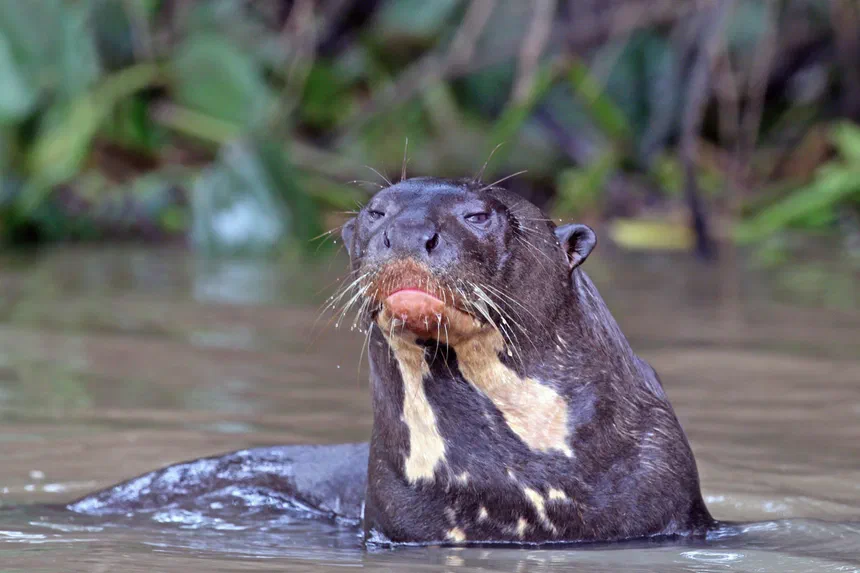
Image: Charles J. Sharp — CC BY-SA 4.0 · source
What Is a Giant Otter?
The giant otter (Pteronura brasiliensis) is the largest member of the weasel family, Mustelidae, and the longest of all otter species. Native to the rivers and wetlands of tropical South America, it is a highly social, family-living carnivore sometimes nicknamed the “river wolf.” It is instantly recognizable by its size, its sleek dark coat, and the pale, individually unique throat markings that let researchers tell one animal from another.
Appearance and Identification
Giant otters have an elongated, muscular body covered in short, dense, velvety fur that appears deep chocolate brown when dry and almost black when wet. Each animal carries a distinctive cream or white blotch on the throat and chest, and no two patterns are exactly alike. The head is broad and flattened with small ears, sensitive whiskers, and eyes and nostrils set high for surfacing. Powerful webbed feet and a wide, flattened, paddle-like tail make them exceptional swimmers. Adults typically measure 1 to 1.4 meters in body length, reaching roughly 1.7 to 1.8 meters when the long tail is included, and weigh about 22 to 32 kilograms, with males noticeably larger than females.
Habitat and Range
This species is found across much of northern and central South America, including the Amazon, Orinoco, and La Plata river basins, with populations in countries such as Brazil, Peru, Bolivia, Colombia, Venezuela, Guyana, and Paraguay. Giant otters favor slow-moving freshwater: rivers, creeks, oxbow lakes, seasonally flooded forests, and swamps with plenty of fish and stable banks. They rely on gently sloping shorelines where they can dig dens, clear communal latrine sites, and create trampled clearings called campsites at the water’s edge.
Diet
Giant otters are carnivores whose diet is dominated by fish, including characins, catfish, and cichlids, which they catch and eat while gripping the prey in their forepaws. When fish are scarce they will also take crabs, snakes, small caimans, and other aquatic animals. An active adult may consume several kilograms of food per day. Groups sometimes hunt cooperatively, herding fish or working a stretch of water together, though individuals typically pursue and seize prey on their own.
Behavior
Highly social and vocal, giant otters live in tight-knit family groups usually numbering three to eight animals, occasionally more. A group centers on a breeding pair and their offspring from several years, who share territory defense, foraging, and pup care. They communicate with a wide repertoire of calls, from warning snorts and screams to soft coos, and mark their territory with scent at shared latrines. Diurnal by nature, they spend the day fishing, grooming, and resting on land, and are active, curious, and often noisy. They are strong, agile swimmers capable of moving quickly through the water in pursuit of prey.
Life Cycle and Reproduction
Only the dominant pair in a group typically breeds. After a gestation of about 65 to 70 days, the female gives birth to a litter of one to five pups, commonly two or three, in a bankside den. Pups are born blind and helpless and depend entirely on the family at first. Older siblings help guard and raise the young, an arrangement known as cooperative breeding. Cubs begin to swim at a few weeks old, are weaned by several months, and remain with the family for two to three years before dispersing to seek their own territories and mates. In the wild, giant otters generally live around 8 to 10 years, though they can survive longer in protected settings.
Conservation Status
The giant otter is classified as Endangered by the IUCN. It was hunted intensively for its dense, valuable pelt through much of the twentieth century, which drastically reduced its numbers. Today the main threats are habitat loss and degradation from deforestation, gold mining, dam construction, and agriculture, along with water pollution (including mercury from mining), overfishing that depletes prey, and disturbance from people. Protected areas, anti-poaching enforcement, and ecotourism that gives the species economic value are all part of ongoing conservation efforts.
Frequently Asked Questions
How big is a giant otter? It is the longest otter in the world, reaching roughly 1.7 to 1.8 meters including the tail and weighing about 22 to 32 kilograms, with males larger than females.
Are giant otters dangerous to people? They generally avoid humans, but they are powerful predators and can be defensive near their dens and pups, so they are best observed from a respectful distance.
Why are giant otters endangered? Historical hunting for their fur devastated populations, and today habitat destruction, mining, pollution, and reduced fish supplies continue to threaten them across much of their range.