Mammals Guide
Giant Anteater
What Is a Giant Anteater? The giant anteater (Myrmecophaga tridactyla) is the largest of the world’s four anteater species and one of the most distinctive mammals in the Americas. Instantly recognizable by its long, …
At a glance
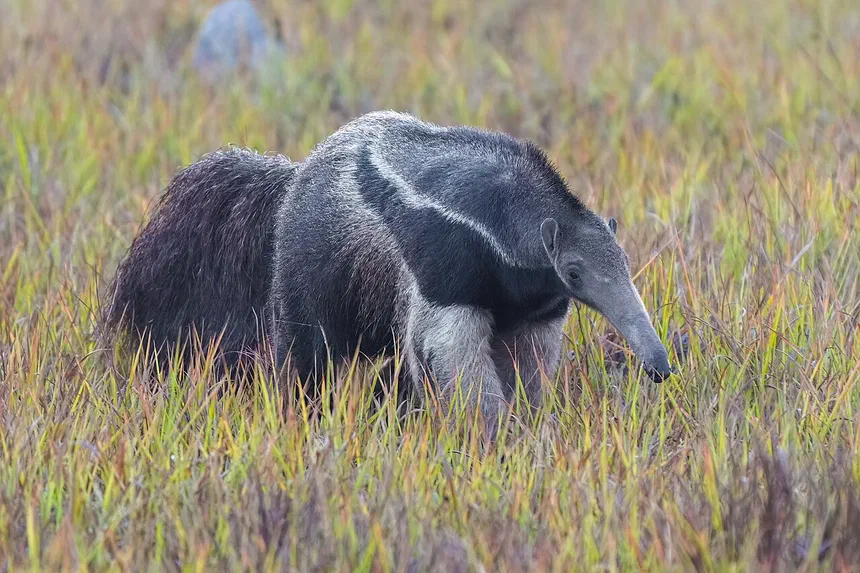
Image: Giles Laurent — CC BY-SA 4.0 · source
What Is a Giant Anteater?
The giant anteater (Myrmecophaga tridactyla) is the largest of the world’s four anteater species and one of the most distinctive mammals in the Americas. Instantly recognizable by its long, tubular snout and enormous plume-like tail, it is a specialized insect eater that spends its days searching for ants and termites. It belongs to an ancient group of mammals that also includes sloths and armadillos.
Appearance and Identification
Few animals are as unmistakable as the giant anteater. Its most striking feature is a narrow, elongated head that tapers into a small mouth at the tip of the snout, from which it can extend a remarkably long, sticky tongue. The coarse coat is mostly grayish-brown, marked by a bold diagonal stripe of black bordered with white running from the throat across the shoulder.
The body is fronted by powerful forelegs armed with large, curved claws, which the animal keeps tucked under as it walks so as not to blunt them. Perhaps its signature trait is the huge, bushy tail, nearly as long as the body itself, which the anteater drapes over itself like a blanket while resting. Adults commonly measure around 6 to 7 feet from snout to tail tip.
Habitat and Range
Giant anteaters range from parts of Central America southward through much of South America, including the grasslands of Brazil, Paraguay, Bolivia, and northern Argentina. They favor open habitats such as tropical grasslands, savanna, and seasonally flooded wetlands, but they also live in dry and humid forests where prey is abundant.
Because they depend on healthy insect populations, anteaters tend to move across large home ranges in search of productive foraging grounds. They are found from lowlands up into some higher-elevation areas, wherever ants and termites are plentiful and the terrain allows easy travel.
Diet
As their name suggests, giant anteaters feed almost entirely on ants and termites, and a single individual may consume tens of thousands of insects in a day. They locate colonies largely by smell, then use their strong claws to tear open nests and mounds. The tongue, which can extend well over a foot and is coated in sticky saliva, flicks in and out rapidly to gather insects.
Anteaters have no teeth and swallow their prey whole, grinding it internally with the help of hardened stomach structures and ingested grit. They typically feed at a single nest only briefly before moving on, a habit that avoids destroying entire colonies and helps ensure a renewable food supply.
Behavior
Giant anteaters are generally solitary and spend much of their time walking slowly with the snout lowered to the ground, sniffing out prey. Depending on the region and human pressure, they may be active by day or shift to nighttime foraging. Their eyesight is poor, but their sense of smell is exceptionally keen.
Normally shy and non-aggressive, an anteater will flee from danger when it can. If cornered by a predator such as a jaguar or puma, however, it can rear up on its hind legs and tail and slash with its formidable front claws, making it a surprisingly capable defender.
Life Cycle and Reproduction
Females typically give birth to a single pup after a gestation of about six months. The newborn is well developed and climbs onto its mother’s back soon after birth, where it clings for warmth and protection. The pup’s stripe pattern often lines up with the mother’s, providing effective camouflage.
The young anteater rides on its mother for several months and gradually becomes independent over roughly a year, though it may remain with her until she is ready to breed again. Sexual maturity is reached at a few years of age, and in the wild individuals usually live into their mid-teens.
Conservation Status
The giant anteater is listed as Vulnerable on the IUCN Red List. Its populations are declining due to habitat loss from agriculture and development, wildfires that sweep through grasslands, and deaths from road collisions. Hunting and conflict with people add further pressure in some regions. Protected areas and wildlife corridors are important tools for safeguarding remaining populations.
Frequently Asked Questions
Do giant anteaters have teeth? No. They have no teeth at all and instead use a long, sticky tongue to collect insects, which are ground up inside the stomach.
Are giant anteaters dangerous to humans? They are shy and avoid confrontation, but their large claws can inflict serious wounds if the animal feels cornered and is forced to defend itself.
How much can a giant anteater eat in a day? An individual can consume tens of thousands of ants and termites daily, visiting many nests briefly rather than emptying any single colony.
References
The conservation status and key facts in this profile are supported by these sources:
- Animal Diversity Web — Myrmecophaga tridactyla (Giant Anteater) (accessed 2026-07-29)
- GBIF — Myrmecophaga tridactyla Linnaeus, 1758 (accessed 2026-07-29)
Found an error, source problem, or image concern? Report this page.