Mammals Guide
Mongolian Gerbil
What Is a Mongolian Gerbil? The Mongolian gerbil (Meriones unguiculatus) is a small, burrowing rodent native to the dry grasslands and deserts of Central and East Asia. Also called the clawed jird, it is a highly social, …
At a glance
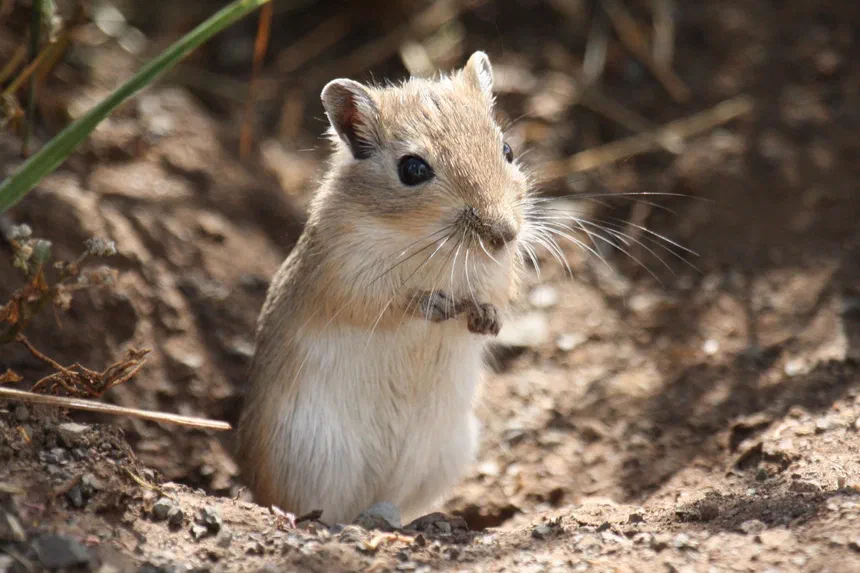
Image: Alastair Rae — Public domain · source
What Is a Mongolian Gerbil?
The Mongolian gerbil (Meriones unguiculatus) is a small, burrowing rodent native to the dry grasslands and deserts of Central and East Asia. Also called the clawed jird, it is a highly social, day-active animal that has become one of the most familiar small pets worldwide. In the wild it plays an important role in steppe ecosystems as both a seed disperser and a prey species.
Appearance and Identification
Mongolian gerbils are compact rodents with a sandy, agouti-brown coat that blends into desert soils, a pale cream underside, and a distinct dark stripe of longer fur running down the tail to a small tufted tip. The body measures roughly 10 to 13 centimeters, and the furred tail adds a similar length, helping the animal balance when it rears up or leaps. Adults typically weigh between 50 and 90 grams. They have large dark eyes, prominent ears, and strong hind legs suited to hopping. A notable feature is a hairless scent gland on the belly, which is larger in males and used to mark territory.
Habitat and Range
This species occupies arid and semi-arid environments across Mongolia, northern China (particularly Inner Mongolia), and neighboring parts of southern Russia. Preferred habitats include open steppe, sandy semi-desert, scrubland, and dry grassland. Gerbils cope with harsh, temperature-swinging climates by living in extensive underground burrow systems, which stay cooler in summer and warmer in winter and provide shelter from predators. A single burrow network may include multiple entrances, nesting chambers, and food-storage rooms.
Diet
Mongolian gerbils are primarily herbivorous, feeding on seeds, grasses, leaves, roots, and bulbs. Seeds form a large part of the diet, and gerbils will gather and cache surplus food in their burrows to survive lean seasons. They occasionally consume insects when plant food is scarce. Adapted to dry environments, they obtain much of their water from food and are remarkably efficient at conserving moisture, producing very concentrated urine and dry droppings.
Behavior
These rodents are diurnal to crepuscular, meaning they are active mainly during daylight and twilight hours, which sets them apart from many nocturnal desert rodents. They are highly social and live in family groups that share and defend a burrow. Communication involves scent marking, vocalizations, and foot-thumping, in which an alarmed gerbil rapidly drums its hind feet against the ground to warn others of danger. Grooming and huddling help maintain group bonds and conserve warmth.
Life Cycle and Reproduction
Mongolian gerbils can breed throughout much of the year where conditions allow, with peaks in the warmer months. After a gestation of roughly three weeks, a female gives birth to a litter that commonly numbers four to seven pups, though litters can be larger. The young are born blind and hairless, develop fur and open their eyes within the first two to three weeks, and are weaned at around three to four weeks. Both parents may help care for the young, and older siblings sometimes remain to assist. Sexual maturity is reached at a few months of age.
Conservation Status
The Mongolian gerbil is listed as Least Concern by the IUCN. It has a wide range and large, resilient populations, and in some agricultural regions it is even considered a crop pest. It faces no major threats overall, although local numbers fluctuate with rainfall, food availability, and predation. Its abundance and hardiness have also made it a widely kept pet and a common laboratory animal.
Frequently Asked Questions
Are Mongolian gerbils nocturnal? No. Unlike many desert rodents, they are active during the day and around dawn and dusk, resting in their burrows during the hottest and coldest hours.
Why do gerbils thump their back feet? Foot-thumping is a form of communication. A startled gerbil drums its hind feet to signal alarm to the rest of its group, and the behavior can also feature in social and breeding contexts.
How long do Mongolian gerbils live? In the wild they usually live around two to four years, shaped by predation and harsh conditions; well-cared-for pets often reach the upper end of that range.