Mammals Guide
Common Genet
What Is a Common Genet? The common genet (Genetta genetta) is a small, slender, cat-like carnivore that belongs to the family Viverridae, the same group that includes civets. Despite its feline appearance, it is not a …
At a glance
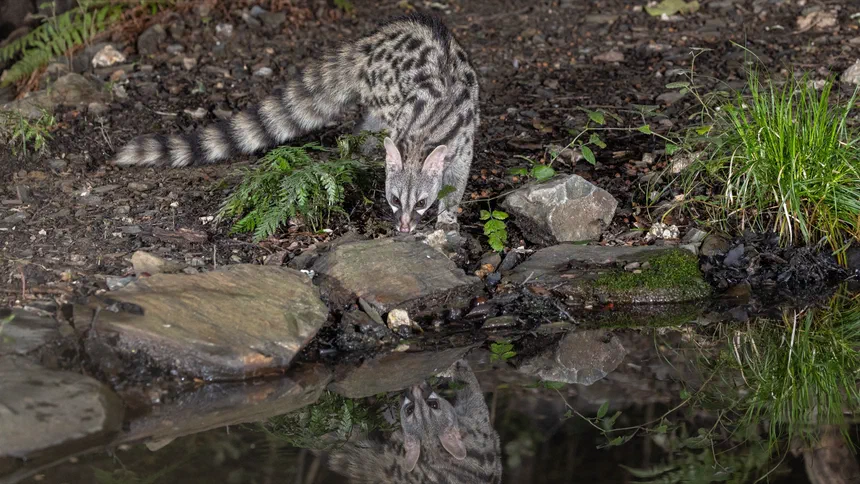
Image: Scarabinol — CC BY-SA 4.0 · source
What Is a Common Genet?
The common genet (Genetta genetta) is a small, slender, cat-like carnivore that belongs to the family Viverridae, the same group that includes civets. Despite its feline appearance, it is not a cat, and it is one of the few members of its family found naturally in Europe as well as across much of Africa.
Appearance and Identification
The common genet has a long, low-slung body, short legs, and a pointed muzzle that give it an almost weasel-like silhouette. Its coarse coat is pale gray to buff, marked with rows of dark brown or black spots running along the flanks and a dark stripe down the spine. The most striking feature is the long, bushy tail, which is roughly as long as the body and ringed with eight to ten alternating pale and dark bands ending in a dark tip. A short erectile crest of hair runs along the back, and the face carries pale patches beneath the eyes. The retractable or semi-retractable claws and supple joints make it an agile climber.
Habitat and Range
Common genets occupy a wide variety of environments, including deciduous and evergreen woodlands, Mediterranean scrub, rocky hillsides, and the edges of farmland and human settlements. They favor areas with dense cover and access to water. The species has a broad distribution across most of Africa, particularly the savannas and woodlands south of the Sahara, as well as parts of North Africa. In Europe, populations occur throughout the Iberian Peninsula and into parts of France, where they are believed to have been introduced centuries ago, possibly as semi-domesticated animals.
Diet
The common genet is an opportunistic feeder that leans toward a carnivorous diet. Small mammals such as mice, voles, and rats make up a large share of its prey, supplemented by birds, reptiles, amphibians, and large insects. It also takes fruit and other plant material when available, making it effectively omnivorous in some seasons. Genets are skilled hunters that use both stealth on the ground and agility in trees, pouncing on prey after a careful stalk and dispatching it with a bite to the neck.
Behavior
Genets are mainly nocturnal and solitary, spending the day resting in tree hollows, rock crevices, dense vegetation, or abandoned burrows. They are excellent climbers and can move confidently through branches, though they hunt on the ground as well. Individuals maintain home ranges that they mark with scent from anal glands and with communal latrine sites, which help space out neighbors and convey information about identity and reproductive condition. Generally shy and secretive, genets are rarely seen despite living close to human activity in many regions. When alarmed, they can release a strong-smelling secretion from their scent glands.
Life Cycle and Reproduction
Breeding can occur in one or two seasons per year depending on the climate, with births often timed to periods of abundant prey. After a gestation of roughly ten to eleven weeks, the female gives birth to a litter of usually two or three young in a sheltered den. The kits are born blind and helpless, opening their eyes after a week or two and being weaned over the following months. They begin taking solid food and learning to hunt under the mother’s care before dispersing to establish their own ranges. Sexual maturity is reached at around two years of age.
Conservation Status
The common genet is listed as Least Concern by the IUCN, reflecting its wide range, adaptable habits, and large overall population. It tolerates a degree of human presence and can persist in agricultural and semi-urban landscapes. Localized threats include habitat loss, road mortality, and persecution by people who mistake it for a poultry pest, but none of these currently threaten the species as a whole.
Frequently Asked Questions
Is a genet a type of cat? No. Although it looks and moves much like a cat, the genet belongs to the family Viverridae and is more closely related to civets and mongooses than to true cats.
Are common genets dangerous to people? No. Genets are small, shy, and avoid humans. At most they may raid a poultry coop, but they pose no real danger to people.
Can genets be kept as pets? Genets have occasionally been tamed, and historically some were kept to control rodents, but they remain wild animals with specialized needs and strong scent-marking behavior that make them poorly suited to typical households.