Mammals Guide
Gemsbok
What Is a Gemsbok? The gemsbok (Oryx gazella) is a large, powerfully built antelope of the oryx group, native to the arid regions of southern Africa. Renowned for its long, straight, rapier-like horns and boldly …
At a glance
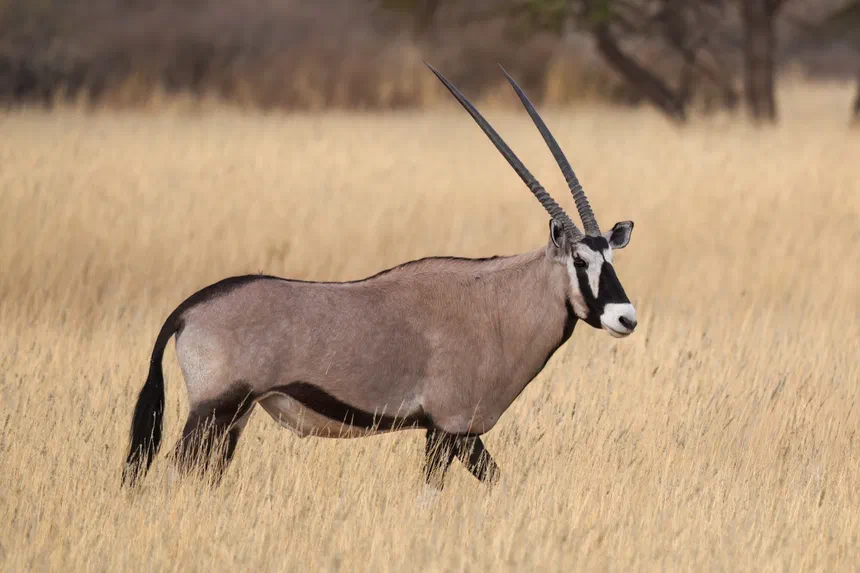
Image: Giles Laurent — CC BY-SA 4.0 · source
What Is a Gemsbok?
The gemsbok (Oryx gazella) is a large, powerfully built antelope of the oryx group, native to the arid regions of southern Africa. Renowned for its long, straight, rapier-like horns and boldly patterned face, it is one of the desert’s most striking large grazers. The gemsbok is superbly adapted to survive in landscapes where water is scarce for much of the year.
Appearance and Identification
The gemsbok is unmistakable at a distance thanks to its dramatic markings. Its body is a pale fawn to grayish-tan, set off by a black stripe running along the flank where the upper body meets the white belly. The face carries a bold black-and-white mask, with dark bands running from the base of the horns down through the eyes, and black markings on the throat and legs. Both males and females carry horns, which are long, nearly straight, and ringed near the base; they can reach roughly 60 to 85 centimeters in length. Females’ horns tend to be thinner and slightly longer, while males’ are thicker. Adults stand around 1.2 meters at the shoulder and typically weigh between 180 and 240 kilograms, with males generally heavier than females.
Habitat and Range
Gemsbok inhabit the dry country of southern Africa, including the Kalahari and Namib regions across Namibia, Botswana, South Africa, and neighboring areas. They favor open, arid environments such as semi-desert, dry savanna, scrubland, and sparse grassland, where their coloration blends with the pale, sun-bleached terrain. Their tolerance for heat and drought allows them to occupy habitats that many other large herbivores avoid. A separate introduced population also thrives in the desert of the southwestern United States, where the species was released in the 20th century.
Diet
As herbivores, gemsbok graze primarily on grasses but readily broaden their diet during dry spells. They browse leaves, eat roots and tubers that they dig up, and seek out water-storing plants such as wild tsama melons and cucumbers, which provide vital moisture. This flexible feeding strategy lets them go for long stretches without drinking, extracting most of the water they need from their food. They often feed during the cooler parts of the day and rest in shade during peak heat to conserve moisture.
Behavior
Gemsbok are highly adapted to conserve water and endure extreme heat. They can allow their body temperature to rise during the hottest hours and use a specialized network of blood vessels to keep the brain cooler than the rest of the body. They typically live in herds that may number from a handful to several dozen animals, often composed of females, young, and a dominant male, though bachelor groups and lone bulls also occur. Herd composition tends to be loose and shifting. When threatened by predators such as lions or hyenas, a gemsbok will stand its ground and use its formidable horns as defensive weapons, and it can inflict serious injury.
Life Cycle and Reproduction
Gemsbok can breed throughout the year, with births sometimes peaking after seasonal rains when food is more plentiful. After a gestation of roughly eight to nine months, a female gives birth to a single calf. The newborn is a plain tan color, lacking the bold adult markings, and it typically lies hidden in vegetation for the first weeks of life while the mother returns to nurse it. As the calf grows, it develops the distinctive facial mask and flank stripe and joins the herd. Sexual maturity is reached in the second year or so. In the wild, gemsbok commonly live around 15 to 18 years.
Conservation Status
The gemsbok is listed as Least Concern by the IUCN, reflecting a relatively stable and widespread population across its southern African range. It benefits from protection in national parks and reserves and from managed populations on private and game farmland. Localized pressures include habitat conversion, fencing that disrupts movement, and hunting, but overall the species is not considered globally threatened. Its resilience in harsh, arid environments contributes to its continued success.
Frequently Asked Questions
How does a gemsbok survive without much water? It gets most of its moisture from food, including water-rich melons and roots, and it tolerates high body temperatures to reduce water loss through sweating.
Do both male and female gemsbok have horns? Yes. Both sexes carry the long, straight horns, though females’ tend to be more slender and males’ somewhat thicker.
Are gemsbok dangerous to predators? They can be. A cornered gemsbok will use its sharp horns to defend itself and has been known to seriously injure attacking predators.