Mammals Guide
Gelada
What Is a Gelada? The gelada (Theropithecus gelada) is a large, ground-dwelling monkey found only in the mountains of Ethiopia. It is the last surviving member of a once-widespread genus and is best known for the …
At a glance
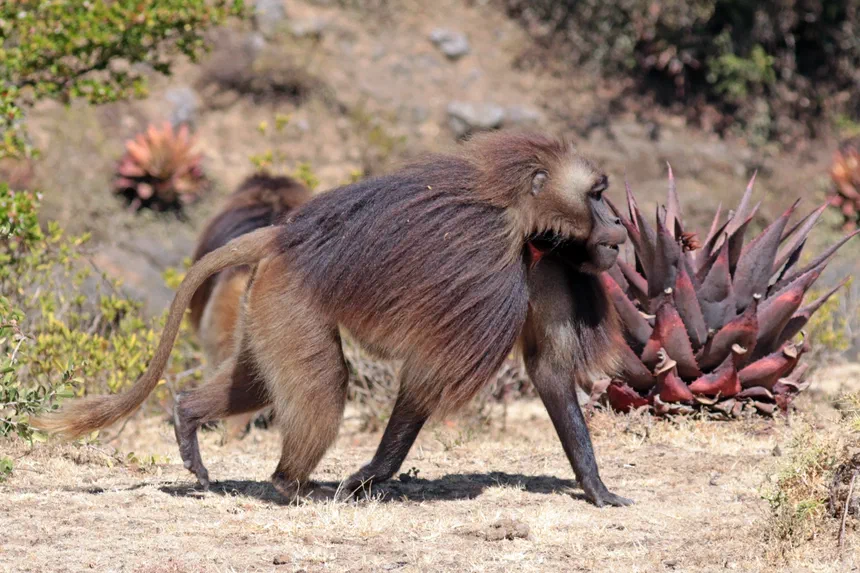
Image: Charles J. Sharp — CC BY-SA 4.0 · source
What Is a Gelada?
The gelada (Theropithecus gelada) is a large, ground-dwelling monkey found only in the mountains of Ethiopia. It is the last surviving member of a once-widespread genus and is best known for the striking bare patch of skin on its chest, which has earned it the nickname “bleeding-heart monkey.” Despite its fearsome canine teeth, the gelada is a specialized grass-eater.
Appearance and Identification
Geladas are stocky, powerfully built primates with thick brown to buff-colored fur. Adult males are considerably larger than females and grow an impressive cape of long hair over the shoulders and back, along with a pale mane. Both sexes display the trademark hourglass-shaped patch of bare pink skin on the chest, which is brighter and more vivid in males and in females that are ready to breed. Their faces are dark, their muzzles are short, and males possess long, sharp canine teeth used mainly in displays and fights with rivals. Unlike many other Old World monkeys, geladas have short fingers and an opposable thumb well suited to plucking grass.
Habitat and Range
This species is endemic to the Ethiopian Highlands, living at elevations that commonly range from about 1,800 to 4,400 meters. Geladas favor open alpine grasslands and mountain meadows that sit above steep gorges and cliff faces. These rugged escarpments are central to their way of life: the animals graze across the plateaus during the day and retreat to sleep on sheltered cliff ledges at night, where they are safe from most predators.
Diet
Geladas are among the most specialized grazing primates in the world. The bulk of their diet consists of grass blades, along with seeds, roots, rhizomes, and herbs. During drier periods they dig for underground plant parts and consume more seeds. They spend much of their day seated, shuffling along the ground while methodically picking and eating vegetation with quick, dexterous hand movements. Insects and other small foods are eaten only occasionally.
Behavior
Geladas are highly social and live in some of the largest aggregations known among primates, sometimes numbering several hundred individuals. Their society is layered: small reproductive units of one dominant male and several related females form the core, and these units join together into bands and larger herds. Geladas are notably vocal, producing a rich repertoire of calls, grunts, and lip-smacking sounds used to maintain social bonds. Much of their communication is thought to convey subtle information about mood and intent, making them a favorite subject for researchers studying primate language-like behavior.
Life Cycle and Reproduction
Within a reproductive unit, the dominant male fathers most offspring, though females hold considerable influence over group cohesion. After a gestation of roughly five to six months, a female typically gives birth to a single infant. Newborns cling to their mothers and are weaned over the course of a year or more. Young females usually remain in their birth group, while males leave to join bachelor groups before eventually attempting to take over or start a unit of their own. Takeovers by rival males can be dramatic and occasionally lead to the loss of dependent infants.
Conservation Status
The gelada is currently listed as Least Concern by the IUCN, with a population that remains relatively large across its highland range. Even so, its numbers have declined in places, and its future depends on the health of Ethiopia’s alpine grasslands. The main pressures include the conversion of grassland to farmland, competition with livestock for grazing, and localized hunting. Because the species is found nowhere else on Earth, protecting the mountain ecosystems of Ethiopia is essential to its long-term survival.
Frequently Asked Questions
Why does the gelada have a red chest patch? The bare patch of skin acts as a social signal. Its brightness reflects an individual’s status and, in females, their reproductive condition, allowing group members to communicate without the need to display swellings as many other monkeys do.
Are geladas dangerous to people? Geladas are generally shy and non-aggressive toward humans. Males have large canines used mainly to intimidate rival males, but the animals feed on grass and pose little threat to people.
Where can geladas be seen in the wild? They are found only in the Ethiopian Highlands, with the Simien Mountains being one of the most reliable and famous places to observe large herds up close.