Mammals Guide
Fox Squirrel
What Is a Fox Squirrel? The fox squirrel (Sciurus niger) is the largest tree squirrel native to North America. Named for its bushy, fox-like tail and often rusty coloring, it is a familiar sight in open woodlands, city …
At a glance
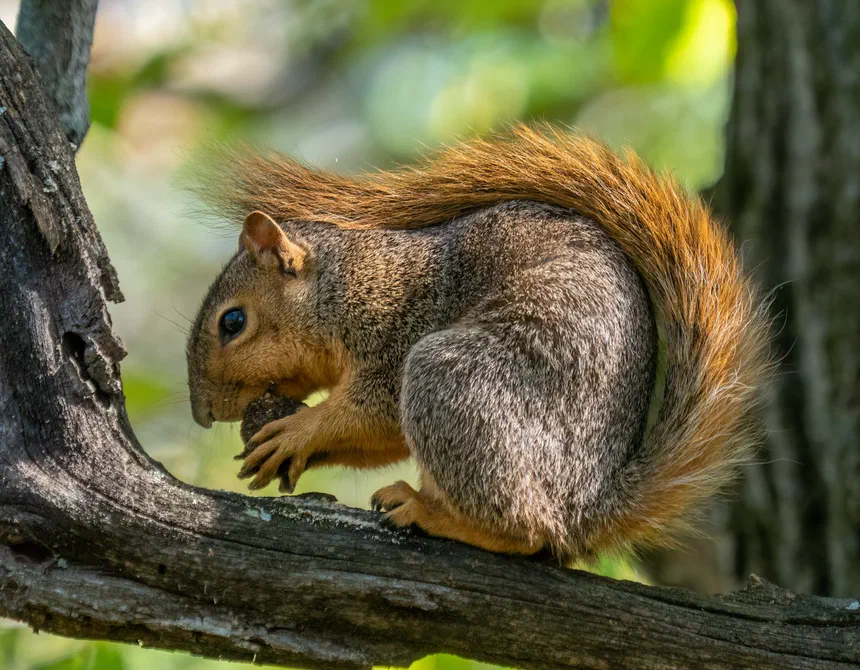
Image: Rhododendrites — CC BY-SA 4.0 · source
What Is a Fox Squirrel?
The fox squirrel (Sciurus niger) is the largest tree squirrel native to North America. Named for its bushy, fox-like tail and often rusty coloring, it is a familiar sight in open woodlands, city parks, and suburban yards across much of the central and eastern United States.
Appearance and Identification
Fox squirrels are noticeably larger and heavier than the more common eastern gray squirrel, with a stout body and a long, plumed tail nearly equal to the body in length. Their coloring is highly variable across their range: many individuals are a warm brownish-orange with paler orange or buff underparts, while others appear grayish, and populations in parts of the southeast can be strikingly dark or even black, sometimes with white markings on the face and feet. Adults typically measure 10 to 15 inches (25 to 38 cm) in head-and-body length, with a tail adding roughly the same again, and weigh between about 1 and 2.2 pounds (500 to 1,000 grams). Sharp curved claws and strong hind limbs make them agile climbers.
Habitat and Range
This species favors open, park-like forests rather than dense, closed-canopy woods. It thrives in stands of oak, hickory, and pine, along forest edges, in savannas, and increasingly in human-altered landscapes such as farmland shelterbelts, golf courses, city parks, and residential neighborhoods. Its native range covers much of the central and eastern United States, extending north into southern Canada and south toward northeastern Mexico. Introductions have also established populations in parts of the western United States. Fox squirrels tolerate proximity to people well and often become abundant where mature trees provide both food and nesting sites.
Diet
Fox squirrels are opportunistic omnivores with a strong emphasis on plant matter. Acorns, hickory nuts, walnuts, and pine seeds form the core of their diet, supplemented by tree buds, flowers, fruits, berries, fungi, and agricultural crops such as corn. They are important seed dispersers: like other tree squirrels, they bury nuts in scattered caches for winter and fail to recover many of them, effectively planting new trees. When plant foods are scarce, they will also eat insects, bird eggs, and occasionally nestlings.
Behavior
Fox squirrels are diurnal and most active in the morning and late afternoon. Unlike some rodents, they do not hibernate, remaining active year-round and relying on cached food and body fat to survive winter. They are generally less skittish and more deliberate in their movements than gray squirrels and spend a fair amount of time foraging on the ground, sprinting for the nearest tree when alarmed. They build leaf nests, called dreys, high in branches and also den in tree cavities. Though not strongly territorial, they maintain loose home ranges and communicate through tail flicking, chattering calls, and scent.
Life Cycle and Reproduction
Breeding typically peaks in winter and again in mid-summer, so females may raise up to two litters a year. After a gestation of roughly 44 to 45 days, a female gives birth to a litter of about two to four young, born blind, hairless, and helpless in a tree cavity or drey. The mother cares for the pups alone; they open their eyes at around four to five weeks and are usually weaned by two to three months, dispersing soon after. In the wild, fox squirrels commonly live around 6 to 12 years, though many die young to predators, vehicles, and harsh weather. Hawks, owls, foxes, bobcats, and snakes are among their natural predators.
Conservation Status
The fox squirrel is listed as Least Concern by the IUCN, reflecting a broad range and generally stable, often abundant populations. It adapts readily to suburban environments and is a common game species in parts of its range. Some regional subspecies, however, have declined due to habitat loss and fragmentation, and a few isolated populations receive special protection. Maintaining mature nut-bearing trees and open woodland habitat is the main key to their continued success.
Frequently Asked Questions
How is a fox squirrel different from a gray squirrel? Fox squirrels are larger and typically show warmer, more rusty or orange tones, whereas gray squirrels are smaller and usually grayer. The two often overlap in range but tend to favor slightly different habitats.
Are fox squirrels dangerous to people? No. They are shy of humans and pose little threat, though like any wild rodent they may gnaw on structures or raid gardens and bird feeders.
Do fox squirrels hibernate? No. They stay active throughout the year, relying on stored food caches and fat reserves to get through winter.