Mammals Guide
Fossa
What Is a Fossa? The fossa (Cryptoprocta ferox) is Madagascar’s largest native carnivore, a lithe, cat-like predator found only on that island. Despite its feline appearance, it is not a cat but a member of the family …
At a glance
What Is a Fossa?
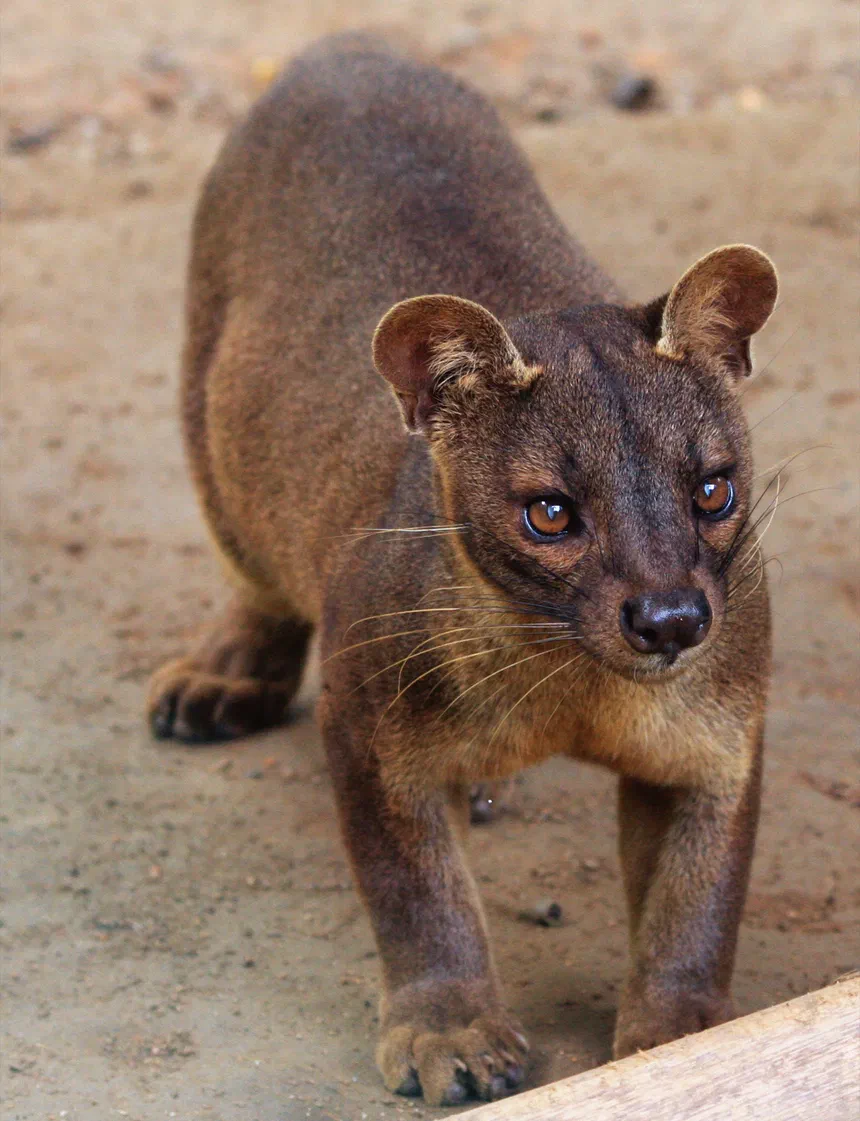
The fossa (Cryptoprocta ferox) is Madagascar’s largest native carnivore, a lithe, cat-like predator found only on that island. Despite its feline appearance, it is not a cat but a member of the family Eupleridae, a group of carnivores whose ancestors are thought to have colonized Madagascar from mainland Africa millions of years ago.
Appearance and Identification
With a slender, muscular body, short reddish-brown to dark-brown fur, and a long tail roughly equal in length to its body, the fossa is often mistaken for a small cougar or an oversized mongoose. Adults typically measure about 70 to 80 centimeters from head to rump, with a tail nearly as long that aids balance during climbing. Weights generally range from about 5 to 9 kilograms, and males tend to be noticeably larger than females. The head is rounded with a short muzzle, forward-set brown eyes, and prominent rounded ears. Semi-retractable claws and flexible ankle joints that can rotate the hind feet allow the fossa to descend tree trunks headfirst, an unusual ability among carnivores.
Habitat and Range
The fossa is endemic to Madagascar, meaning it occurs nowhere else on Earth. It ranges across many of the island’s remaining forested regions, from humid eastern rainforest to the dry deciduous woodlands of the west and the spiny forests of the south. Individuals require large territories and are strongly associated with intact forest, so they are largely absent from heavily cleared and cultivated landscapes. Because its distribution mirrors the island’s shrinking forest cover, the species has become increasingly patchy and fragmented.
Diet
As Madagascar’s top mammalian predator, the fossa is a versatile carnivore. Lemurs make up a substantial part of its diet, and the fossa is one of the few predators capable of pursuing them through the canopy. It also takes small mammals such as tenrecs and rodents, along with birds, reptiles, frogs, and insects. Hunting occurs both in the trees and on the ground, and the fossa’s climbing agility lets it ambush prey that other predators cannot easily reach. Larger animals may be taken with a throat or nape bite typical of specialized hunters.
Behavior
Fossas are mostly solitary and maintain large home ranges that they mark with scent from well-developed anal and chest glands. They are active by day and night, adjusting their patterns to prey availability and season. Comfortable both in trees and on the ground, they are strong climbers and capable swimmers. Vocalizations include mews, purrs, and threatening calls, though for much of the year individuals encounter one another rarely. During the breeding season, however, their social behavior changes dramatically as animals gather at traditional mating sites.
Life Cycle and Reproduction
Breeding is seasonal, typically occurring in the warmer months. Females often mate at established sites, sometimes over several days and with more than one male. After a gestation of about three months, a litter of two to four young is born in a den, tree hollow, or sheltered cavity. The pups are helpless and blind at birth and develop slowly, remaining dependent on the mother for many months. Young fossas are not fully weaned until several months of age and may not reach independence until well into their second year. Sexual maturity comes at around three to four years, and wild individuals may live roughly 15 to 20 years.
Conservation Status
The fossa is classified as Vulnerable by the IUCN. Its greatest threat is habitat loss, as Madagascar’s forests continue to be cleared for agriculture, logging, and charcoal production. Because the species needs extensive, connected forest, fragmentation isolates populations and reduces genetic exchange. Fossas are also sometimes killed in retaliation for preying on poultry, and they can be affected by diseases carried by domestic animals. Protected areas and forest-corridor initiatives are central to conserving the species, along with efforts to reduce conflict with rural communities.
Frequently Asked Questions
Is the fossa a type of cat? No. Although it looks and behaves somewhat like a cat, the fossa belongs to the family Eupleridae, a group of Madagascar carnivores more closely related to mongooses and civets.
Where do fossas live? They are found only on the island of Madagascar, where they inhabit a range of forest types from rainforest to dry woodland.
Are fossas dangerous to people? Fossas are shy and generally avoid humans. They pose little threat to people, though they may occasionally take domestic poultry near villages.