Mammals Guide
Forest Elephant
What Is a Forest Elephant? The African forest elephant (Loxodonta cyclotis) is one of the world’s largest land animals and the smaller of the two living African elephant species. Once considered a subspecies of the …
At a glance
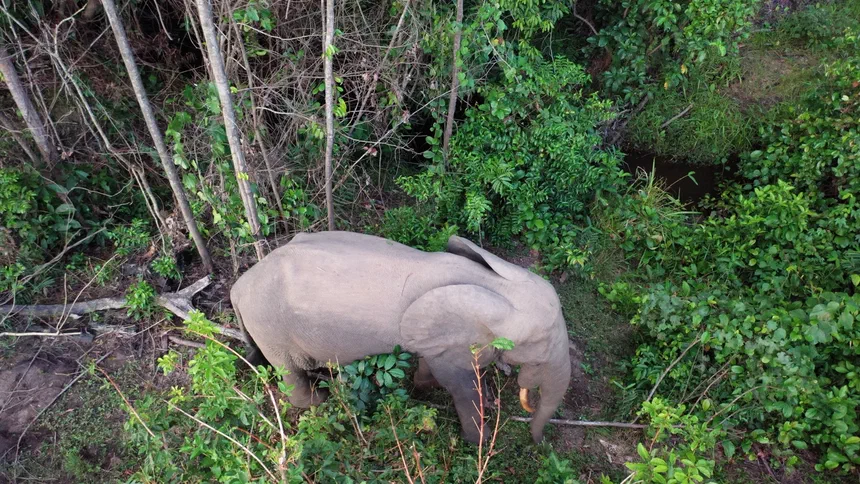
Image: VIGNA christian — CC BY-SA 4.0 · source
What Is a Forest Elephant?
The African forest elephant (Loxodonta cyclotis) is one of the world’s largest land animals and the smaller of the two living African elephant species. Once considered a subspecies of the African bush elephant, it is now recognized as a distinct species adapted to the dense rainforests of Central and West Africa.
Appearance and Identification
Forest elephants are noticeably smaller and more compact than their savanna relatives, standing roughly 1.6 to 2.5 meters tall at the shoulder. Their ears are more oval and rounded, giving the species its name (cyclotis means “round-eared”). The tusks are straighter and point downward, and they tend to be harder and more pinkish in color, which historically made them a target for the ivory trade. The skin is dark gray, often masked by mud and dust, and the body is built low and stocky to move through thick undergrowth.
Habitat and Range
This species inhabits the humid tropical forests of the Congo Basin and parts of West Africa, with important populations in Gabon, the Republic of the Congo, Cameroon, and the Central African Republic. Forest elephants rely on a mosaic of dense woodland interspersed with clearings known as “bais,” which are open, mineral-rich swampy areas where the animals gather to feed on nutrient-laden soil and socialize. Their range has contracted sharply due to habitat loss and hunting.
Diet
Forest elephants are herbivores with a remarkably varied diet. They consume large quantities of leaves, bark, stems, and grasses, but fruit forms an especially important part of their intake. Because they eat and disperse the seeds of many rainforest tree species, they are often called “forest gardeners” or ecosystem engineers. Seeds pass through their digestive tract and are deposited far from the parent tree, helping to regenerate the forest. This role makes them vital to the health and carbon storage capacity of Central African rainforests.
Behavior
Forest elephants live in smaller family groups than savanna elephants, typically consisting of an adult female and her offspring, an adaptation to the limited visibility and resources of dense forest. They communicate over long distances using low-frequency rumbles that travel through the vegetation, and they gather at forest clearings where larger social interactions take place. They are intelligent, long-lived, and maintain networks of well-worn trails that connect feeding areas, water sources, and mineral licks across their range.
Life Cycle and Reproduction
Reproduction is slow in this species, one of the factors that makes population recovery difficult. Females reach maturity later than savanna elephants, often not breeding until their twenties, and the gestation period lasts around 22 months, among the longest of any mammal. A single calf is born and depends heavily on its mother and the wider family group for several years. Calves are nursed for extended periods and learn feeding routes and social behaviors from older relatives. With such long intervals between births, forest elephant populations grow very slowly.
Conservation Status
The forest elephant is listed as Critically Endangered by the IUCN. Populations have declined dramatically over recent decades, driven primarily by poaching for ivory and by the fragmentation and loss of rainforest habitat. Because their slow reproductive rate cannot keep pace with hunting losses, even moderate poaching pressure can cause steep declines. Conservation efforts focus on anti-poaching patrols, protected forest corridors, and reducing demand for ivory. Their survival is closely tied to the future of the Congo Basin rainforest itself.
Frequently Asked Questions
How is a forest elephant different from a savanna elephant? Forest elephants are smaller, have rounder ears, and carry straighter, downward-pointing tusks. They live in dense rainforest rather than open grassland and form smaller family groups.
Why are forest elephants important to their ecosystem? By eating fruit and dispersing seeds across long distances, they help regenerate rainforest trees and are often called ecosystem engineers or forest gardeners.
Why are forest elephants endangered? Poaching for their prized ivory combined with rainforest loss has caused severe declines, and their naturally slow reproduction makes it very hard for populations to recover.