Mammals Guide
Flying Squirrel
What Is a Flying Squirrel? The southern flying squirrel (Glaucomys volans) is a small, nocturnal rodent native to the woodlands of eastern North America. Despite its name, it does not truly fly but instead glides between …
At a glance
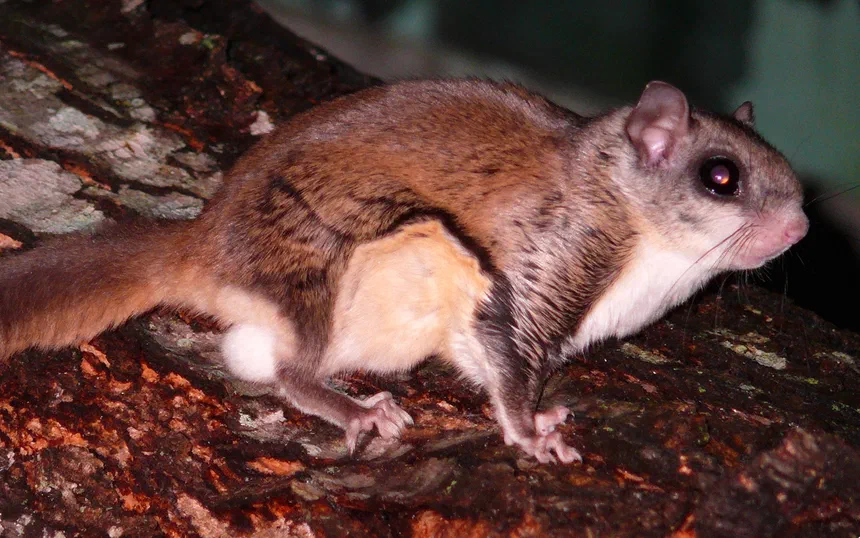
Image: Ken Thomas — Public domain · source
What Is a Flying Squirrel?
The southern flying squirrel (Glaucomys volans) is a small, nocturnal rodent native to the woodlands of eastern North America. Despite its name, it does not truly fly but instead glides between trees using a furred membrane stretched between its limbs. It is one of the most common yet rarely seen mammals across much of its range, owing to its strictly night-active habits.
Appearance and Identification
This is a small squirrel with soft, dense fur that is grayish-brown on the back and cream-white on the underside. Its most distinctive feature is the patagium, a loose flap of skin extending from wrist to ankle on each side of the body that allows gliding. The eyes are large and dark, an adaptation for seeing in low light. The tail is flattened and feather-like, helping with steering and balance in the air. Adults typically measure about 8 to 10 inches (21 to 26 centimeters) from nose to tail tip and weigh only about 2 to 3 ounces (50 to 85 grams), making them noticeably smaller and lighter than the familiar gray squirrel.
Habitat and Range
Southern flying squirrels are found across the eastern United States and into parts of southeastern Canada and Mexico. They favor mature deciduous and mixed forests, particularly stands with oak, hickory, beech, and maple that provide abundant nuts and seeds. Old trees with natural cavities and abandoned woodpecker holes are important, as these serve as nesting and denning sites. The species readily uses wooded suburban areas and will occasionally take up residence in attics or nest boxes.
Diet
Flying squirrels are omnivorous and among the most carnivorous of North American tree squirrels. Their diet includes nuts, acorns, seeds, berries, tree buds, and a notable amount of fungi and lichen. They also eat insects, bird eggs, nestlings, and occasionally carrion. Nuts and acorns are cached in autumn to sustain the animals through winter, when they may share communal dens to conserve heat.
Behavior
These squirrels are strictly nocturnal, emerging after dark to forage and glide among the trees. A glide begins with a leap from a high perch, after which the animal spreads its limbs to extend the patagium and sails downward in a controlled descent, sometimes covering distances of well over 100 feet. Small adjustments of the limbs and tail allow surprisingly precise landings, and the squirrel typically alights low on a target trunk before scrambling upward. They are social animals, and in cold weather groups may huddle together in a single cavity. Owls, hawks, snakes, and climbing predators such as domestic cats are their main threats.
Life Cycle and Reproduction
Breeding generally occurs in late winter and again in mid to late summer, producing one or two litters per year. After a gestation of about 40 days, the female gives birth to a litter of usually two to five young in a tree cavity or leaf nest. The pups are born blind and hairless and depend entirely on the mother, opening their eyes at around four weeks and being weaned by roughly six to eight weeks. Young remain with the mother for a period before dispersing. In the wild most individuals live around three to six years, though predation and harsh winters claim many before they reach maturity.
Conservation Status
The southern flying squirrel is listed as Least Concern by the IUCN and remains widespread and locally common throughout its range. It is not currently considered threatened, though it depends on mature forest with cavity-bearing trees, so intensive logging and the loss of old timber can reduce local populations. Providing nest boxes and retaining dead standing trees can benefit the species in managed woodlands.
Frequently Asked Questions
Do flying squirrels actually fly? No. They cannot achieve powered flight like birds or bats. Instead they glide, using the patagium as a living parachute to sail from a higher point to a lower one.
Are flying squirrels active during the day? Rarely. They are among the most strictly nocturnal of squirrels, which is why they are seldom seen even where they are abundant.
What do flying squirrels eat in winter? They rely heavily on nuts and acorns cached in autumn, supplemented by fungi, lichen, and tree buds, and they conserve energy by denning communally during the coldest weather.