Mammals Guide
Flying Fox
What Is a Flying Fox? The large flying fox (Pteropus vampyrus) is among the biggest bats in the world, a fruit-eating megabat native to Southeast Asia. Despite the “fox” in its name, it is not related to foxes at all; …
At a glance
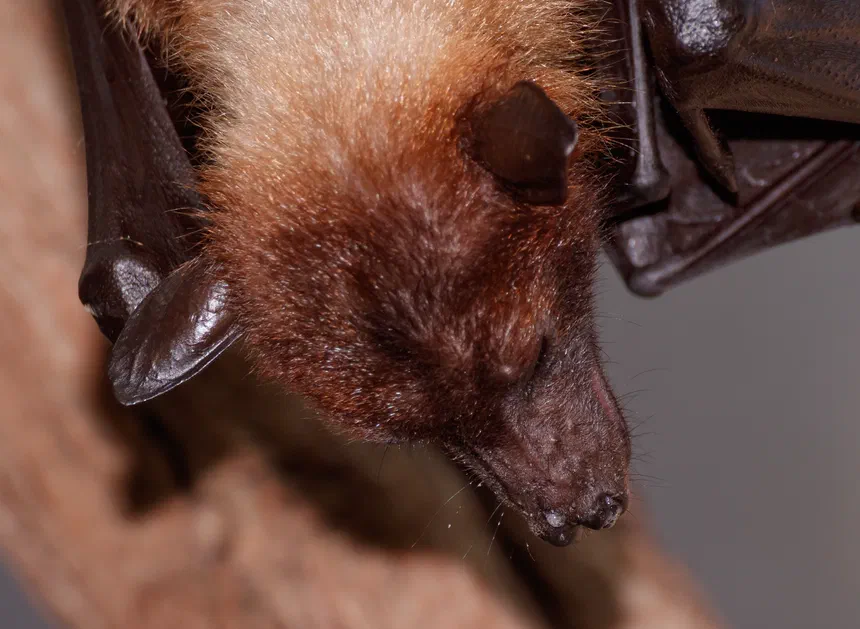
Image: H. Zell — CC BY-SA 3.0 · source
What Is a Flying Fox?
The large flying fox (Pteropus vampyrus) is among the biggest bats in the world, a fruit-eating megabat native to Southeast Asia. Despite the “fox” in its name, it is not related to foxes at all; the label refers to its long snout, upright ears, and reddish fur, which give its face a distinctly canine look. Like all flying foxes, it feeds on plants rather than blood, and it navigates by keen eyesight and smell rather than echolocation.
Appearance and Identification
This is a strikingly large bat. Its head-and-body length runs roughly 27 to 32 centimeters, and its outstretched wings can span up to about 1.5 meters, making it one of the largest bats by wingspan. Adults typically weigh between 0.65 and 1.1 kilograms. The fur is generally reddish-brown to dark brown or blackish, frequently with a lighter tan or golden mantle across the shoulders and back of the neck. The wings are leathery and dark, supported by elongated finger bones, and each thumb bears a strong claw used for climbing and clambering through branches. Large eyes and a fox-like muzzle complete the look.
Habitat and Range
The large flying fox occurs across much of Southeast Asia, including parts of the Malay Peninsula, Sumatra, Borneo, Java, the Philippines, and neighboring islands. It favors tropical and subtropical lowland forests, mangroves, swamp forest, and coastal woodlands, and it readily visits plantations and gardens where flowering and fruiting trees are available. Colonies often roost near water and along coastlines, and individuals may commute considerable distances between daytime roosts and nighttime feeding grounds.
Diet
Flying foxes are strict plant-eaters. Their diet centers on nectar, pollen, and soft fruits, along with flowers and occasionally young leaves. They are drawn to blossoming and fruiting trees such as figs, mangoes, bananas, and various native forest species. When feeding, a bat often crushes the fruit or flower to extract juice and pulp, swallowing the liquid and spitting out much of the fibrous material. In doing so, these bats become important pollinators and seed dispersers, spreading seeds far from the parent plant.
Behavior
Large flying foxes are highly social and gregarious, gathering in noisy daytime roosts, or camps, that can number from hundreds to many thousands of individuals. They hang upside down from exposed branches, wrapping their wings around the body or fanning them to cool off in the heat. Active mainly at dusk and through the night, they leave the roost in long, streaming flights to reach feeding areas. Communication involves a wide range of squabbling calls, and jostling over prime roosting spots is common. Their eyesight and sense of smell, rather than echolocation, guide them to food and roosts.
Life Cycle and Reproduction
Females generally produce a single pup each year, following a gestation of roughly five to six months. Newborns cling tightly to the mother, and she may carry the pup on early foraging flights before it is left at the roost as it grows. The young are nursed for a period of weeks to months before becoming independent and learning to fly and forage on their own. Sexual maturity is reached after a year or two. In the wild these bats commonly live around 15 years, and individuals in protected conditions can live somewhat longer.
Conservation Status
The large flying fox is listed as Near Threatened by the IUCN, and its numbers have been declining across much of its range. Major threats include intensive hunting for food and trade, disturbance and destruction of roost sites, and loss of forest habitat to agriculture and development. Because these bats gather in large, conspicuous colonies, entire camps can be heavily exploited in a short time. Protecting roost sites and regulating hunting are seen as key measures for their long-term survival, especially given the ecological role they play in pollination and seed dispersal.
Frequently Asked Questions
Do flying foxes drink blood? No. Despite the species name vampyrus, flying foxes are fruit and nectar feeders and pose no threat as blood-drinkers.
How big can a flying fox get? The large flying fox is among the biggest bats, with a wingspan reaching roughly 1.5 meters and a weight of about 0.65 to 1.1 kilograms.
Are flying foxes useful to the environment? Yes. By feeding on nectar and fruit they pollinate flowers and disperse seeds across wide areas, helping to regenerate tropical forests.