Mammals Guide
Flat-Headed Cat
What Is a Flat-Headed Cat? The flat-headed cat (Prionailurus planiceps) is a small, secretive wild cat native to the swampy lowland forests of Southeast Asia. It belongs to the same genus as the leopard cat and fishing …
At a glance
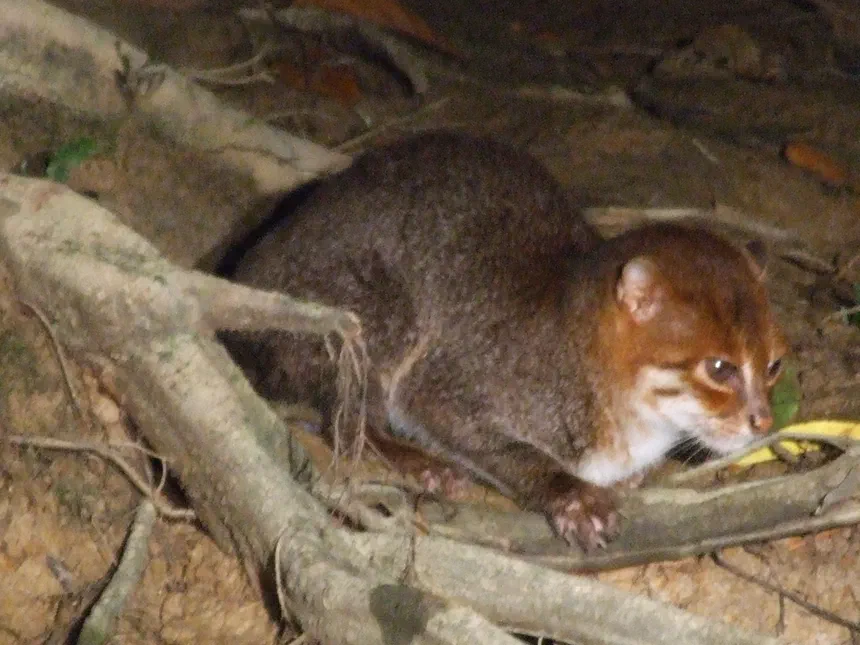
Image: Thibaud Aronson — CC BY-SA 4.0 · source
What Is a Flat-Headed Cat?
The flat-headed cat (Prionailurus planiceps) is a small, secretive wild cat native to the swampy lowland forests of Southeast Asia. It belongs to the same genus as the leopard cat and fishing cat, and it is one of the most water-adapted and least-studied felines in the world. Named for the distinctive flattened profile of its skull, this diminutive predator is closely tied to rivers, marshes, and other freshwater habitats.
Appearance and Identification
This is one of the smallest wild cats, roughly the size of a domestic cat but built low to the ground. Its fur is thick and soft, ranging from reddish-brown to a dark gray-brown, with a lighter, mottled underside and a whitish muzzle. The head is unusually long and flattened, with the eyes set close together and far forward, giving excellent binocular vision for judging distances in water. The ears are small and rounded, and the legs are short. Two adaptations stand out: the teeth are relatively large and sharp for gripping slippery prey, and the paws have partially webbed toes with claws that do not fully retract, aiding traction and swimming.
Habitat and Range
The flat-headed cat is strongly associated with freshwater wetlands in lowland tropical rainforest. It favors the edges of rivers, streams, swamps, oxbow lakes, and coastal peat forests, rarely straying far from water. Its range covers the southern Thai-Malay Peninsula, the island of Sumatra, and Borneo. Much of its preferred lowland habitat overlaps with regions under heavy pressure from agriculture, making suitable territory increasingly fragmented and scarce.
Diet
As its physical adaptations suggest, this cat is a specialized aquatic hunter. Fish appear to make up a large share of its diet, and it also takes frogs, crustaceans such as shrimp and crabs, and other small aquatic animals. It may supplement these with rodents, birds, and insects. Observations suggest it wades and dips its head or forepaws into shallow water to seize prey, and captive animals have been seen washing food and even submerging their heads to grab items, behaviors that hint at a highly water-focused feeding strategy.
Behavior
The flat-headed cat is nocturnal and largely solitary, spending its active hours foraging along water margins under the cover of darkness. Because it is so rarely observed in the wild, much of its behavior remains poorly documented and is inferred from camera-trap images and captive individuals. It appears to be a capable swimmer and comfortable in wet terrain. Like most small cats, individuals are thought to maintain and mark territories, though the details of their spacing and communication are not well understood.
Life Cycle and Reproduction
Reproduction in the wild is almost entirely undocumented, and most information comes from the small number of animals kept in captivity. Gestation is estimated at around two months, after which a female typically gives birth to a litter of one or two kittens. The young are raised by the mother and gradually learn to hunt before becoming independent. Lifespan in the wild is uncertain, but individuals are thought to live somewhere in the range of ten to fourteen years under favorable conditions.
Conservation Status
The flat-headed cat is classified as Endangered by the IUCN, with a declining population estimated at fewer than 2,500 mature individuals. Its dependence on lowland freshwater habitat makes it acutely vulnerable to the clearing of forests for oil palm plantations, drainage and conversion of wetlands, and pollution or overfishing that reduces its prey. Because it lives at low densities and is so hard to detect, monitoring is difficult. Conservation efforts focus on protecting intact riverine and swamp forests across its range.
Frequently Asked Questions
Why is it called the flat-headed cat? The name comes from the long, flattened shape of its skull and the low profile of the top of its head, an unusual look among wild cats that is linked to its forward-facing, water-hunting eyes.
Is the flat-headed cat good at swimming? Yes. It has partially webbed feet and is strongly tied to water, wading and even dunking its head to catch fish and other aquatic prey.
How endangered is it? It is listed as Endangered, with fewer than an estimated 2,500 mature individuals remaining, mainly because of the loss of the lowland wetland forests it depends on.