Mammals Guide
Fishing Cat
What Is a Fishing Cat? The fishing cat (Prionailurus viverrinus) is a medium-sized wild cat native to the wetlands of South and Southeast Asia. As its name suggests, it is one of the few felines that readily takes to …
At a glance
What Is a Fishing Cat?
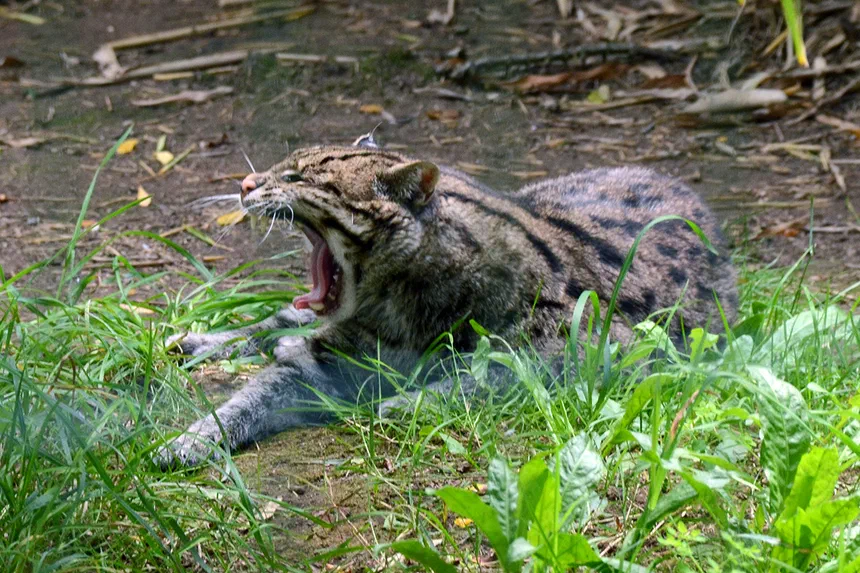
The fishing cat (Prionailurus viverrinus) is a medium-sized wild cat native to the wetlands of South and Southeast Asia. As its name suggests, it is one of the few felines that readily takes to water, hunting fish and other aquatic prey with remarkable skill. Roughly twice the size of a domestic cat, it is a stocky, powerfully built predator adapted to life along rivers, marshes, and mangrove swamps.
Appearance and Identification
The fishing cat has a robust, muscular body with relatively short legs and a deep chest. Its coarse coat is grayish to olive-brown, marked with rows of dark solid spots that often blend into stripes running along the back and neck. The face is broad, with a short muzzle and small, rounded ears set low on a flattened head. A short, thick tail, ringed with dark bands and measuring only about a third of the body length, aids in steering while swimming. The paws are partially webbed, and the claws do not fully retract, both useful traits for gripping slippery prey.
Habitat and Range
Fishing cats are closely tied to wetland environments. They inhabit freshwater marshes, reed beds, oxbow lakes, mangrove forests, and the vegetated banks of rivers and streams. Their range extends across parts of India, Nepal, Bangladesh, Sri Lanka, and Southeast Asia, including Thailand and the island of Java in Indonesia, though populations are increasingly fragmented. Because they depend so heavily on healthy wetlands, they are considered an indicator species for the condition of these ecosystems.
Diet
True to their name, fishing cats are specialist carnivores whose diet centers on fish. They also take frogs, crustaceans, snails, water snakes, rodents, and birds, and will occasionally scavenge or prey on small mammals. A fishing cat often waits at the water’s edge, tapping the surface to mimic insect movement and lure fish closer before scooping them out with a paw or diving in headfirst. This ability to hunt underwater sets it apart from most other cats.
Behavior
Fishing cats are largely solitary and most active at night, spending the daytime resting in dense vegetation. They are strong, confident swimmers and can cover considerable distances in water, sometimes diving to catch prey or to escape danger. Individuals maintain home ranges that they mark with scent, and males typically occupy larger territories that overlap with those of several females. Though generally quiet, they communicate through a range of calls, including a distinctive raspy “chuckle.”
Life Cycle and Reproduction
After a gestation period of roughly 60 to 70 days, a female fishing cat gives birth to a litter of usually one to four kittens, often in a sheltered den among reeds or thick brush. The kittens are born blind and helpless, opening their eyes after about two weeks. They begin taking solid food at around one to two months and are weaned by four to six months, though they may remain with their mother until they approach adulthood at eight to ten months. In the wild, fishing cats typically live around 10 to 12 years.
Conservation Status
The fishing cat is listed as Vulnerable on the IUCN Red List. Its greatest threat is the loss and degradation of wetlands, which are drained for agriculture, aquaculture, and settlement across much of its range. The animals also suffer from poaching, retaliatory killing over raided fish farms, and depletion of the fish stocks they rely on. Conservation efforts focus on protecting and restoring wetland habitats, reducing conflict with local communities, and monitoring the scattered populations that remain.
Frequently Asked Questions
Do fishing cats really catch fish? Yes. Fishing cats are among the most aquatic of all wild cats and regularly hunt fish, frogs, and crustaceans, often scooping prey from the water with a paw or diving after it.
How big is a fishing cat compared to a house cat? A fishing cat is roughly twice the size of a typical domestic cat, weighing anywhere from about 5 to 16 kilograms, with a stockier, more muscular build.
Are fishing cats dangerous to people? No. They are shy, mostly nocturnal animals that avoid humans. Conflict usually arises only when they raid fish ponds, which can lead to retaliation from farmers.