Mammals Guide
Fin Whale
What Is a Fin Whale? The fin whale (Balaenoptera physalus) is a giant baleen whale and the second-largest animal on Earth, surpassed only by the blue whale. Sleek and fast-moving, it is sometimes called the “greyhound of …
At a glance
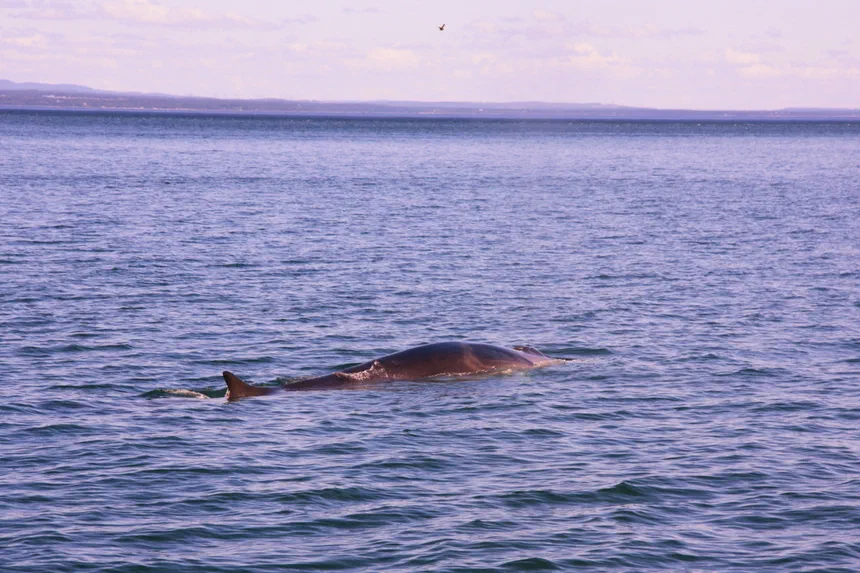
Image: glynniqua — CC BY-SA 2.0 · source
What Is a Fin Whale?
The fin whale (Balaenoptera physalus) is a giant baleen whale and the second-largest animal on Earth, surpassed only by the blue whale. Sleek and fast-moving, it is sometimes called the “greyhound of the sea” for its slender build and impressive swimming speed. Fin whales roam every major ocean, from tropical seas to the edges of the polar ice.
Appearance and Identification
Fin whales have a long, streamlined body that is dark brownish-gray on the back and sides and pale white underneath. Their most distinctive feature is an asymmetrical color pattern on the head: the lower right jaw is white, while the left jaw is dark. A small, curved dorsal fin sits far back on the body, and a prominent ridge runs along the back toward the tail, giving the species its older name, “razorback.” Fully grown adults typically measure between 18 and 26 meters (about 60 to 85 feet), with individuals in the Southern Hemisphere tending to be larger than those in the north.
Habitat and Range
Fin whales are found in oceans around the world, favoring deep, open waters well offshore rather than shallow coastal zones. They occur from subtropical to polar latitudes and are common in both the North Atlantic and North Pacific, as well as throughout the Southern Ocean. Many populations are migratory, moving toward higher, colder latitudes in summer to feed and returning to warmer waters in winter, though their movements are less predictable than those of some other great whales.
Diet
As filter feeders, fin whales eat enormous quantities of small prey. Their diet consists mainly of krill and other small crustaceans, along with schooling fish such as herring, capelin, and sand lance, and occasionally squid. A feeding fin whale lunges through a dense patch of prey with its mouth open, taking in a huge volume of water, then uses its baleen plates to strain out the food as the water is pushed back out. During peak feeding, an adult can consume well over a ton of food in a single day.
Behavior
Fin whales are among the fastest of the large whales, capable of sustained bursts of speed that once made them difficult targets for early whalers. They are often seen alone or in small groups, though larger aggregations may form where food is abundant. Fin whales produce very low-frequency calls, among the loudest and deepest sounds made by any animal, which likely travel across long stretches of ocean to communicate with distant individuals. They generally dive for several minutes at a time when feeding.
Life Cycle and Reproduction
Fin whales are slow to mature and reproduce, typically becoming sexually mature between about 6 and 10 years of age. After a gestation period of roughly 11 to 12 months, a female gives birth to a single calf, usually in warmer waters during winter. Newborn calves are already several meters long and nurse on rich milk for around six to seven months, growing quickly before weaning. Females generally give birth only once every two to three years. Fin whales are long-lived, with lifespans commonly reaching 80 to 90 years.
Conservation Status
Fin whales were heavily hunted during the twentieth century, and commercial whaling drastically reduced their global numbers. Since international protections were put in place, many populations have shown signs of recovery, and the species is currently listed as Vulnerable by the IUCN. Ongoing threats include ship strikes, entanglement in fishing gear, underwater noise, and the effects of climate change on their prey. Continued monitoring and protection remain important for the species’ long-term survival.
Frequently Asked Questions
How big is a fin whale compared to a blue whale? The fin whale is the second-largest animal alive, slightly smaller and more slender than the blue whale but still reaching lengths of up to about 26 meters.
Why is a fin whale’s jaw two different colors? Fin whales have a striking asymmetry, with a white lower right jaw and a dark left jaw. Researchers think this may play a role in how the whale herds or startles prey while feeding.
Are fin whales endangered? Fin whales are currently classified as Vulnerable. They were severely depleted by commercial whaling, but several populations have been slowly recovering under international protection.