Mammals Guide
Field Vole
What Is a Field Vole? The field vole (Microtus agrestis), also called the short-tailed vole, is a small, stout rodent widespread across the grasslands of Europe and northern Asia. It belongs to the vole and lemming …
At a glance
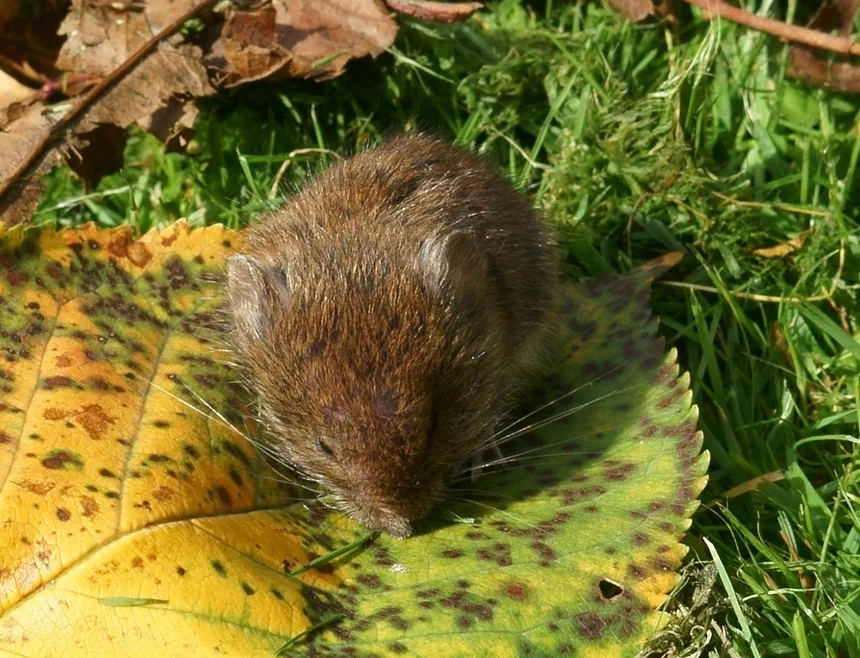
Image: Jürgen Howaldt — CC BY-SA 4.0 · source
What Is a Field Vole?
The field vole (Microtus agrestis), also called the short-tailed vole, is a small, stout rodent widespread across the grasslands of Europe and northern Asia. It belongs to the vole and lemming subfamily and is one of the most abundant mammals throughout much of its range.
Appearance and Identification
The field vole has a compact, rounded body with a blunt snout, small dark eyes, and short ears that are largely hidden in its fur. Its coat is a grizzled grayish-brown above, fading to a paler gray on the belly. The head-and-body length is roughly 3.5 to 5.1 inches (9 to 13 cm), and the tail is notably short, usually under a third of the body length. Adults typically weigh between about 0.7 and 1.6 ounces (20 to 45 g). Field voles are easily confused with the closely related bank vole, but they have a shorter tail, smaller ears, and a duller, grayer coat. Their small, robust build and continuously growing, ridged cheek teeth are adaptations for a life spent grinding tough plant material.
Habitat and Range
Field voles occupy a broad band across Europe and northern Asia, from Britain and western Europe eastward through Russia to Siberia. They favor damp, rough grassland with dense ground cover, including ungrazed meadows, moorland, marsh edges, young forestry plantations, road verges, and woodland clearings. The key requirement is thick, tussocky vegetation that provides both food and concealment. Within this cover they create a network of surface runways and shallow burrows, along with nests of woven grass tucked beneath the vegetation or just below ground.
Diet
Field voles are herbivores that feed chiefly on grasses and sedges, clipping stems and leaves with their sharp incisors. Their diet shifts with the seasons: green leaves and shoots dominate in the warmer months, while in winter they turn to roots, rhizomes, moss, and the bark of shrubs and young trees. This winter bark-stripping can damage saplings in plantations and orchards, making the species an occasional forestry pest. Because their food is fibrous and low in nutrients, field voles must eat frequently, consuming a large share of their body weight in vegetation each day.
Behavior
Field voles are active year-round and do not hibernate. They are busy in short bursts throughout the day and night, alternating feeding with rest, though they tend to keep to their covered runways to avoid the many predators that hunt them. Females are territorial during the breeding season and defend patches of grassland, marking boundaries with scent. The species can be surprisingly vocal, producing chattering and squeaking calls, and individuals may drum or grind their teeth in aggressive encounters. Their populations are famous for dramatic cycles, rising and crashing over roughly three-to-five-year periods, which in turn drives the fortunes of the predators that depend on them.
Life Cycle and Reproduction
Field voles are prolific breeders, which offsets their extremely high mortality. The breeding season runs mainly from spring into autumn, though it can extend through mild winters when food is plentiful. After a gestation of about three weeks, a female gives birth to a litter of roughly four to six blind, hairless young in a grass nest. The pups develop quickly, are weaned in around two weeks, and can themselves breed within a month or two of birth. A single female may produce several litters in a season. This rapid turnover means most field voles live only a matter of months, and few survive a full year in the wild.
Conservation Status
The field vole is listed as Least Concern by the IUCN. It is one of the most numerous mammals across its range and its populations, while naturally cyclical, are not in overall decline. As a foundational prey species, the field vole is ecologically vital: owls, kestrels, weasels, stoats, foxes, and many other predators rely heavily on it, so its abundance ripples through entire ecosystems. Maintaining rough, unmanaged grassland benefits both the voles and the wildlife that hunts them.
Frequently Asked Questions
How is a field vole different from a mouse? Voles have blunter faces, shorter tails, smaller ears, and stockier bodies than mice, and they feed mostly on grasses rather than seeds and scraps.
Why do field vole numbers rise and fall so sharply? Field vole populations follow multi-year boom-and-bust cycles driven by food supply, breeding rates, and predator pressure, a pattern that strongly influences owls and other predators.
Are field voles harmful to people? They pose no direct threat, but heavy winter bark-stripping can damage young trees, so they are sometimes regarded as a minor forestry or orchard pest.