Mammals Guide
Fennec Fox
What Is a Fennec Fox? The fennec fox (Vulpes zerda) is the smallest of the world’s foxes and one of the most recognizable desert mammals, famous for its enormous ears set on a tiny, cream-colored body. Native to the …
At a glance
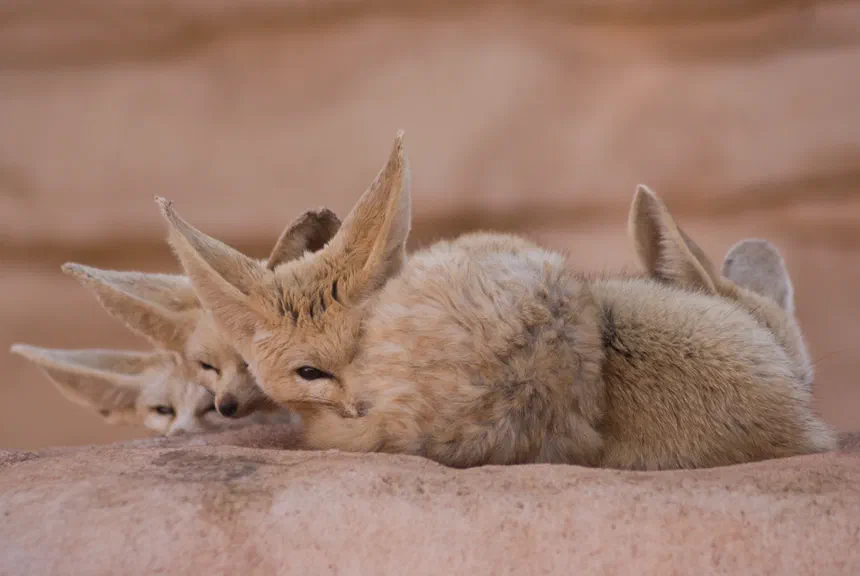
Image: Anass ERRIHANI — CC BY-SA 4.0 · source
What Is a Fennec Fox?
The fennec fox (Vulpes zerda) is the smallest of the world’s foxes and one of the most recognizable desert mammals, famous for its enormous ears set on a tiny, cream-colored body. Native to the sandy deserts of North Africa, it is superbly adapted to life in one of the planet’s harshest environments.
Appearance and Identification
The fennec is a diminutive canid, with a head-and-body length of roughly 24 to 40 centimeters and a bushy, black-tipped tail nearly as long as the body again. Adults typically weigh less than 1.5 kilograms, making them lighter than most house cats. Their most striking feature is a pair of oversized ears, which can reach 10 to 15 centimeters in length. The soft, dense coat ranges from pale cream to sandy fawn, blending almost perfectly with desert dunes, while thick fur on the soles of the feet cushions the paws against scorching sand. Large, dark eyes and a slender muzzle complete the look of an animal built for both concealment and keen sensory awareness.
Habitat and Range
Fennec foxes inhabit arid and semi-arid regions across North Africa, from Morocco and the western Sahara eastward toward the Sinai Peninsula and the fringes of the Arabian deserts. They favor stable sand dunes and sparse scrub, where they can dig extensive burrows. These dens provide shelter from daytime heat and nighttime cold, and a single fox may maintain several tunnel systems, some with multiple entrances, within its home range.
Diet
As an opportunistic omnivore, the fennec fox eats a wide variety of foods depending on availability. Insects, small rodents, lizards, birds, and eggs form much of its animal prey, while roots, fruit, and other plant matter supplement the diet. Much of the moisture the fox needs comes directly from its food, an important adaptation in a landscape where free-standing water is scarce. Its large ears help it detect the faint sounds of prey moving beneath the sand, and it will dig rapidly to capture burrowing insects and small animals.
Behavior
Fennec foxes are chiefly nocturnal, sheltering in cool burrows during the searing daylight hours and emerging at dusk to forage. The enormous ears do more than aid hunting; the rich network of blood vessels within them helps radiate excess body heat, a form of natural temperature control. Fennecs are notably social for a small fox and are often found living in family groups. They communicate through a range of chirps, barks, whimpers, and squeaks, and they are agile, capable diggers, able to excavate burrows with remarkable speed.
Life Cycle and Reproduction
Fennec foxes generally form long-term pair bonds, and the breeding pair raises young together. After a gestation of roughly seven to eight weeks, the female gives birth to a litter of usually two to five pups within the safety of the den. The pups are born blind and helpless, opening their eyes after about two weeks. The male provides food and guards the burrow while the mother nurses the young, which are weaned over the following weeks and reach independence within their first year. In the wild, fennec foxes may live around ten years.
Conservation Status
The fennec fox is currently listed as Least Concern by the IUCN, reflecting a wide range and no evidence of major population decline. It is nonetheless hunted in some areas and collected for the exotic pet trade, and it can be affected by human expansion into desert margins. Because it lives across remote and lightly monitored terrain, precise population figures are difficult to establish, but the species is not presently considered threatened.
Frequently Asked Questions
Why does the fennec fox have such big ears? The oversized ears sharpen the fox’s hearing so it can locate prey underground, and they also help shed body heat, keeping the animal cool in the desert.
Is the fennec fox the smallest fox? Yes. At under 1.5 kilograms, the fennec is the smallest wild canid in the world.
How does it survive without much water? The fennec obtains most of its moisture from its food and conserves water through efficient kidneys and a burrowing, nocturnal lifestyle that limits exposure to the heat.