Mammals Guide
Fallow Deer
What Is a Fallow Deer? The fallow deer (Dama dama) is a medium-sized deer best known for its spotted summer coat and the broad, hand-like antlers carried by mature males. Native to the Mediterranean region and Asia …
At a glance
What Is a Fallow Deer?
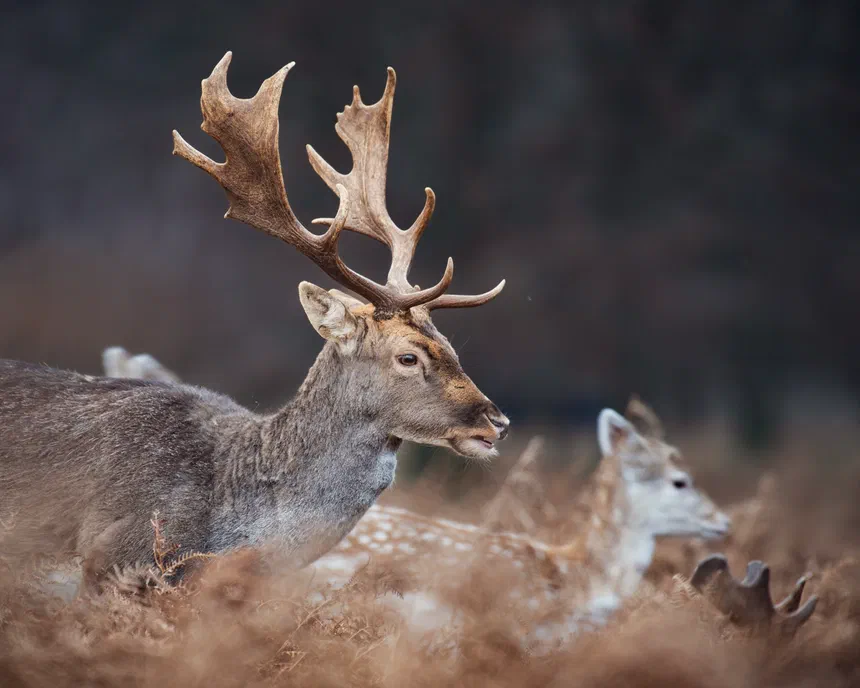
The fallow deer (Dama dama) is a medium-sized deer best known for its spotted summer coat and the broad, hand-like antlers carried by mature males. Native to the Mediterranean region and Asia Minor, it has been moved by people across the globe for thousands of years and now lives wild on nearly every continent.
Appearance and Identification
Fallow deer are instantly recognizable in their classic form: a reddish-brown to tan coat scattered with white spots in summer, a paler underside, and a black-bordered white rump patch framing a long, black-striped tail. The coat darkens and the spots fade in winter. The species is unusually variable, and several color morphs are common, including a pale “menil” form with soft spots, a nearly white morph, and a dark, almost black morph. Mature bucks grow palmate (flattened, shovel-like) antlers, a trait that separates them from most other deer, whose antlers are simply branched. Males are noticeably larger than females and develop a prominent Adam’s apple and a swollen neck during the breeding season.
Habitat and Range
Historically native to the eastern Mediterranean and Asia Minor, fallow deer favor a mix of mature deciduous or mixed woodland for shelter and open grassland for grazing. Forest edges, clearings, and parkland suit them especially well. Because they adapt readily to managed landscapes, they have long been kept in deer parks and hunting estates, and escaped or released animals have established free-living populations across much of Europe, as well as in North and South America, Africa, Australia, and New Zealand. In many of these regions they are considered introduced or even invasive.
Diet
Fallow deer are herbivores with a flexible, mixed-feeding strategy. Grasses and low herbaceous plants make up much of their diet, but they also browse leaves, shoots, and young twigs, and they take advantage of seasonal foods such as acorns, chestnuts, berries, and other mast in autumn. As ruminants, they chew cud and rely on a multi-chambered stomach to break down fibrous plant material. Feeding is concentrated around dawn and dusk, with animals resting and ruminating in cover through the middle of the day.
Behavior
Fallow deer are social and typically live in groups that vary in size with the season and habitat. For much of the year the sexes remain apart, with does and their young forming one set of herds and bucks another. They are alert and quick to flee, and when alarmed they may perform a stiff-legged bounce known as “pronking” or “stotting.” The species is best known for its dramatic autumn rut, when mature bucks establish and defend territories or traditional display grounds called leks. Rutting males give a deep, groaning belch that carries across the landscape, and rivals size one another up before clashing antlers to win access to females.
Life Cycle and Reproduction
The rut generally falls in autumn, and after a gestation of roughly 33 to 35 weeks does give birth in early summer, usually to a single spotted fawn. Newborns lie hidden in vegetation for the first days of life while the mother feeds nearby, returning to nurse. Fawns grow quickly and are weaned over the following months. Females may breed in their second year, while young bucks usually must wait several years until they are large enough to compete for mates. Antlers are shed and regrown annually, becoming larger and more fully palmate as a buck matures. In the wild, fallow deer commonly live around 8 to 16 years, with some individuals reaching greater ages in protected settings.
Conservation Status
The fallow deer is listed as Least Concern by the IUCN. Its introduced populations are widespread, abundant, and often actively managed, so the species as a whole faces no global threat. The picture is more nuanced within its native range, where truly wild ancestral populations are far more restricted and a related species, the Persian fallow deer (Dama mesopotamica), is endangered. In many introduced areas, high densities of fallow deer can damage crops, forestry, and native vegetation, making population control a common management concern.
Frequently Asked Questions
Are fallow deer native to Britain? No. They were introduced to Britain in historical times, most likely by the Normans (with possible earlier Roman introductions), and became a favored park and hunting animal.
Why do fallow bucks have such unusual antlers? Mature males grow palmate antlers with a broad, flattened blade, unlike the simple branched antlers of most deer. These are used in visual display and in pushing contests during the rut.
Are all fallow deer spotted? No. The spotted tan coat is the classic form, but white, pale menil, and dark morphs are common, and spots fade in the winter coat.