Mammals Guide
European Mink
What Is a European Mink? The European mink (Mustela lutreola) is a small, semiaquatic carnivore belonging to the weasel family, Mustelidae. Once widespread across the continent, it is now one of Europe’s most endangered …
At a glance
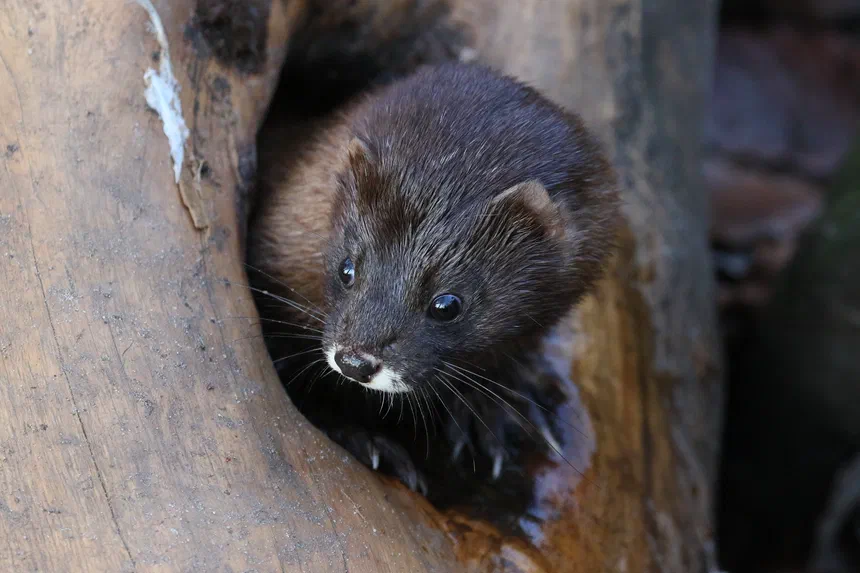
What Is a European Mink?
The European mink (Mustela lutreola) is a small, semiaquatic carnivore belonging to the weasel family, Mustelidae. Once widespread across the continent, it is now one of Europe’s most endangered mammals, surviving in scattered populations. It makes its living along waterways, hunting both in the water and on land.
Appearance and Identification
The European mink has the long, low-slung, cylindrical body typical of weasels and their relatives, set on short legs with partially webbed feet that aid swimming. Its dense, glossy fur is a uniform dark brown, thick enough to trap air and keep the animal warm and buoyant in cold water. The most reliable field mark is a patch of white fur covering both the upper and lower lips and often the chin. This feature helps distinguish it from the closely resembling American mink, which usually has a white patch only on the lower lip. Adults typically measure around 28 to 43 centimeters in head-and-body length, with a bushy tail adding a further 12 to 19 centimeters. Males are noticeably larger than females, and most individuals weigh between about 0.4 and 0.8 kilograms.
Habitat and Range
European mink are closely tied to fresh water. They favor the densely vegetated banks of slow-moving rivers, streams, lakes, and marshes, where overhanging cover and abundant prey are available. Historically the species ranged across much of Europe, from Spain to the Ural Mountains. Today its distribution is severely fragmented: the largest remaining populations are found in parts of Eastern Europe, including Russia, Ukraine, and the Danube Delta region of Romania, with small, isolated populations persisting in northern Spain and southwestern France. This patchy range reflects a dramatic contraction from the animal’s former abundance.
Diet
As a carnivore, the European mink takes a varied menu of small prey drawn from both aquatic and terrestrial habitats. Frogs, fish, crayfish, aquatic insects, and small mammals such as water voles form the core of its diet, supplemented by birds, mollusks, and the occasional egg. A skilled swimmer and diver, it hunts along the water’s edge and beneath the surface, using its agility to pursue prey in tight spaces. Its opportunistic feeding habits allow it to adjust to seasonal changes in what is available.
Behavior
The European mink is a solitary and largely nocturnal animal, most active during the night and at dusk. Each individual maintains a home range along a stretch of waterway, marking territory with scent from specialized glands. It is a strong swimmer that readily enters cold water to hunt, though it also forages on land. Dens are usually established in burrows, among tree roots, or in dense bankside vegetation. Outside the breeding season, adults generally avoid one another.
Life Cycle and Reproduction
Breeding typically takes place in spring, with mating occurring from around February to March. After a gestation of roughly five to ten weeks, the female gives birth to a litter usually numbering two to seven kits in a sheltered den. The young are born blind, hairless, and entirely dependent on their mother. They develop over the following weeks, opening their eyes and beginning to explore before being weaned at around two to two and a half months. Juveniles disperse to establish their own ranges in late summer or autumn and reach sexual maturity in their first year. In the wild, European mink generally live around six to ten years.
Conservation Status
The European mink is classified as Critically Endangered on the IUCN Red List, and its population has collapsed across most of its historic range. Several pressures have driven this decline, including habitat loss and degradation of wetlands, water pollution, and historical trapping for fur. A particularly serious threat is competition with the larger, introduced American mink, which outcompetes and displaces the native species and can also transmit disease. Road mortality and small, isolated population sizes add further risk. Captive breeding programs, reintroduction efforts, and control of invasive American mink are among the measures being used to try to secure the species’ future.
Frequently Asked Questions
How is the European mink different from the American mink? The two look similar, but the European mink usually has a white patch on both the upper and lower lips, while the American mink typically has white only on the lower lip. The American mink is also generally larger and now widespread across Europe as an invasive species.
Why is the European mink so endangered? Its decline stems from a combination of wetland habitat loss, pollution, past fur trapping, and especially competition and disease pressure from the introduced American mink. Remaining populations are small and fragmented, which leaves them highly vulnerable.
Is the European mink related to the otter? Both belong to the weasel family, Mustelidae, and share a semiaquatic lifestyle, but they are distinct animals. The European mink is much smaller than the Eurasian otter and is more closely related to weasels and polecats.