Mammals Guide
European Hedgehog
What Is a European Hedgehog? The European hedgehog (Erinaceus europaeus) is a small, spiny mammal native to much of western and northern Europe. Instantly recognizable by the coat of stiff spines covering its back, it is …
At a glance
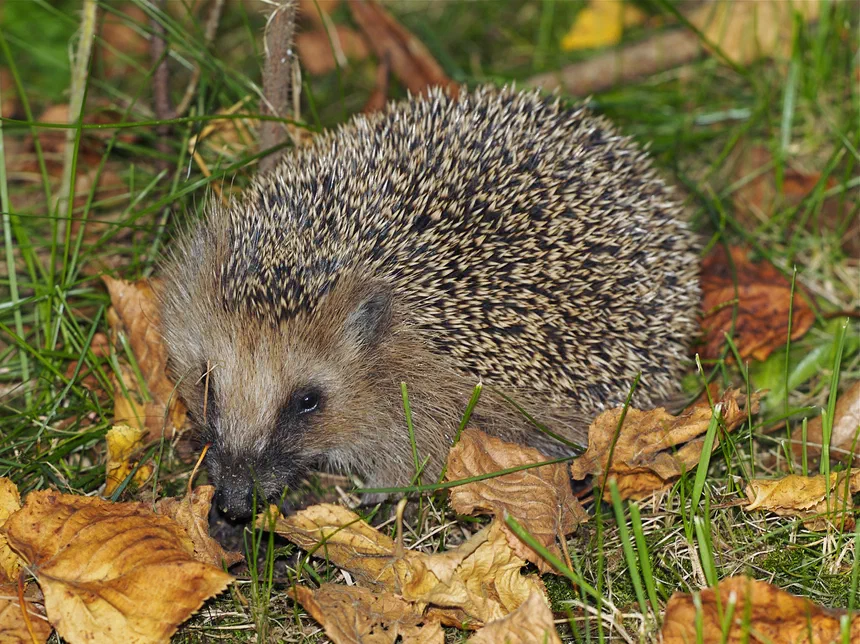
Image: Jörg Hempel — CC BY-SA 2.0 de · source
What Is a European Hedgehog?
The European hedgehog (Erinaceus europaeus) is a small, spiny mammal native to much of western and northern Europe. Instantly recognizable by the coat of stiff spines covering its back, it is a familiar and much-loved visitor to gardens across its range. As a nocturnal insect-eater, it plays a useful role in controlling populations of invertebrate garden pests.
Appearance and Identification
The most distinctive feature of the European hedgehog is its dense covering of spines, which are modified hairs made of keratin. An adult carries several thousand of these banded, brown-and-cream spines across its back and flanks. The face, legs, and underside are covered instead in coarse grayish-brown fur. Hedgehogs have a pointed, mobile snout, small dark eyes, and rounded ears often hidden by spines. Adults typically measure roughly 20 to 30 centimeters in body length and weigh anywhere from about 600 to over 1,200 grams, with weight fluctuating greatly through the year as they build fat reserves for hibernation. When threatened, a hedgehog can contract powerful muscles to roll into a tight ball, presenting an attacker with nothing but a barrier of spines.
Habitat and Range
This species is found across much of western, central, and northern Europe, from the British Isles and Iberia through Scandinavia and into parts of Russia. It has also been introduced to some regions outside its native range, including New Zealand, where it can become a problematic non-native predator. European hedgehogs favor a mix of habitats offering both foraging opportunities and secure cover, such as woodland edges, hedgerows, grasslands, farmland margins, parks, and suburban gardens. They generally avoid dense coniferous forest, wetlands, and open moorland, preferring landscapes with abundant leaf litter, shrubs, and edges where they can shelter and hunt.
Diet
The European hedgehog is an omnivore with a strong preference for animal prey. Its diet is dominated by ground-dwelling invertebrates, including beetles, earthworms, caterpillars, earwigs, millipedes, and slugs. It will also take small vertebrates on occasion, along with carrion, and may sample fallen fruit or other plant material. Foraging is done largely by scent and hearing as the animal snuffles noisily through leaf litter and grass. An adult can cover a surprising distance in a single night’s search for food, sometimes ranging over a kilometer or more.
Behavior
Hedgehogs are mostly solitary and nocturnal, emerging at dusk to forage and returning to a nest of leaves and grass by day. Outside the breeding season they are not strongly territorial, and individuals may overlap in their home ranges. In cooler parts of their range they hibernate through winter, building a well-insulated nest called a hibernaculum and dramatically slowing their metabolism to survive months without food. Hibernation is not continuous, and animals may rouse and shift nests during mild spells. Their best-known defense is rolling into a spiny ball, effective against most predators, though badgers are able to overcome this protection.
Life Cycle and Reproduction
Breeding generally takes place from spring into late summer. After a gestation of roughly a month, the female gives birth to a litter of usually four to five young, called hoglets. Newborns are blind and are born with soft spines beneath the skin that emerge within hours of birth. The young are weaned at around four to six weeks and then disperse to live independently. In favorable years a female may raise a second litter, though late-born young often struggle to gain enough weight to survive their first hibernation. Many hedgehogs do not survive their first year, but those that do may live several years in the wild.
Conservation Status
The European hedgehog is currently assessed by the IUCN as Near Threatened, reflecting documented declines across parts of its range. Populations in several countries have fallen significantly in recent decades, driven by factors such as habitat loss and fragmentation, intensive agriculture, road traffic mortality, and the loss of insect prey. Conservation efforts often focus on connecting fragmented habitats, creating wildlife-friendly gardens, and reducing hazards such as pesticides and unsafe garden equipment.
Frequently Asked Questions
Do European hedgehogs really hibernate? Yes. In colder parts of their range they hibernate through winter in an insulated nest, lowering their body temperature and metabolism to survive until warmer weather returns.
Are hedgehogs helpful in gardens? Generally, yes. They feed on many invertebrates that gardeners consider pests, and a hedgehog-friendly garden with cover and safe passage between yards can support local populations.
Can a hedgehog’s spines hurt a predator? The spines are not venomous or barbed, but when the animal rolls into a ball they form a dense, sharp barrier that deters most predators.