Mammals Guide
European Hare
What Is a European Hare? The European hare (Lepus europaeus), also called the brown hare, is a large, fast-running mammal of open landscapes across Europe and western Asia. It belongs to the family Leporidae, which also …
At a glance
What Is a European Hare?
The European hare (Lepus europaeus), also called the brown hare, is a large, fast-running mammal of open landscapes across Europe and western Asia. It belongs to the family Leporidae, which also includes rabbits, but hares differ in being larger, longer-legged, and adapted to life above ground rather than in burrows.
Appearance and Identification
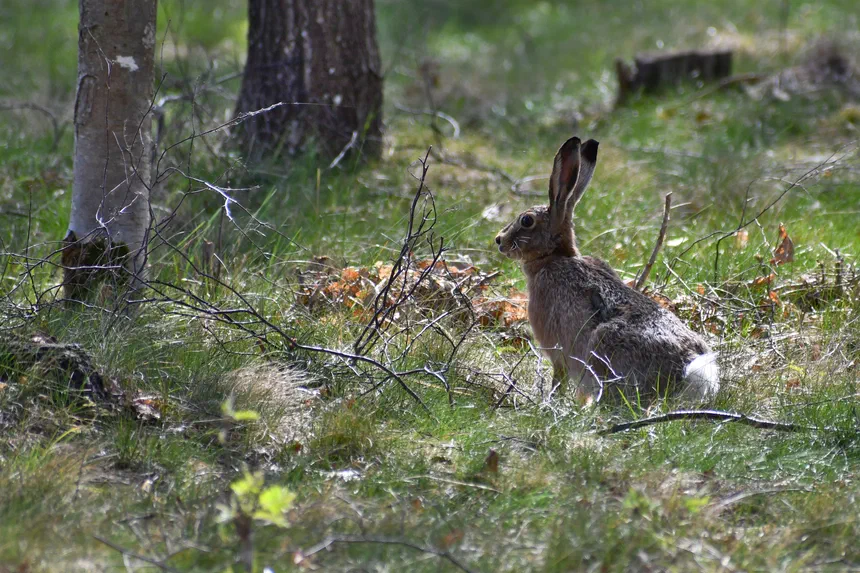
The European hare is a long-limbed animal with a sandy or yellowish-brown coat streaked with black, a paler underside, and a rufous tinge on the shoulders and legs. Its most distinctive features are its very long ears, each tipped with black, and its powerful hind legs built for sprinting. The tail is black on top and white beneath. Adults typically measure 50 to 70 centimeters in body length and weigh between 3 and 5 kilograms, with the ears alone reaching 9 to 11 centimeters. Large amber eyes set high on the sides of the head give the hare a wide field of vision to watch for predators.
Habitat and Range
This species favors open country, thriving in farmland, grassland, meadows, steppe, and the margins of woodland. It generally avoids dense forest and wetlands, preferring mixed agricultural landscapes that offer both feeding grounds and cover. Native to much of Europe and western Asia, the European hare has also been introduced to regions well outside its natural range, including parts of North and South America, Australia, and New Zealand, where it has established wild populations.
Diet
The European hare is a strict herbivore. Its diet centers on grasses and low-growing herbs, but it also eats crops such as cereals and root vegetables, along with buds, twigs, and bark during winter when green vegetation is scarce. Like other lagomorphs, it practices refection, re-ingesting soft pellets to extract additional nutrients from its high-fiber food. Feeding takes place mainly around dawn and dusk.
Behavior
Hares are largely solitary and most active at twilight and through the night, resting by day in a shallow scrape in the ground called a form. Rather than digging burrows, they rely on camouflage, remaining motionless until a threat comes close, then bursting into a rapid zigzagging run that can exceed 60 kilometers per hour. In the breeding season, hares gather in loose groups, and the well-known “boxing” behavior can be seen as females fend off males or test their vigor. Their acute hearing and vision, combined with explosive speed, are their main defenses.
Life Cycle and Reproduction
Breeding can extend through much of the year, peaking in spring and summer. After a gestation of roughly six weeks, the female gives birth to a litter of usually two to four young, called leverets. Unlike newborn rabbits, leverets are precocial: they are born fully furred, with open eyes, and are able to move soon after birth. The mother hides them apart in separate forms and visits briefly to nurse, reducing the chance that a predator finds the whole litter. Females may produce several litters in a single season. In the wild, European hares typically live three to four years, though many fall to predators or hunting long before that.
Conservation Status
The European hare is listed as Least Concern by the IUCN, reflecting its wide distribution and large overall population. Even so, numbers have declined markedly in parts of western and central Europe, a trend linked to intensive agriculture, loss of field margins and mixed cropping, pesticide use, and disease. In several countries the species is a focus of conservation and game-management efforts aimed at restoring farmland habitat.
Frequently Asked Questions
What is the difference between a hare and a rabbit? Hares are generally larger, with longer ears and legs, and their young are born furred and mobile. Rabbits are smaller, live in underground burrows, and bear blind, hairless young.
How fast can a European hare run? A startled European hare can sprint at speeds exceeding 60 kilometers per hour (about 40 miles per hour), using sharp turns to escape predators.
Why do hares appear to “box” in spring? Boxing is usually a female rejecting or testing a male during the breeding season, striking out with her forelegs rather than two males fighting.