Mammals Guide
European Bison
What Is a European Bison? The European bison (Bison bonasus) is the largest land mammal native to Europe and a close relative of the American bison. Also known as the wisent, it is a massive, forest-dwelling herbivore …
At a glance
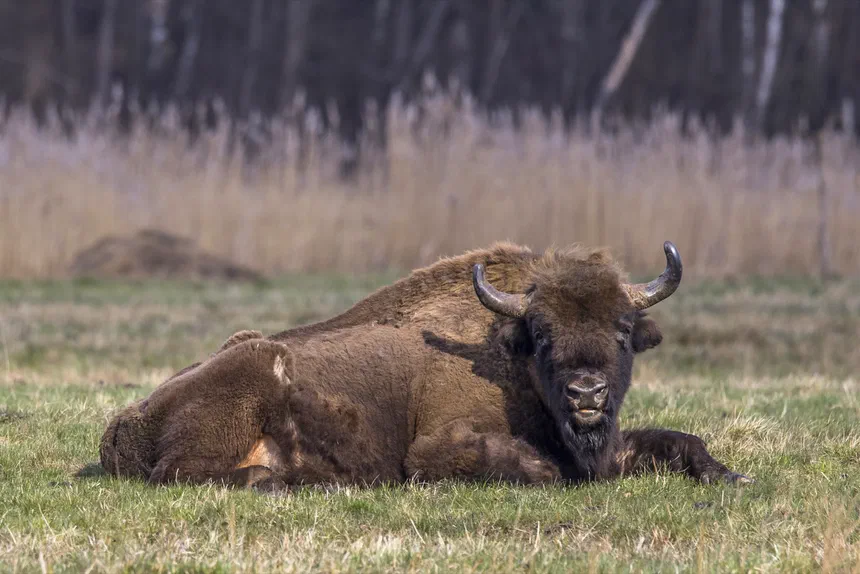
Image: Charles J. Sharp — CC BY-SA 4.0 · source
What Is a European Bison?
The European bison (Bison bonasus) is the largest land mammal native to Europe and a close relative of the American bison. Also known as the wisent, it is a massive, forest-dwelling herbivore that was driven to extinction in the wild in the early twentieth century and later restored through captive breeding.
Appearance and Identification
The European bison is a heavy, powerfully built animal with a large head, a pronounced shoulder hump, and comparatively slender hindquarters. Its coat is dark brown to grayish-brown, thicker and more shaggy around the neck, shoulders, and front legs, with a short beard beneath the chin. Both sexes carry short, curved horns. Bulls are noticeably larger than cows, and large males can approach or exceed 900 kg. Compared with the American bison, the wisent stands taller at the shoulder, holds its head higher, and has a slightly less exaggerated hump, giving it a more upright profile suited to browsing.
Habitat and Range
Historically the species ranged across much of lowland Europe, but today it is associated primarily with mixed and deciduous woodlands broken by clearings, meadows, and river valleys. These mosaic habitats provide both cover and the varied grazing and browsing the animals need. The most famous population lives in the Bialowieza Forest straddling the border of Poland and Belarus. Reintroduction and breeding programs have since established free-ranging and semi-wild herds in numerous countries across Eastern and Central Europe, including Poland, Belarus, Russia, Romania, Lithuania, and Germany.
Diet
European bison are strict herbivores with a broad plant diet. They graze on grasses and low herbaceous plants and also browse extensively on the leaves, twigs, shoots, and bark of trees and shrubs. Their diet shifts with the seasons, relying more heavily on woody browse and bark in winter when green forage is scarce. In managed reserves, supplementary hay is often provided during harsh winters. An adult can consume tens of kilograms of vegetation each day, and the animals spend much of their time feeding and ruminating.
Behavior
The species is social, forming loose herds usually made up of cows, calves, and young animals, while mature bulls tend to live alone or in small bachelor groups outside the breeding season. Herd sizes vary but commonly number a dozen or more, with membership fluid as animals join and leave. European bison are generally calm and shy toward humans but can be dangerous if provoked, and bulls become more assertive during the rut. Despite their bulk they move easily through forest and can run quickly and jump surprisingly well over obstacles.
Life Cycle and Reproduction
The breeding season, or rut, typically peaks in late summer and early autumn, when bulls compete for access to receptive cows through displays and occasional clashes. Gestation lasts roughly nine months, and cows usually give birth to a single calf, most often in spring or early summer. Calves are reddish-brown at birth, can stand and follow their mother within hours, and nurse for several months while beginning to sample vegetation. Females generally reach breeding age at around three to four years, and cows may produce a calf roughly every year or two under good conditions. Wild animals typically live around 15 to 20 years, with some individuals living longer in protected settings.
Conservation Status
The European bison is one of conservation’s landmark recovery stories. The wild population was lost by the 1920s, and the entire living species descends from a small number of surviving captive animals bred to rebuild the herds. Decades of coordinated breeding and reintroduction have raised numbers into the thousands, and the IUCN has downgraded its status from Vulnerable to Near Threatened. Ongoing threats include limited genetic diversity, habitat fragmentation, disease, and conflict with human land use, so the species remains dependent on active management and monitoring.
Frequently Asked Questions
Is the European bison the same as the wisent? Yes. “Wisent” is another common name for the same species, Bison bonasus.
How is it different from the American bison? The European bison is generally taller at the shoulder, carries its head higher, and browses more on trees and shrubs, whereas the American bison is a more grassland-oriented grazer.
Were European bison ever extinct in the wild? Yes. They disappeared from the wild in the early twentieth century and were reintroduced from captive stock, making today’s wild herds the product of a long recovery effort.
References
The conservation status and key facts in this profile are supported by these sources:
- Animal Diversity Web — Bison bonasus (European bison) (accessed 2026-07-28)
- GBIF — Bison bonasus (Linnaeus, 1758) (accessed 2026-07-28)
Found an error, source problem, or image concern? Report this page.