Mammals Guide
European Badger
What Is a European Badger? The European badger (Meles meles) is a stocky, burrowing carnivore in the weasel family, Mustelidae. It is best known for its bold black-and-white facial stripes and its habit of digging large …
At a glance
What Is a European Badger?
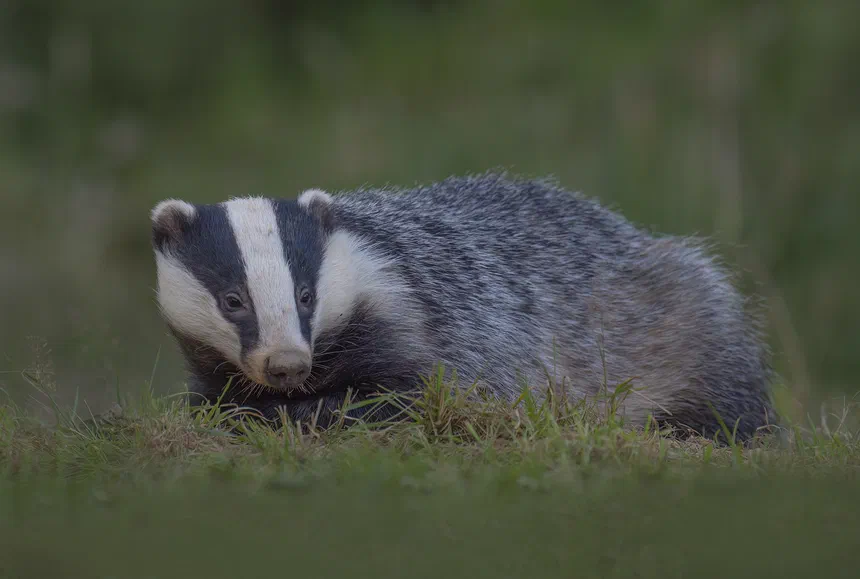
The European badger (Meles meles) is a stocky, burrowing carnivore in the weasel family, Mustelidae. It is best known for its bold black-and-white facial stripes and its habit of digging large underground homes called setts. Widespread across the continent, it is one of Europe’s most familiar nocturnal mammals.
Appearance and Identification
The European badger has a low, wedge-shaped body built for digging, with short but powerful legs and long claws on the front feet. Its coarse coat appears grizzled gray on the back and flanks, while the legs and underside are dark. The most distinctive feature is the head: a white face crossed by two broad black stripes that run from the muzzle back over each eye and ear. Adults generally measure roughly 25 to 35 inches (65 to 90 cm) in body length, with a short tail. Weight varies with the seasons, often ranging from about 20 to 35 pounds (9 to 16 kg), as badgers put on considerable fat before winter. Males, called boars, tend to be slightly larger than females, or sows.
Habitat and Range
Badgers occur across most of Europe and extend eastward into parts of western Asia. They favor deciduous woodland and its edges but readily use hedgerows, pastures, scrubland, and the margins of farmland, and they can persist near towns and suburbs. Good badger territory usually combines well-drained soil that is easy to excavate with nearby foraging grounds. Family groups live in setts, networks of tunnels and chambers that may be enlarged and reused across many generations, sometimes becoming quite extensive.
Diet
The European badger is an opportunistic omnivore, and in much of its range the earthworm is a dietary staple. Badgers also eat insects and their larvae, slugs, and other invertebrates, along with fruit, nuts, roots, bulbs, and cereals. When the chance arises, they take small mammals, amphibians, eggs, and carrion. Their broad diet shifts with the seasons and with local abundance, which helps them thrive in varied landscapes.
Behavior
Badgers are mainly nocturnal, emerging from the sett after dusk to forage and returning before dawn. They are notably social for a mustelid, often living in family groups that share and defend a common territory, which they mark with scent and with communal latrines dug along the boundaries. Grooming and other social contact help maintain group bonds. Though not true hibernators, badgers become far less active in cold weather and may stay underground for long stretches during harsh winter spells, living off stored fat.
Life Cycle and Reproduction
European badgers use delayed implantation, so although mating can occur over much of the year, the fertilized egg does not begin developing until later, and most cubs are born in late winter or early spring. A typical litter contains two or three cubs, born blind and helpless deep within the sett. They remain underground for their first weeks before venturing out to explore and forage with the group. Young badgers may stay in their natal group or disperse to establish territories elsewhere. In the wild many live around five to eight years, though some individuals reach older ages.
Conservation Status
The European badger is listed as Least Concern by the IUCN, reflecting a wide distribution and large, generally stable population. Regional threats still exist, including road traffic, which kills many badgers each year, along with habitat loss and, in some areas, illegal persecution. In parts of its range the species is also drawn into disputes over its possible role in transmitting bovine tuberculosis to cattle. Legal protection varies from country to country.
Frequently Asked Questions
Are European badgers dangerous to people? Badgers are shy and avoid humans, and encounters are rare because they are active mostly at night. Like any wild animal, one that is cornered or handled may defend itself, so it is best observed from a distance.
What is a badger’s home called? Badgers live in a sett, an underground system of tunnels and chambers that a family group may expand and reuse over many years.
Do European badgers hibernate? No. They do not truly hibernate, but they slow down in winter and can remain in the sett for extended periods during very cold weather.