Mammals Guide
Eurasian Otter
What Is a Eurasian Otter? The Eurasian otter (Lutra lutra) is a semi-aquatic member of the weasel family, built for a life split between land and water. It ranges more widely than any other otter, occurring across most …
At a glance
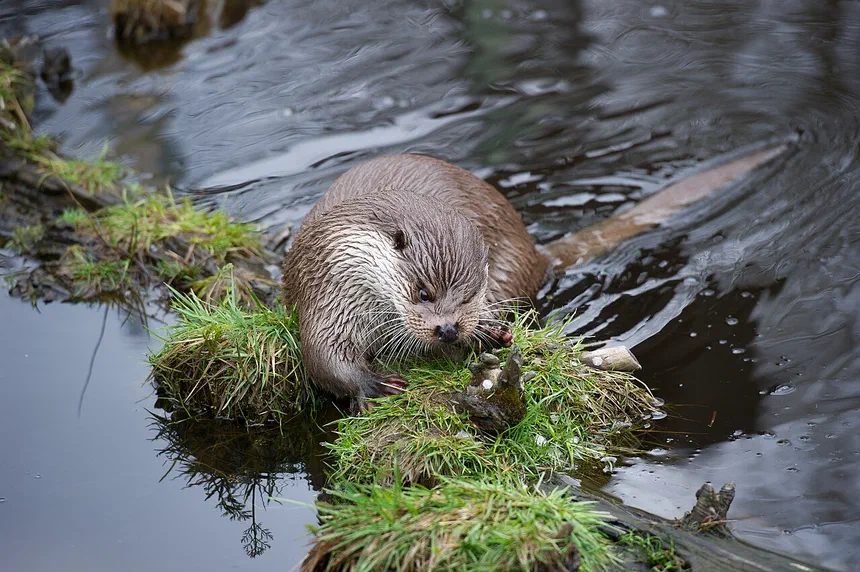
Image: Alexander Leisser — CC BY-SA 4.0 · source
What Is a Eurasian Otter?
The Eurasian otter (Lutra lutra) is a semi-aquatic member of the weasel family, built for a life split between land and water. It ranges more widely than any other otter, occurring across most of Europe and Asia and into North Africa. Sleek, streamlined, and secretive, it is a top predator of freshwater habitats and a well-known indicator of clean, healthy waterways.
Appearance and Identification
The Eurasian otter has a long, muscular body, a broad flattened head, and a thick tapering tail that acts as a rudder and propeller in the water. Its dense fur is brown on the back and sides and noticeably paler, often cream or grayish, on the throat, chest, and belly. This coat is made of two layers: a waterproof outer layer of guard hairs and a fine, insulating underfur that traps air and keeps the skin dry. The feet are webbed, the ears are small and round, and long, sensitive whiskers help detect prey in murky water. Adults typically measure around 60 to 90 centimeters in body length, with an additional tail of roughly 30 to 45 centimeters, and weigh somewhere between 5 and 12 kilograms. Males are generally larger and heavier than females.
Habitat and Range
Eurasian otters occupy an exceptionally broad range of freshwater and coastal environments, from clear upland streams and lowland rivers to lakes, marshes, and estuaries. Along some coastlines, notably in Scotland, they also forage in the sea, returning to fresh water to wash salt from their fur. Their distribution spans nearly all of Europe, extends across large parts of Asia to the Pacific, and reaches into North Africa. The key requirements are clean water with abundant prey and undisturbed bankside vegetation for resting and breeding sites.
Diet
The Eurasian otter is a carnivore that feeds chiefly on fish, which usually make up the largest share of its diet. It also takes amphibians such as frogs, along with crustaceans, aquatic insects, and occasionally water birds, small mammals, and mollusks. Diet shifts with season and location: frogs may become especially important in winter when fish are harder to catch. Otters hunt largely by sight and touch, using their whiskers to sense movement, and prey is often eaten at the water’s edge or on a favored bank.
Behavior
Eurasian otters are largely solitary and maintain territories that they mark with scent from droppings called spraints, deposited on rocks, logs, and other prominent spots. These markings advertise identity and status to other otters. Activity is mainly nocturnal or crepuscular in areas with human disturbance, though coastal otters may be active by day. Powerful swimmers and agile on land, they travel considerable distances along waterways and rest in burrows known as holts, often dug into banks among tree roots, or in dense vegetation. They are generally shy and quick to slip out of sight.
Life Cycle and Reproduction
Eurasian otters can breed at any time of year across much of their range. After a gestation of roughly two months, a female gives birth to a litter of usually one to three cubs in a secure holt. The cubs are born blind and helpless, opening their eyes after several weeks and remaining dependent on their mother for many months. She raises them alone, gradually teaching them to swim and hunt. Young otters typically stay with their mother for around a year before dispersing to establish their own territories. In the wild many otters live only about 4 to 10 years, with mortality highest among juveniles, though some individuals survive longer.
Conservation Status
The Eurasian otter is listed as Near Threatened on the IUCN Red List. During the twentieth century, populations across much of Europe declined sharply due to water pollution, particularly pesticides and other contaminants, along with habitat loss and hunting. Improvements in water quality, legal protection, and habitat restoration have allowed the species to recover in many regions, and it has recolonized rivers where it had disappeared. Ongoing threats include pollution, loss of wetland habitat, road traffic, and disturbance, so continued protection of clean waterways remains important for its future.
Frequently Asked Questions
How is the Eurasian otter different from the North American river otter? They are closely related but separate species living on different continents. The Eurasian otter ranges across Europe, Asia, and North Africa, while the North American river otter is found only in North America. They look broadly similar but differ in details of size, skull shape, and range.
Why are otters considered indicators of healthy rivers? Because otters sit near the top of the freshwater food chain and are sensitive to pollution, their presence usually signals clean water with plentiful prey. Their return to a river is often taken as a sign of improving environmental health.
Are Eurasian otters dangerous to people? No. They are shy, elusive animals that avoid humans and pose no real threat, tending to slip quietly away when disturbed.