Mammals Guide
Ethiopian Wolf
What Is a Ethiopian Wolf? The Ethiopian wolf (Canis simensis) is a slender, long-legged wild canid found only in the high mountains of Ethiopia. Often described as Africa’s most endangered carnivore and its rarest canid, …
At a glance
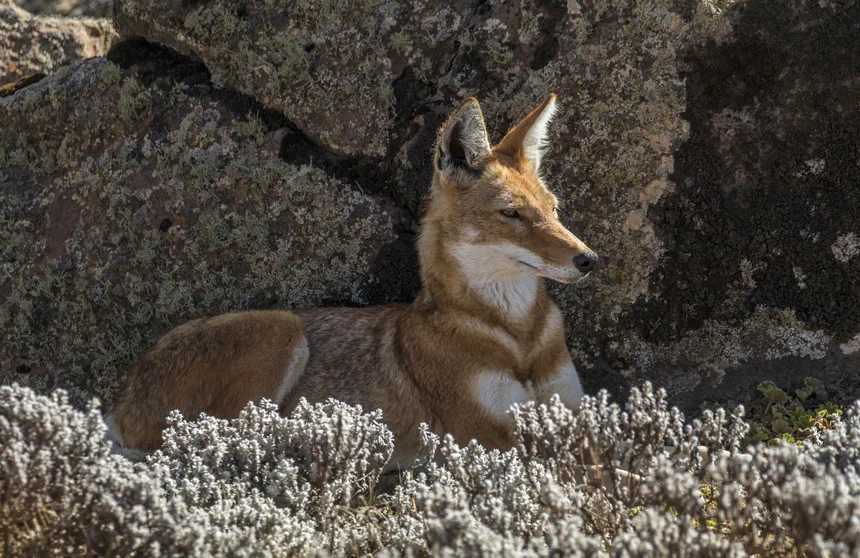
Image: Charles J. Sharp — CC BY-SA 4.0 · source
What Is a Ethiopian Wolf?
The Ethiopian wolf (Canis simensis) is a slender, long-legged wild canid found only in the high mountains of Ethiopia. Often described as Africa’s most endangered carnivore and its rarest canid, it is a specialized rodent hunter adapted to cold, treeless highlands. Despite its fox-like coloring, genetic studies place it firmly among the true wolves and jackals.
Appearance and Identification
This is a strikingly marked, medium-sized canid built for a life of running and pouncing. Adults carry a bright tawny to rust-red coat set off by crisp white markings on the throat, chest, belly, and inside of the legs, with a dark bushy tail tipped in black. The muzzle is narrow and elongated, the ears broad and pointed, and the legs notably long relative to the body. Males are somewhat larger than females, though the difference is modest. The overall silhouette is more reminiscent of a coyote or jackal than of the bulkier gray wolf.
Habitat and Range
The Ethiopian wolf lives exclusively in a handful of isolated Afroalpine enclaves scattered across the Ethiopian highlands, typically between about 3,000 and 4,500 meters in elevation. Preferred habitat includes open grassy meadows, tussock grasslands, and heath moorland where burrowing rodents are abundant. The Bale Mountains in the south hold the largest surviving population, with smaller groups persisting in the Simien Mountains and a few other massifs. Because these habitats sit like islands above the surrounding lowlands, the remaining populations are small and fragmented.
Diet
The species is a highly specialized carnivore that feeds overwhelmingly on small mammals. Diurnal highland rodents, especially the big-headed mole-rat and various grass rats, make up the bulk of its diet. A wolf typically hunts alone, stalking through the grass and then digging or pouncing to seize prey from burrows. This solitary foraging style contrasts with the pack-based cooperative hunting of larger wolves, and it reflects the small size of the prey they pursue.
Behavior
Ethiopian wolves are social animals that live in cohesive, territorial family packs, yet they hunt individually because their rodent prey is too small to share. Packs defend their territory together, patrol boundaries, and gather for social greetings and vocal displays at dawn and dusk. Members rest and travel as a group, and scent-marking helps advertise territory ownership. They are generally active during the day, tracking the activity peaks of their prey, and retreat to sheltered spots during the harsh nighttime cold.
Life Cycle and Reproduction
Within each pack, breeding is usually limited to a single dominant female, who mates with the dominant male or occasionally with males from neighboring territories. After a gestation of about two months, she gives birth to a litter of roughly two to six pups in an underground den. Other pack members act as helpers, guarding the den, playing with the young, and regurgitating food to supplement the mother’s care. Pups are weaned over several weeks and gradually shift to solid food as they mature, reaching adult size within their first year.
Conservation Status
The Ethiopian wolf is listed as Endangered, with a wild population thought to number only in the hundreds spread across a few small subpopulations. Its greatest threats include the loss and fragmentation of Afroalpine habitat to expanding agriculture and livestock grazing, and disease. Rabies and canine distemper transmitted by domestic dogs can sweep through packs and cause catastrophic die-offs. Conservation efforts focus on vaccinating both domestic dogs and wolves, protecting remaining highland habitat, and monitoring the isolated populations.
Frequently Asked Questions
Is the Ethiopian wolf a true wolf? Yes. Although its slender build and reddish coat give it a fox-like look, genetic evidence shows it is a close relative of the gray wolf and coyote rather than a fox or jackal.
Why is it endangered? Its tiny, fragmented range makes it vulnerable, and outbreaks of rabies and distemper from domestic dogs, combined with habitat loss, keep the total population dangerously low.
Where can it be seen in the wild? The Bale Mountains National Park in southern Ethiopia offers the best chance of seeing wild Ethiopian wolves, as it holds roughly half of the world’s remaining individuals.