Mammals Guide
Ermine
What Is a Ermine? The ermine (Mustela erminea), also called the stoat or short-tailed weasel, is a small, agile carnivore belonging to the weasel family (Mustelidae). Famous for its slender body and its dramatic seasonal …
At a glance
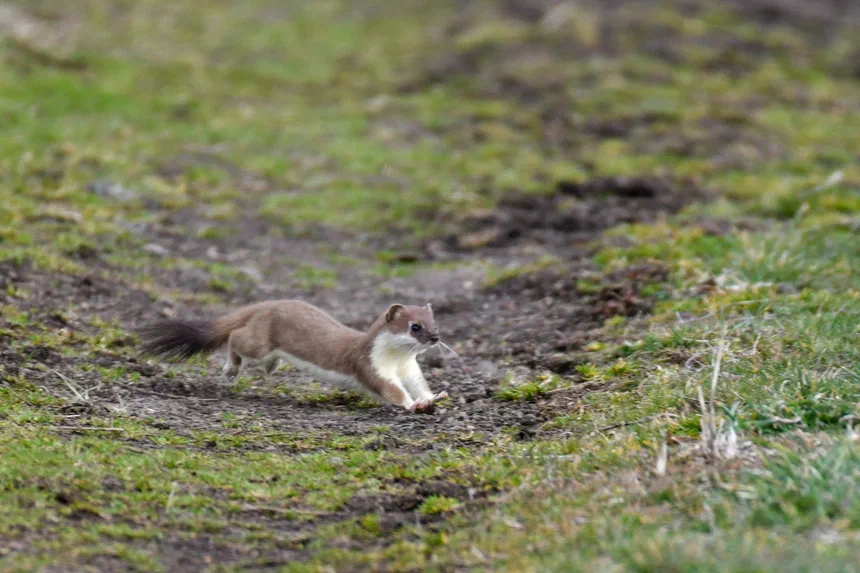
What Is a Ermine?
The ermine (Mustela erminea), also called the stoat or short-tailed weasel, is a small, agile carnivore belonging to the weasel family (Mustelidae). Famous for its slender body and its dramatic seasonal color change, this predator ranges across the cold and temperate regions of the Northern Hemisphere. Despite its small size, the ermine is a bold and highly effective hunter.
Appearance and Identification
The ermine has the classic weasel build: a long, tube-shaped body, short legs, a small triangular head, and a proportionally long neck. In summer its coat is chocolate to reddish brown on the back and sides with creamy white to yellowish underparts. In winter, populations in colder climates molt into a pure white coat, an adaptation that provides camouflage against snow. In all seasons the tail ends in a distinctive black tip, which is a reliable field mark separating the ermine from the smaller least weasel. Adults typically measure about 6.5 to 13 inches (17 to 33 cm) in body length, with an additional 1.5 to 5 inch (4 to 12 cm) tail. Males are noticeably larger than females, often nearly twice their weight.
Habitat and Range
Ermines occupy a broad range across northern North America, Europe, and much of Asia, and they have also been introduced to New Zealand. They are habitat generalists, thriving in woodlands, tundra, marshes, grasslands, hedgerows, and agricultural land. They favor areas with abundant cover and prey, often near water. Rather than digging their own burrows, ermines commonly take over the dens of the rodents they hunt, lining these shelters with grasses, leaves, and the fur of their prey.
Diet
The ermine is an obligate carnivore with a fast metabolism that demands frequent feeding. Small mammals form the core of its diet, especially voles, mice, lemmings, and young rabbits, and an ermine can kill prey considerably larger than itself. It also takes birds, eggs, insects, amphibians, and occasionally fish. Hunting largely by scent and sound, the ermine pursues prey into burrows and crevices that larger predators cannot reach, dispatching victims with a swift bite to the base of the skull. When food is plentiful, ermines may cache surplus kills to eat later.
Behavior
Ermines are mostly solitary and are active by day and night, though hunting peaks around dawn and dusk. They are territorial, marking their ranges with scent from anal glands, and males generally hold larger territories that may overlap those of several females. Quick, curious, and fearless, an ermine moves in a series of bounding leaps and can climb and swim well. When threatened or excited, it may perform a hopping, twisting “war dance,” a behavior that some observers believe can confuse or mesmerize prey. Their small size makes them vulnerable to birds of prey, foxes, and domestic cats.
Life Cycle and Reproduction
Ermines have an unusual reproductive strategy involving delayed implantation. Mating occurs in late spring or summer, but the fertilized eggs do not implant in the uterus until the following spring, so the total time from mating to birth can stretch to roughly 9 to 10 months even though active gestation is only about four weeks. Litters usually contain 4 to 9 young, called kits, born blind and helpless in a fur-lined den. Females raise the young alone. Kits grow rapidly, and remarkably, young females may be mated while still in the nest. Ermines reach independence within a couple of months and are short-lived, with most surviving only one to two years in the wild.
Conservation Status
The ermine is listed as Least Concern by the IUCN, reflecting its wide distribution and large, stable populations. It faces no major range-wide threats, although local numbers fluctuate with the abundance of prey such as voles and lemmings. Historically the species was trapped extensively for its white winter fur, which was prized in ceremonial and royal garments. Where ermines have been introduced, notably in New Zealand, they are considered a serious invasive pest that preys on native ground-nesting birds.
Frequently Asked Questions
Is an ermine the same animal as a stoat? Yes. “Ermine” and “stoat” refer to the same species, Mustela erminea. The name “ermine” is often used specifically for the animal in its white winter coat or for the fur itself.
Why does the ermine turn white in winter? In cold, snowy climates the ermine molts into a white coat that camouflages it against snow, helping it ambush prey and avoid predators. In milder regions where snow is scarce, some ermines stay brown year-round.
How can you tell an ermine from a least weasel? The ermine is larger and, most reliably, has a black tip on its tail in every season. The least weasel is smaller and lacks the prominent black tail tip.