Mammals Guide
Eland
What Is a Eland? The common eland (Taurotragus oryx) is the largest of Africa’s spiral-horned antelopes and one of the biggest antelope species on Earth. Despite its bulk, it is a surprisingly agile animal, capable of …
At a glance
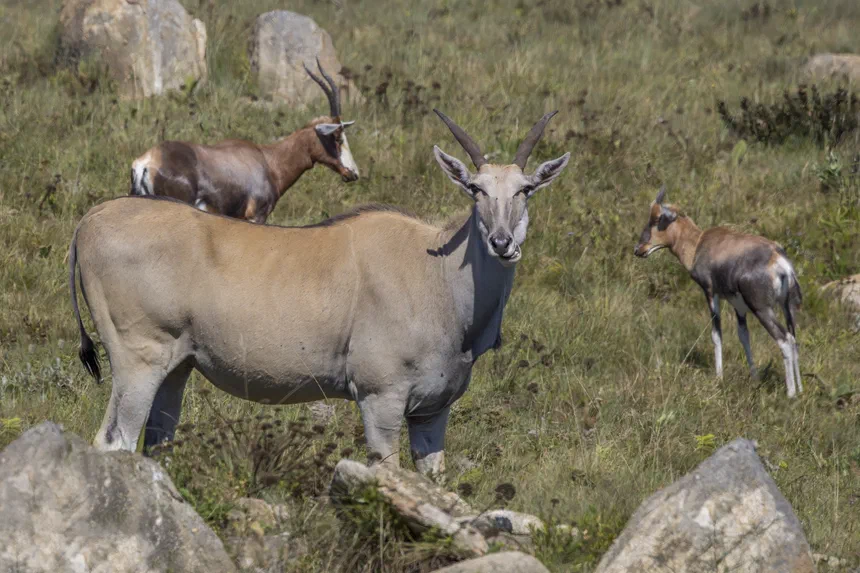
Image: Charles J. Sharp — CC BY-SA 4.0 · source
What Is a Eland?
The common eland (Taurotragus oryx) is the largest of Africa’s spiral-horned antelopes and one of the biggest antelope species on Earth. Despite its bulk, it is a surprisingly agile animal, capable of clearing tall fences from a standing start. It ranges across the open savannas and woodlands of eastern and southern Africa.
Appearance and Identification
The eland is a massive, ox-like antelope with a fawn to grayish-tan coat that often turns bluish-gray in older bulls. A series of faint, narrow white stripes typically marks the flanks, though these fade with age. Both sexes carry straight, tightly spiraled horns, which in bulls can reach roughly 0.6 to 1 m; females’ horns are usually longer and thinner. Mature males develop a prominent dewlap hanging from the throat, a shaggy tuft of dark hair on the forehead, and heavy, muscular shoulders. A distinctive feature is the loud clicking sound the animal produces as it walks, thought to come from the tendons or joints of its legs and audible from some distance.
Habitat and Range
Common elands occupy a broad band of eastern and southern Africa, from Ethiopia and South Sudan down through Kenya and Tanzania to Zambia, Zimbabwe, Botswana, and South Africa. They favor open and semi-open country, including grassy plains, savanna woodland, montane grassland, and semi-arid scrub, but generally avoid dense forest and true desert. Their tolerance for dry conditions allows them to survive in areas with little standing water, since they obtain much of their moisture from browse.
Diet
Elands are primarily browsers, feeding on the leaves, shoots, and young branches of shrubs and trees, along with herbs, flowers, seed pods, and fruits. They will also take fresh grass, especially after rains when new growth is abundant. Using their horns, they sometimes break off higher branches to reach foliage. Their ability to extract water from plant material and to concentrate their urine helps them go long periods without drinking, an adaptation well suited to arid habitats.
Behavior
Elands are social and generally non-territorial. They gather in loose, shifting herds that can number from a handful of animals to several hundred, particularly where food is plentiful. Group membership is fluid, with individuals joining and leaving frequently. Despite their size, elands are wary and will flee from danger, trotting steadily or breaking into a gallop; they are also strong jumpers. A dominance hierarchy exists among bulls, established through displays and occasional horn-clashing rather than prolonged fights. They tend to be most active in the cooler parts of the day, resting and ruminating during the midday heat.
Life Cycle and Reproduction
Breeding can occur year-round but often peaks with the rains, when nutrition is best. After a gestation of roughly nine months, a female gives birth to a single calf, retreating from the herd to a secluded spot to do so. Newborn calves lie hidden for the first weeks of life before joining nursery groups, where several calves may gather under the loose supervision of adults. Calves are weaned at around three to six months. Females typically reach sexual maturity within two to three years, and males a little later. In the wild, elands generally live about 15 to 20 years, sometimes longer in protected conditions.
Conservation Status
The common eland is listed as Least Concern by the IUCN, reflecting a wide distribution and reasonably large overall population. Numbers have nonetheless declined in parts of the range because of habitat loss, expanding agriculture, and hunting for meat and hides. The species persists strongly in many protected areas and on private game ranches, and it has been domesticated experimentally in some regions for milk and meat, thanks to its docile temperament and hardiness.
Frequently Asked Questions
How big is an eland? Adult elands stand roughly 1.3 to 1.8 m at the shoulder and can weigh anywhere from about 300 kg in smaller females to more than 900 kg in large bulls, making them among the heaviest antelopes alive.
Why do elands make a clicking sound? Walking elands produce a sharp clicking noise believed to originate in the tendons or joints of their forelegs. Larger, heavier animals tend to click more loudly, and the sound may signal an individual’s size and status to others.
Can elands really jump? Yes. Despite weighing several hundred kilograms, elands are remarkable jumpers and can clear obstacles of two meters or more from a standstill, which helps them escape predators and cross fences.