Mammals Guide
Egyptian Fruit Bat
What Is a Egyptian Fruit Bat? The Egyptian fruit bat (Rousettus aegyptiacus) is a medium-sized megabat, or “flying fox” relative, found across Africa and parts of the Middle East. Unlike most fruit bats, it roosts deep …
At a glance
What Is a Egyptian Fruit Bat?
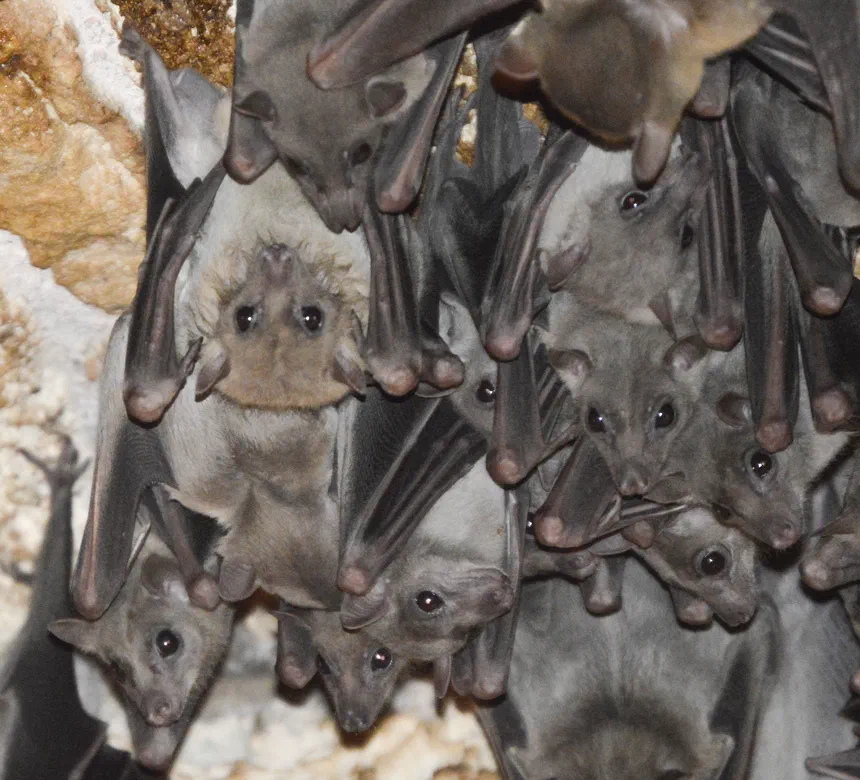
The Egyptian fruit bat (Rousettus aegyptiacus) is a medium-sized megabat, or “flying fox” relative, found across Africa and parts of the Middle East. Unlike most fruit bats, it roosts deep inside caves and uses a simple form of echolocation to navigate in total darkness, making it one of the few Old World fruit bats able to do so.
Appearance and Identification
This bat has a fox-like face with large, dark eyes, small rounded ears, and a slender snout. Its fur is typically grayish-brown to olive above and paler below, sometimes with a yellowish collar in males. The wings are broad, dark, and leathery, spanning roughly 2 feet (60 cm) when fully outstretched. Adults measure about 6 inches (15 cm) in body length and weigh between 3 and 6 ounces (80-170 g). Compared with insect-eating bats, its eyes are noticeably large, reflecting a reliance on keen vision to find food.
Habitat and Range
Egyptian fruit bats occupy a wide band across sub-Saharan Africa, North Africa, and the eastern Mediterranean, extending into the Arabian Peninsula, Turkey, and parts of South Asia. They favor regions with reliable fruiting trees, including forests, savannas, orchards, and increasingly urban gardens and parks. Roosting sites are usually caves, rock crevices, old buildings, or tunnels that stay dark and humid. A single roost can shelter hundreds to several thousand individuals packed together.
Diet
As a strict herbivore, this bat feeds on a range of ripe fruits such as figs, dates, mulberries, and cultivated crops like apricots and peaches. It also laps nectar and chews on leaves and flowers, extracting juices and spitting out tough fibers as small pellets. Because it travels widely each night and drops seeds far from parent trees, the species is an important seed disperser and pollinator. This same taste for orchard fruit can bring it into conflict with farmers.
Behavior
Egyptian fruit bats are highly social and largely nocturnal, leaving their roosts at dusk to forage and returning before dawn. Within the roost they are noisy and active, producing a constant chorus of squabbles and calls. They are notable for using tongue-clicking echolocation to orient inside dark caves, a rare ability among fruit bats that otherwise depend on sight and smell. Strong, agile fliers, they can cover many miles in a single night in search of fruiting trees.
Life Cycle and Reproduction
Females usually give birth to a single pup, and in favorable climates they may breed twice a year. Gestation lasts roughly four months, after which the newborn clings to its mother, gripping her fur as she flies and roosts. Pups are weaned over several weeks and become independent within a few months, reaching sexual maturity at around one to one and a half years. In the wild these bats commonly live 8 to 10 years, though individuals in captivity have survived considerably longer.
Conservation Status
The Egyptian fruit bat is listed as Least Concern by the IUCN, reflecting a broad range and large, stable population. In some agricultural areas it is regarded as a pest and has historically been targeted with culling or roost fumigation, which can harm other cave-dwelling species. It is also studied as a natural reservoir for certain viruses, drawing scientific and public-health attention. Overall, however, the species remains widespread and adaptable.
Frequently Asked Questions
Do Egyptian fruit bats really echolocate? Yes, though in a simpler way than insect-eating bats. They make clicks with their tongues to navigate dark caves, while still relying mainly on vision and smell to locate fruit.
Are they dangerous to people? They pose little direct threat and do not attack humans. Like many wild animals they can carry pathogens, so handling wild bats is discouraged, but casual encounters carry minimal risk.
Why do farmers consider them pests? Because they feed on ripe orchard fruit such as dates, figs, and stone fruits, large colonies can damage commercial crops, leading to conflict with growers.