Mammals Guide
Echidna
What Is a Echidna? The short-beaked echidna (Tachyglossus aculeatus) is a small, spine-covered mammal native to Australia and New Guinea. Together with the platypus, echidnas belong to the monotremes, the only living …
At a glance
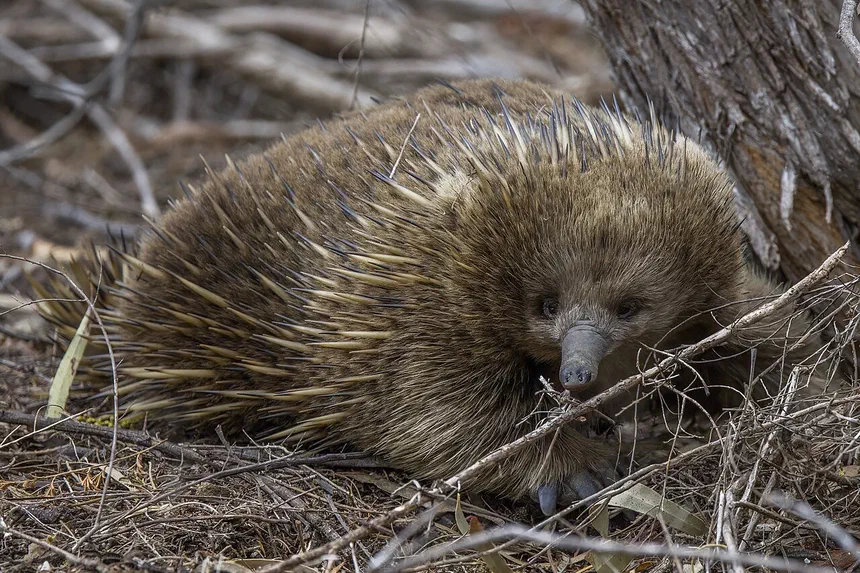
Image: Charles J. Sharp — CC BY-SA 4.0 · source
What Is a Echidna?
The short-beaked echidna (Tachyglossus aculeatus) is a small, spine-covered mammal native to Australia and New Guinea. Together with the platypus, echidnas belong to the monotremes, the only living mammals that lay eggs rather than giving birth to live young. Despite their superficial resemblance to hedgehogs or porcupines, echidnas are not closely related to either and represent one of the most ancient mammalian lineages still alive today.
Appearance and Identification
An echidna is a compact, rounded animal covered in a coat of coarse hair interspersed with sharp, hollow spines, which are modified hairs made of keratin. Between the spines the fur ranges from light brown to nearly black, while the spines themselves are typically cream to buff colored with darker tips. The most distinctive feature is the slender, tubular snout, or “beak,” which houses a long, sticky tongue. Echidnas have short, powerful limbs ending in broad claws well suited to digging. Adults usually measure about 30 to 45 centimeters in length and weigh anywhere from roughly 2 to 7 kilograms, with size varying across their wide range.
Habitat and Range
The short-beaked echidna is remarkably adaptable and occupies one of the broadest ranges of any Australian mammal. It is found throughout mainland Australia, in Tasmania, and across parts of New Guinea. Echidnas thrive in a wide variety of environments, including wet and dry forests, open woodlands, heathlands, arid deserts, alpine meadows, and coastal scrub. Their tolerance for such varied conditions stems from their ability to shelter in hollow logs, rock crevices, dense vegetation, and burrows, which buffer them against temperature extremes.
Diet
Echidnas are specialized insectivores, feeding primarily on ants and termites, which gives them their nickname “spiny anteater.” Using their strong claws, they tear open ant nests, termite mounds, and rotting logs, then probe the exposed galleries with their long, sticky tongue to gather prey. They have no teeth; instead, food is ground between hard pads at the base of the tongue and the roof of the mouth. Echidnas also consume other invertebrates such as beetle larvae and worms when available, and they ingest a fair amount of soil while feeding.
Behavior
Echidnas are generally solitary and slow-moving, spending much of their time foraging or resting. They are strong diggers and can rapidly burrow straight down into soft ground when threatened, leaving only a wall of spines exposed. On harder surfaces they may curl into a defensive ball. Largely silent, they rely on a keen sense of smell and sensitivity to vibrations to locate prey and detect danger. Depending on climate and season, echidnas may be active during the day, at dusk, or at night, shifting their schedule to avoid heat. In cooler regions some individuals enter torpor or true hibernation, dramatically lowering their body temperature and metabolism to conserve energy.
Life Cycle and Reproduction
Reproduction in echidnas is among the most unusual of any mammal. During the breeding season, several males may follow a single female in a slow procession sometimes called an “echidna train.” After mating, the female lays a single leathery-shelled egg directly into a temporary pouch on her belly. The egg hatches after about ten days, producing a tiny, undeveloped young known as a puggle. The puggle remains in the pouch and nurses on milk secreted from specialized skin patches, as echidnas lack nipples. Once its spines begin to develop, the mother deposits it in a nursery burrow and returns periodically to nurse it for several months until it is weaned.
Conservation Status
The short-beaked echidna is listed as Least Concern by the IUCN and remains widespread and reasonably common across its range. Its adaptability and broad diet help it persist in landscapes altered by humans. Nonetheless, individuals face threats from vehicle traffic, habitat loss, predation by introduced foxes and dogs, and disturbance to the soils and insect populations they depend on. The long-beaked echidnas of New Guinea, a separate group, are far more threatened, but the familiar short-beaked species is not currently considered at risk.
Frequently Asked Questions
Do echidnas really lay eggs? Yes. Echidnas are monotremes, one of only a few living mammal groups that reproduce by laying eggs. The female lays a single egg into a pouch, where it hatches into a tiny young called a puggle.
Are echidna spines dangerous? The spines are sharp and provide effective defense against predators, but echidnas are not aggressive and pose no real threat to people. They rely on the spines passively, curling up or digging in rather than attacking.
How long do echidnas live? Echidnas are notably long-lived for their size. In the wild they commonly reach 15 to 40 years, and individuals in captivity have survived even longer.