Mammals Guide
Eastern Quoll
What Is a Eastern Quoll? The eastern quoll (Dasyurus viverrinus) is a small, spotted marsupial predator belonging to the family Dasyuridae, the same group that includes the Tasmanian devil. About the size of a small …
At a glance
What Is a Eastern Quoll?
The eastern quoll (Dasyurus viverrinus) is a small, spotted marsupial predator belonging to the family Dasyuridae, the same group that includes the Tasmanian devil. About the size of a small domestic cat, it is one of Australia’s six quoll species and is now found in the wild only on the island of Tasmania.
Appearance and Identification
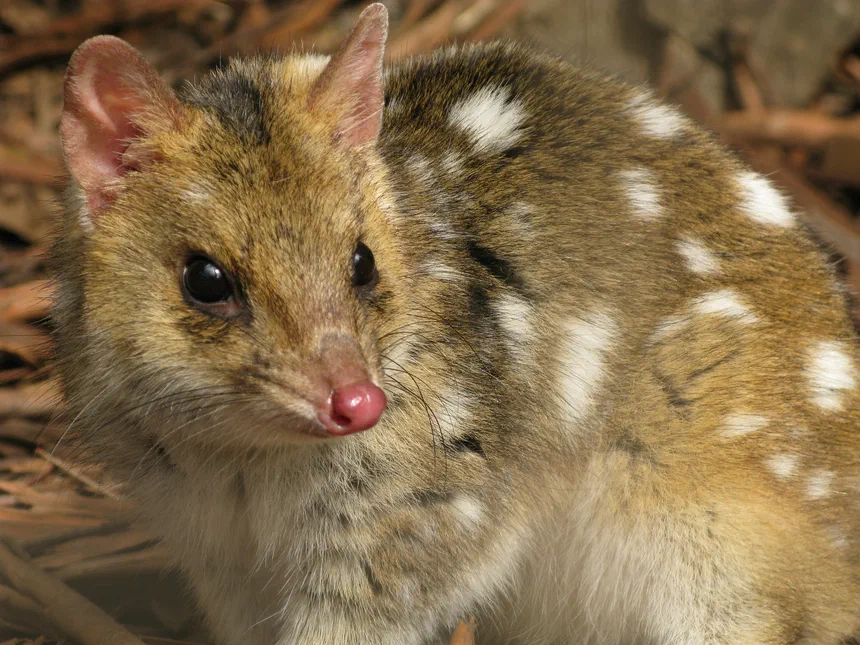
Eastern quolls are easily recognized by the scattering of white spots across their backs and flanks. The species occurs in two color morphs: a common fawn or ginger-brown form and a darker, almost black form, both dotted with the characteristic white markings. Unlike some of their relatives, eastern quolls have no spots on the tail, which is typically long and bushy with a pale tip. They have a pointed, pinkish snout, prominent rounded ears, and large dark eyes suited to a nocturnal lifestyle. Adults measure roughly 28 to 45 centimeters in head-and-body length, with a tail adding another 17 to 28 centimeters. Males are noticeably heavier than females, ranging from about 0.9 to 2 kilograms compared with 0.7 to 1.1 kilograms for females.
Habitat and Range
Historically the eastern quoll ranged across southeastern mainland Australia, but it vanished from the mainland by the mid-20th century and now survives naturally only in Tasmania. There it favors a mosaic of dry grassland, open woodland, heath, and the margins of agricultural land, where prey is plentiful. The species does well in mixed landscapes that offer both open hunting ground and sheltered sites such as hollow logs, burrows, and rock piles for denning. Small reintroduced or fenced populations have been established at conservation sites on the mainland in recent years.
Diet
Eastern quolls are opportunistic carnivores with a strong emphasis on invertebrates. Insects such as beetles, grasshoppers, and moth larvae form a large part of the diet, especially in warmer months. They also take small mammals, birds, reptiles, and the eggs of ground-nesting species, and will readily scavenge carrion. On occasion they eat fruit and other plant material, making the overall diet somewhat flexible depending on season and availability.
Behavior
This is a mainly solitary and nocturnal animal, resting by day in a den and emerging after dark to forage across a home range that it navigates on the ground. Eastern quolls are agile and can climb, but they hunt primarily by moving through low vegetation and open country. They communicate through scent marking and a range of hisses, growls, and other vocalizations, particularly during the breeding season when encounters between individuals increase. Outside of breeding, adults generally avoid one another.
Life Cycle and Reproduction
Breeding takes place in early winter, generally around May and June. As a marsupial, the female gives birth after a very short gestation of about three weeks to tiny, underdeveloped young. She may bear more offspring than she can raise, since she has a limited number of teats in her shallow pouch; typically around six young survive by attaching to a teat. The young remain in the pouch for roughly two months before being left in a den or carried on the mother’s back as they continue to grow. They are weaned and independent by late summer. Eastern quolls mature quickly and have a relatively short life, usually living only three to four years in the wild.
Conservation Status
The eastern quoll is listed as Endangered by the IUCN. Its extinction on mainland Australia has been linked to a combination of disease, predation by introduced foxes and cats, habitat loss, and possibly poisoning. Tasmania remains a stronghold because it lacks established fox populations, but even there numbers have declined, prompting concern about long-term stability. Conservation efforts include captive breeding, predator-proof reserves, and trial reintroductions to suitable mainland habitat.
Frequently Asked Questions
Are eastern quolls related to Tasmanian devils? Yes. Both belong to the family Dasyuridae, the group of carnivorous marsupials native to Australia and New Guinea, though the devil is considerably larger.
Why did eastern quolls disappear from mainland Australia? Their mainland decline is attributed to introduced predators such as foxes and cats, disease, and habitat change, with the last confirmed mainland records dating to the mid-1900s.
Are the black and fawn quolls different species? No. The dark and fawn-brown animals are simply two color morphs of the same species and can even occur within the same litter.