Mammals Guide
Eastern Mole
What Is a Eastern Mole? The eastern mole (Scalopus aquaticus), also called the common mole, is a small, burrowing mammal in the mole family, Talpidae, native to North America. It spends almost its entire life …
At a glance
What Is a Eastern Mole?
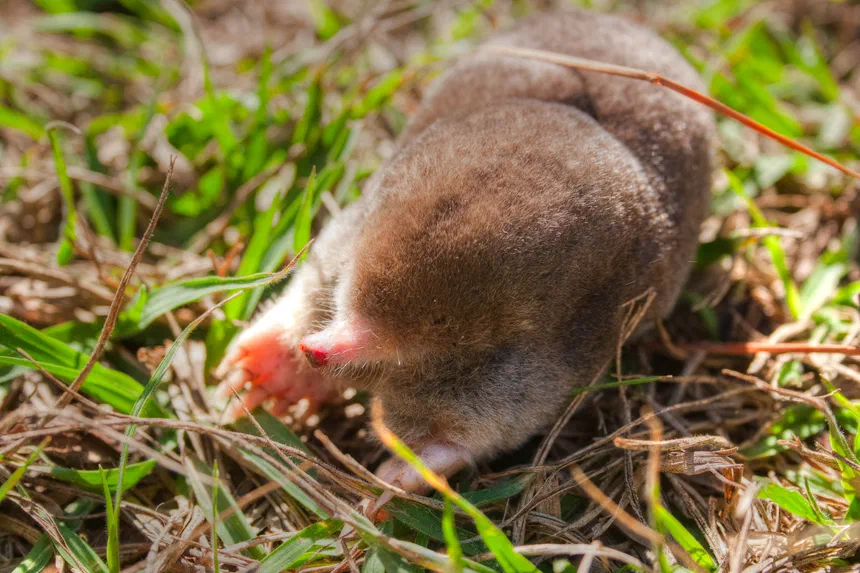
The eastern mole (Scalopus aquaticus), also called the common mole, is a small, burrowing mammal in the mole family, Talpidae, native to North America. It spends almost its entire life underground, using powerful, outward-facing front feet to tunnel through soil in search of earthworms and insects. Despite its watery-sounding scientific name, it is a poor swimmer and lives in dry to moist soils rather than in water.
Appearance and Identification
The eastern mole is a compact, cylindrical animal superbly built for life underground. Its fur is short, dense, and velvety, ranging from slate-gray to grayish-brown and often showing a silvery sheen; because the hairs lack a set direction, the coat lies smoothly whether the animal moves forward or backward through a tunnel. Adults typically measure about 11 to 17 centimeters in head-and-body length with a short, nearly hairless tail of 2 to 4 centimeters, and they weigh roughly 30 to 140 grams. The most distinctive features are the broad, spade-like front feet, which are turned permanently outward and tipped with strong claws for digging. The eyes are tiny and hidden beneath the skin, external ears are absent, and the pointed, flexible snout is naked and pink.
Habitat and Range
The eastern mole ranges across much of the eastern and central United States, extending north into southern Canada and south into northeastern Mexico. It favors loose, well-drained, moist soils that are easy to tunnel and rich in prey, and it is common in fields, meadows, pastures, gardens, lawns, and open woodlands. Sandy or loamy soils are preferred, while heavy clay, rocky ground, and waterlogged areas are generally avoided. This adaptability to human-modified landscapes makes the eastern mole a familiar, if seldom-seen, resident of yards and golf courses throughout its range, where its raised ridges and molehills often reveal its presence.
Diet
The eastern mole is an insectivorous carnivore with a hearty appetite driven by a fast metabolism. Earthworms make up the bulk of its diet, but it also consumes beetle grubs, insect larvae, ants, centipedes, snails, and other soil-dwelling invertebrates, and it occasionally nibbles on plant matter such as seeds. As it pushes through the soil, the mole encounters prey exposed within its tunnels, detecting food largely by touch and smell rather than sight. Because of its high energy demands, a mole must eat frequently and may consume a large fraction of its body weight in food each day. Some individuals store paralyzed earthworms in underground larders for later use.
Behavior
The eastern mole is a solitary, largely subterranean animal that is active year-round, both day and night, in bursts of feeding and rest. It constructs two kinds of tunnels: shallow surface runways used for foraging, which create the familiar raised ridges across lawns, and deeper permanent passages used for shelter and nesting. Molehills form where the animal pushes excavated soil up to the surface. Powerful forelimbs allow it to move through earth with a swimming-like motion, and it can dig new tunnels rapidly. Moles are generally intolerant of one another outside the breeding season and defend their tunnel systems. Their poor eyesight is offset by an acute sense of touch, aided by sensitive whiskers and snout.
Life Cycle and Reproduction
Eastern moles breed once a year, typically in late winter or early spring. After a gestation of roughly four to six weeks, the female gives birth to a single litter of usually two to five young in a nest chamber lined with grasses and leaves, set within a deeper part of the tunnel system. The pups are born blind, naked, and helpless, but they grow quickly on their mother’s milk and are typically weaned and ready to leave the nest within about four to five weeks. Young moles then disperse to establish their own territories, generally reaching maturity by the following breeding season. In the wild, eastern moles may live around three to six years.
Conservation Status
The eastern mole is listed as Least Concern by the IUCN, reflecting its wide distribution and large, stable population. It tolerates a range of habitats, including agricultural land and suburban yards, which has helped it persist alongside human development. In many areas it is regarded as a lawn and garden pest because its tunneling disturbs turf and root systems, and it is sometimes trapped or controlled for this reason. Even so, moles play a beneficial ecological role by aerating soil, mixing nutrients, and preying on insect pests. No significant range-wide threats currently endanger the species.
Frequently Asked Questions
Are eastern moles blind? Eastern moles are not completely blind, but their tiny eyes are covered by skin and can likely detect only light and dark, so they rely mainly on touch and smell to navigate and find food underground.
Do eastern moles eat plant roots? Moles are chiefly carnivorous and feed on earthworms and insects rather than roots; damage to plants usually comes from tunneling disturbing the soil, though other animals may use mole tunnels to reach roots.
Why do molehills appear in lawns? Molehills are mounds of loose soil pushed to the surface as a mole excavates its deeper tunnels, while the raised ridges snaking across a lawn mark shallow feeding runways just beneath the surface.