Mammals Guide
Eastern Grey Kangaroo
What Is a Eastern Grey Kangaroo? The eastern grey kangaroo (Macropus giganteus) is one of Australia’s largest and most familiar marsupials, second in size only to the red kangaroo. A member of the family Macropodidae, it …
At a glance
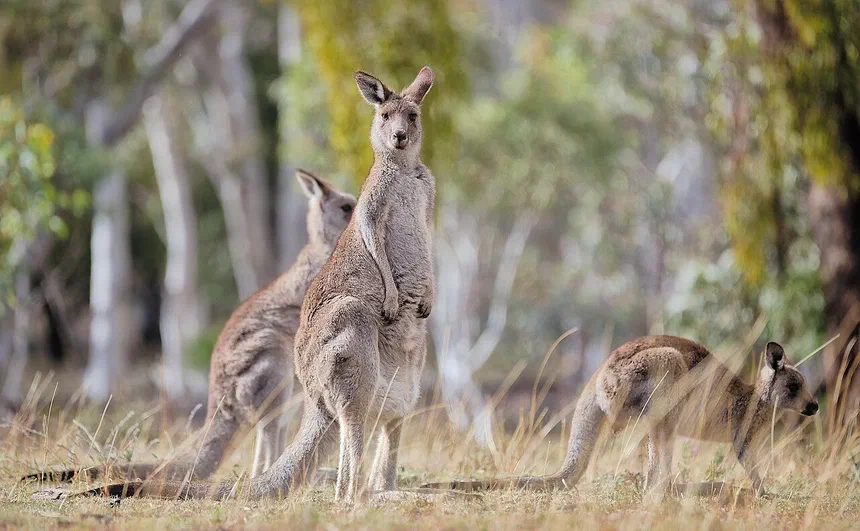
Image: Thennicke — CC BY-SA 4.0 · source
What Is a Eastern Grey Kangaroo?
The eastern grey kangaroo (Macropus giganteus) is one of Australia’s largest and most familiar marsupials, second in size only to the red kangaroo. A member of the family Macropodidae, it is a hopping, grass-eating mammal that carries and nurses its young in a forward-opening pouch.
Appearance and Identification
As its name suggests, this kangaroo wears a coat of soft grey to grey-brown fur, fading to a paler cream or whitish color on the belly, chest, and inner limbs. It has a finely furred muzzle, large upright ears, and dark-tipped paws and feet. Males are noticeably larger and more muscular than females, sometimes standing over 1.8 m tall when upright. The powerful hind legs and long, heavy tail are the animal’s defining features: the tail serves as a counterbalance while hopping and as a supporting “fifth limb” when the animal props itself upright or moves slowly on all fours.
Habitat and Range
The eastern grey kangaroo occupies eastern and southeastern Australia, from Queensland down through New South Wales and Victoria into parts of Tasmania and South Australia. It favors open forests, woodlands, and the grassy edges where trees meet cleared land, as well as coastal heath and farmland. This flexibility means the species is often seen at the boundary between shelter and feeding grounds, resting in the shade of trees by day and moving into open pasture to graze.
Diet
This kangaroo is a specialized herbivore and grazer, feeding mainly on grasses and low herbs. Like other large grazing macropods, it has a chambered, fermenting stomach that helps break down fibrous plant material, and its teeth are adapted for cropping and grinding tough vegetation. It typically feeds in the cooler hours of early morning and evening, and it can go long periods relying on the moisture in fresh grass, though it will drink when water is available.
Behavior
Eastern grey kangaroos are social animals that gather in loose groups known as “mobs,” which may number from a handful to several dozen individuals. Membership is fluid, with animals joining and leaving as they move between feeding areas. They travel by hopping, an energy-efficient gait that lets them cover ground quickly and clear obstacles; at slower speeds they use a five-limbed crawl. Males compete for access to females through “boxing” bouts, balancing on their tails to kick with the hind legs and grapple with the forelimbs. The species is most active around dawn and dusk.
Life Cycle and Reproduction
Females can breed year-round, with births often peaking in the warmer months. After a short gestation of roughly a month, a tiny, undeveloped newborn (called a joey) climbs unaided into the pouch, where it attaches to a teat and continues developing for many months. A joey typically first leaves the pouch at around 9 to 11 months and is weaned some months later. Females can practice a form of delayed development, holding a dormant embryo in reserve while an older joey still occupies the pouch. In the wild, eastern grey kangaroos generally live about 8 to 12 years.
Conservation Status
The eastern grey kangaroo is listed as Least Concern by the IUCN. It remains widespread and abundant across its range, and in many agricultural areas it is common enough to be regarded as overabundant. Populations are managed through regulated culling programs in some regions. The main pressures the species faces come from habitat clearing, drought, vehicle collisions, and competition with livestock, rather than any risk of extinction.
Frequently Asked Questions
How fast can an eastern grey kangaroo move? Over short distances a healthy adult can hop at speeds of around 50 km/h (about 30 mph), using its long tail for balance.
What is the difference between an eastern grey and a red kangaroo? Eastern greys have soft grey-brown fur and favor wetter forests and woodlands of the east, while red kangaroos are larger, often rusty-red, and adapted to arid inland plains.
Are eastern grey kangaroos dangerous to people? They are generally shy and avoid humans, but large males can be powerful and may kick or scratch if cornered or provoked, so wild animals should be observed from a distance.