Mammals Guide
Eastern Gray Squirrel
What Is a Eastern Gray Squirrel? The eastern gray squirrel (Sciurus carolinensis) is a medium-sized tree squirrel native to the woodlands of eastern North America. A familiar sight in parks, backyards, and forests alike, …
At a glance
What Is a Eastern Gray Squirrel?
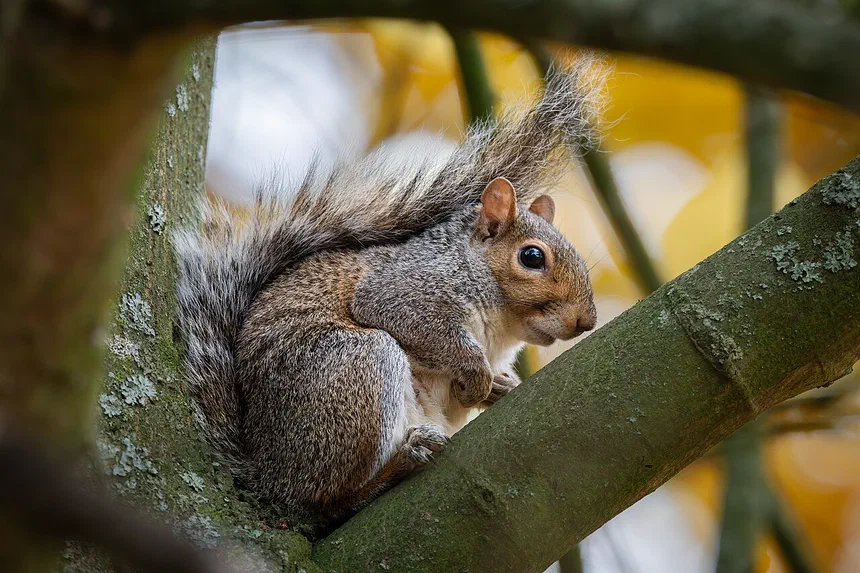
The eastern gray squirrel (Sciurus carolinensis) is a medium-sized tree squirrel native to the woodlands of eastern North America. A familiar sight in parks, backyards, and forests alike, it is one of the most successful and adaptable rodents on the continent. Its ability to thrive alongside people has made it both a beloved neighbor and, where introduced abroad, an invasive concern.
Appearance and Identification
As its name suggests, this squirrel is usually cloaked in grizzled gray fur, though the shade can vary from silvery to brownish, often with rusty or tan highlights along the flanks, face, and tail. The belly is typically pale gray to white. The most striking feature is the long, bushy tail, which nearly matches the body in length and serves as a balance aid, a blanket, and a signaling flag. Adults measure roughly 9 to 12 inches in the body, with an additional 7 to 10 inches of tail, and weigh around 14 to 21 ounces. All-black (melanistic) and, more rarely, all-white or albino individuals occur in some populations, giving certain towns their famous local color morphs.
Habitat and Range
The eastern gray squirrel is native to the eastern and midwestern United States and southeastern Canada, favoring mature deciduous and mixed forests rich in nut-bearing trees such as oaks, hickories, and beeches. It readily adapts to human-altered landscapes, colonizing city parks, wooded suburbs, and campuses wherever large trees provide food and shelter. Introduced populations have become established in the British Isles, parts of Europe, South Africa, and elsewhere, where the species often outcompetes native squirrels and can damage trees.
Diet
Primarily a plant-eater, this squirrel relies heavily on hard mast such as acorns, hickory nuts, walnuts, and beechnuts, supplemented by seeds, tree buds, flowers, fruits, and fungi. During lean seasons it will also nibble bark, and it occasionally takes insects, bird eggs, or nestlings. A hallmark behavior is scatter-hoarding: the squirrel buries individual nuts across its range and relies on spatial memory and a keen sense of smell to recover them. Forgotten caches sprout into seedlings, making the animal an important disperser of oaks and other trees.
Behavior
Eastern gray squirrels are diurnal and active year-round, most energetic in the cool hours of morning and late afternoon. They do not truly hibernate, instead relying on stored fat and cached food to survive winter, sheltering in leafy nests called dreys or in tree cavities during the harshest weather. Agile climbers, they can leap between branches, descend trunks headfirst thanks to rotating ankle joints, and use their tails for balance and communication. They are generally solitary but tolerate overlapping ranges, and they use a repertoire of chattering calls and tail flicks to warn of predators such as hawks, owls, foxes, and domestic cats.
Life Cycle and Reproduction
Breeding typically peaks twice a year, in late winter and again in summer. After a gestation of roughly 40 to 45 days, the female gives birth to a litter of usually two to four pups in a tree den or drey. The young are born blind, hairless, and helpless, opening their eyes at around four to five weeks and weaning by about eight to ten weeks. Juveniles disperse to establish their own territories in the following months. While many young squirrels do not survive their first year, individuals that reach adulthood may live several years in the wild, and considerably longer in captivity.
Conservation Status
The eastern gray squirrel is listed as Least Concern by the IUCN, reflecting its large, stable, and widespread population. Within its native range it is abundant and faces no significant threats. Ironically, its very success poses problems elsewhere: as an introduced species it can displace native squirrels, most notably contributing to the decline of the red squirrel in Britain, and is managed as an invasive pest in several countries.
Frequently Asked Questions
Do eastern gray squirrels hibernate? No. They remain active throughout winter, relying on fat reserves and food caches while sheltering in nests or tree cavities during severe cold.
Are they always gray? Not necessarily. While most are grizzled gray, all-black and rare white or albino individuals occur in some populations.
Why are they considered invasive in Britain? Introduced gray squirrels outcompete the native red squirrel for food and habitat and carry a virus that is often lethal to reds, driving steep declines in red squirrel numbers.