Mammals Guide
Eastern Cottontail
What Is a Eastern Cottontail? The Eastern cottontail (Sylvilagus floridanus) is a small, familiar rabbit native to much of North America and one of the most widespread wild rabbits on the continent. It takes its name …
At a glance
What Is a Eastern Cottontail?
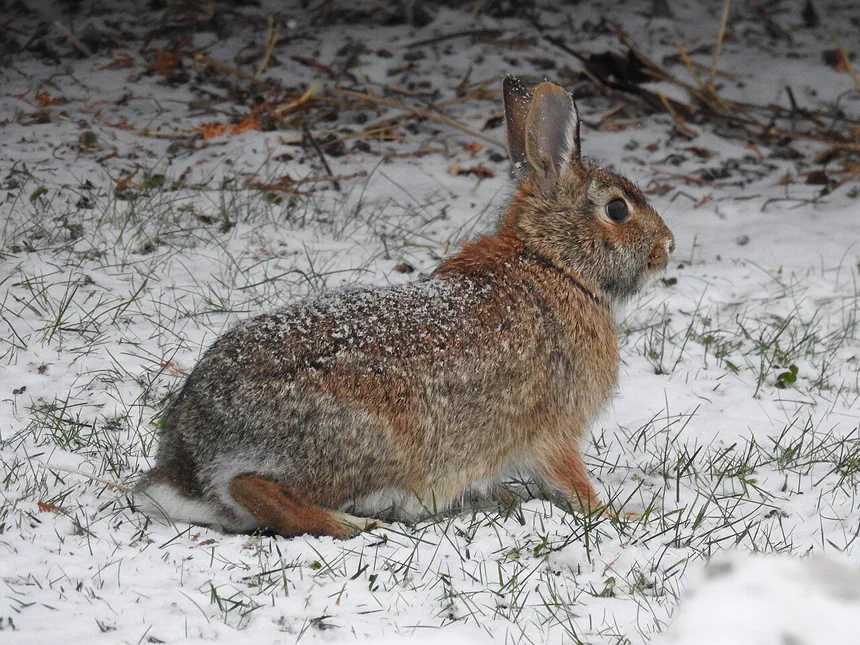
The Eastern cottontail (Sylvilagus floridanus) is a small, familiar rabbit native to much of North America and one of the most widespread wild rabbits on the continent. It takes its name from the fluffy white underside of its tail, which flashes like a cotton ball when the animal bounds away from danger. Adaptable and prolific, it thrives from rural farmland to suburban backyards.
Appearance and Identification
Eastern cottontails have a rounded body, large hind feet, and relatively short ears compared with jackrabbits and hares. Their coat is grayish-brown to reddish-brown, often speckled with black, and grades to a paler gray on the sides. The belly and the underside of the tail are white, while a rusty patch frequently marks the nape of the neck. Adults typically measure about 36 to 48 centimeters (14 to 19 inches) in body length and weigh roughly 0.8 to 1.5 kilograms (about 2 to 3.3 pounds). Large, dark eyes set on the sides of the head give the rabbit a wide field of view to watch for predators.
Habitat and Range
The species ranges across eastern and central North America, from southern Canada through the eastern and central United States and into parts of Mexico and Central America. It favors edge habitats where open ground meets cover, including meadows, old fields, hedgerows, brushy thickets, forest margins, and the fringes of farmland. Eastern cottontails also do well in human-altered landscapes, turning up in parks, gardens, and suburban lots wherever there is enough vegetation for food and shelter.
Diet
Eastern cottontails are strict herbivores. During the warmer months they graze on grasses, clover, and a wide variety of green herbs and leafy plants. In fall and winter, when tender growth is scarce, they shift to woody fare such as twigs, buds, and the bark of shrubs and young trees. Like other rabbits, they practice coprophagy, re-ingesting soft nighttime droppings to extract additional nutrients from their fibrous diet.
Behavior
This rabbit is most active at dawn, dusk, and through the night, spending the daylight hours resting in a shallow depression called a form, tucked into grass or brush. It is generally solitary and does not dig extensive burrows of its own, though it may shelter in the abandoned dens of other animals. When threatened, a cottontail often freezes to avoid detection, then explodes into a zigzagging sprint that can exceed 25 kilometers per hour (about 15 miles per hour). It is a wary, alert animal that relies on speed and cover rather than a fixed home to survive.
Life Cycle and Reproduction
Eastern cottontails are famously fast breeders. In much of their range the breeding season stretches from late winter into early autumn, and a female may produce several litters in a single year. After a gestation of about 28 days, she gives birth to a litter of roughly three to eight young in a shallow, fur- and grass-lined nest. The kits are born blind and nearly hairless but develop quickly, leaving the nest within two to three weeks. This rapid reproduction offsets heavy losses to predators, which include hawks, owls, foxes, coyotes, snakes, and domestic pets.
Conservation Status
The Eastern cottontail is listed as Least Concern by the IUCN. It remains abundant and widespread, and its ability to exploit agricultural and suburban settings has helped it stay common even as landscapes change. It is a major prey species for many predators and a popular game animal in parts of its range, yet populations remain robust overall.
Frequently Asked Questions
Is the Eastern cottontail a rabbit or a hare? It is a true rabbit. Its young are born helpless in a nest, unlike hares, whose young are born furred and open-eyed.
Do Eastern cottontails dig burrows? Not usually. They rest in shallow surface depressions called forms and will use burrows dug by other animals rather than excavate their own.
Why does it have a white tail? The white underside of the tail flashes as the rabbit flees, which may confuse predators or signal alarm to other cottontails.