Mammals Guide
Eastern Chipmunk
What Is a Eastern Chipmunk? The eastern chipmunk (Tamias striatus) is a small, ground-dwelling squirrel native to the forests and woodlands of eastern North America. It is easily recognized by the bold stripes running …
At a glance
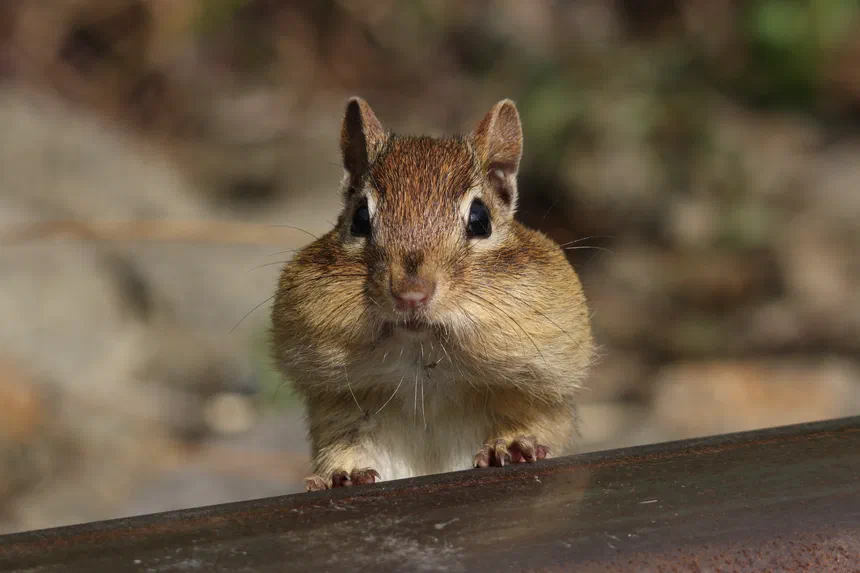
Image: Cephas — CC BY-SA 3.0 · source
What Is a Eastern Chipmunk?
The eastern chipmunk (Tamias striatus) is a small, ground-dwelling squirrel native to the forests and woodlands of eastern North America. It is easily recognized by the bold stripes running down its back and its habit of stuffing food into large cheek pouches. Despite its tiny size, it is one of the most familiar wild mammals across much of its range.
Appearance and Identification
This chipmunk has a compact body with reddish-brown to grayish-brown fur on top and paler underparts. Its most distinctive feature is the pattern of five dark stripes separated by lighter bands running along the back and sides, with the central stripe extending from the head to the tail base. A pair of light and dark stripes also frames each eye. The tail is somewhat flattened and bushy but noticeably shorter and less fluffy than that of a tree squirrel. Internal cheek pouches allow it to carry surprisingly large loads of seeds and nuts back to its burrow.
Habitat and Range
The eastern chipmunk occupies a broad swath of eastern North America, from southern Canada through the eastern and central United States. It favors deciduous and mixed forests, particularly areas with plenty of logs, stumps, rock piles, and leaf litter that provide cover and denning sites. It readily adapts to human-altered landscapes and is a common sight in suburban yards, parks, and gardens where mature trees and shrubs are present. Each animal maintains an extensive underground burrow system, often with well-hidden entrances.
Diet
As an opportunistic omnivore, the eastern chipmunk feeds mainly on nuts, seeds, acorns, berries, and other fruits, supplemented by fungi, buds, and green plant material. It also eats insects, worms, snails, and occasionally small vertebrates, bird eggs, or nestlings. A key behavior is caching: the chipmunk gathers food and carries it in its cheek pouches to store in underground larders, building up reserves that sustain it through periods when fresh food is scarce.
Behavior
Eastern chipmunks are largely solitary and territorial, defending the area around their burrow entrances. They are active during the day and spend much of their time foraging on the ground, though they can climb trees and shrubs to reach food. Vocal and alert, they give sharp “chip” and “chuck” calls that serve as alarm signals. Unlike true hibernators, they enter a state of torpor during the coldest months, periodically waking within their burrows to feed on stored food rather than relying solely on body fat.
Life Cycle and Reproduction
Breeding typically occurs in two peaks, one in early spring and another in summer. After a gestation of about 31 days, the female gives birth to a litter of usually three to five young in an underground nest chamber. The pups are born hairless and helpless, developing over several weeks before emerging above ground at around six weeks of age. They become independent soon after and reach sexual maturity within about a year. In the wild most individuals live only a couple of years, though predation and harsh winters take a heavy toll on the young.
Conservation Status
The eastern chipmunk is listed as Least Concern by the IUCN. It remains widespread and abundant across its range, and its ability to thrive in suburban and disturbed habitats helps buffer it against many pressures. Local populations fluctuate with the availability of mast crops such as acorns, but no significant threats endanger the species as a whole.
Frequently Asked Questions
Do eastern chipmunks hibernate? Not in the strict sense. They enter torpor through winter but wake periodically inside their burrows to eat stored food rather than sleeping straight through the season.
What do the cheek pouches do? The stretchy internal pouches let a chipmunk carry many seeds or nuts at once, so it can gather food quickly and store it safely underground.
Are eastern chipmunks harmful to gardens? They may dig or nibble on bulbs and seeds, but they are generally minor visitors and also help disperse seeds and spores, playing a useful role in the forest ecosystem.