Mammals Guide
Dwarf Sperm Whale
What Is a Dwarf Sperm Whale? The dwarf sperm whale (Kogia sima) is a small, seldom-seen toothed whale that lives in warm oceans around the world. Despite the name, it is only distantly related to the giant sperm whale …
At a glance
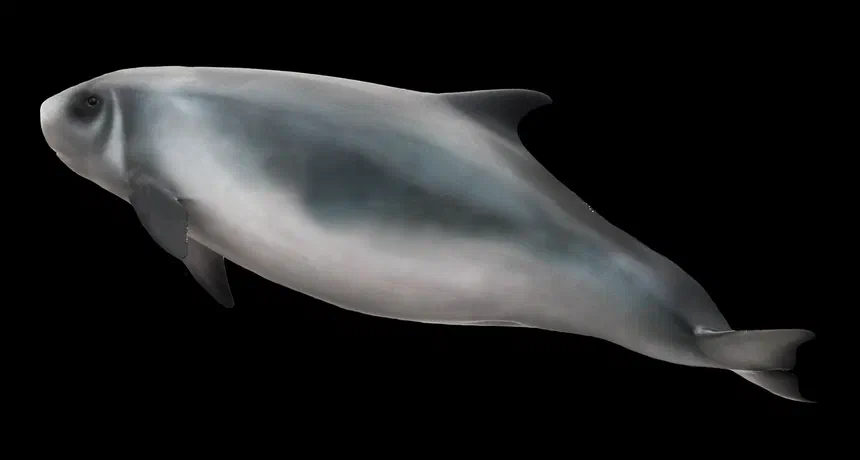
Image: Citron — CC BY-SA 3.0 · source
What Is a Dwarf Sperm Whale?
The dwarf sperm whale (Kogia sima) is a small, seldom-seen toothed whale that lives in warm oceans around the world. Despite the name, it is only distantly related to the giant sperm whale and belongs to a small family of pygmy whales. It is one of the smallest whale species, closer in size to a large dolphin than to the great whales.
Appearance and Identification
The dwarf sperm whale has a robust, tapering body that is bluish-gray to dark gray on the back and fades to a lighter, sometimes pinkish, shade on the belly. Its head is squarish and blunt, with a narrow, underslung lower jaw that gives the mouth a shark-like look. A pale, crescent-shaped mark behind each eye, often called a “false gill,” adds to that resemblance. The dorsal fin is tall and curved, set near the middle of the back, which helps distinguish it from the closely related pygmy sperm whale, whose fin is smaller and set farther back. Adults typically reach about 2 to 2.7 meters (6.5 to 9 feet) in length.
Habitat and Range
This species favors deep water and is most often found beyond the continental shelf, especially over the continental slope where the seafloor drops steeply. It occurs in tropical, subtropical, and warm temperate seas across the Atlantic, Pacific, and Indian Oceans. Because it spends little time at the surface and avoids boats, most of what scientists know comes from stranded animals rather than live sightings. Its exact distribution is therefore not fully mapped, but it appears to be widespread in suitable offshore waters.
Diet
The dwarf sperm whale is a carnivore that feeds mainly on squid and other cephalopods, along with fish and deep-water crustaceans such as shrimp. It hunts at depth, likely using echolocation to find prey in dark waters. Studies of stomach contents suggest it forages well below the surface, taking advantage of the abundant squid found over deep offshore banks and slopes.
Behavior
These whales are shy and undemonstrative, usually seen alone or in small groups of a handful of individuals. They tend to rest quietly at the surface, floating with part of the head and back exposed, and they rarely leap or splash. When startled, the dwarf sperm whale can release a cloud of reddish-brown intestinal fluid into the water, a defensive trick thought to confuse predators and cover an escape, similar to the ink of a squid. Their slow, inconspicuous surface habits make them easy to overlook at sea.
Life Cycle and Reproduction
Details of reproduction are not well documented because the species is so rarely observed. Females are thought to carry a single calf after a gestation of roughly nine to twelve months, with calves born measuring around a meter in length. Young are nursed for a period of months before becoming independent. Individuals are believed to live to about 20 years, though precise longevity in the wild is uncertain.
Conservation Status
The IUCN lists the dwarf sperm whale as Least Concern, in part because it has a broad global range. However, its true numbers are unknown, and it faces threats common to deep-diving whales, including entanglement in fishing gear and the swallowing of floating plastic debris, which can be mistaken for squid. Because it forages by sound, underwater noise may also disturb it. Ongoing strandings provide much of the data used to monitor the species.
Frequently Asked Questions
Is the dwarf sperm whale related to the giant sperm whale? Only distantly. Both share the name and a squid-based diet, but the dwarf sperm whale belongs to a separate family of small pygmy whales and is far closer in size to a dolphin.
Why is it so rarely seen? It lives in deep offshore waters, spends little time at the surface, and behaves quietly, so it is easily missed. Much of what we know comes from stranded animals.
What is the reddish cloud it releases? When alarmed, it can expel a dark, reddish intestinal fluid into the water, likely to confuse a predator while it slips away, much like a squid uses ink.