Mammals Guide
Dwarf Mongoose
What Is a Dwarf Mongoose? The dwarf mongoose (Helogale parvula) is the smallest carnivore native to Africa and a member of the mongoose family, Herpestidae. It is a highly social, insect-eating mammal of sub-Saharan …
At a glance
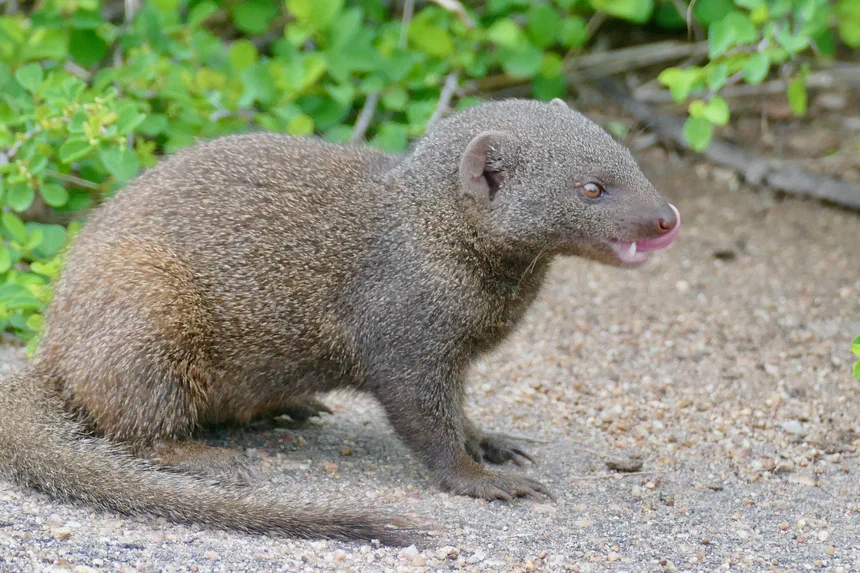
Image: Bernard DUPONT from FRANCE — CC BY-SA 2.0 · source
What Is a Dwarf Mongoose?
The dwarf mongoose (Helogale parvula) is the smallest carnivore native to Africa and a member of the mongoose family, Herpestidae. It is a highly social, insect-eating mammal of sub-Saharan savannas, best known for living in tightly knit family groups that cooperate to raise young and watch for danger.
Appearance and Identification
This is a compact, low-slung animal with a slender body, short legs, and a pointed muzzle. The soft coat is a grizzled, speckled brown that can range from reddish to grayish depending on the region, giving it good camouflage against dry earth and leaf litter. Adults typically measure about 18 to 28 centimeters in head-and-body length, with a tapering tail adding another 14 to 20 centimeters, and weigh roughly 200 to 400 grams. Small rounded ears, dark eyes, and sharp claws suited to digging complete its unassuming appearance.
Habitat and Range
Dwarf mongooses occur across much of eastern and southern Africa, from Ethiopia and Somalia south through Kenya, Tanzania, and Zambia into parts of South Africa. They favor open savanna, dry woodland, and bushy scrub, and are especially tied to areas dotted with old termite mounds. These mounds serve as den sites, lookout posts, and refuges from heat and predators, making them a central feature of a group’s home range.
Diet
As carnivores, dwarf mongooses feed mainly on invertebrates. Beetles, termites, grasshoppers, larvae, spiders, and scorpions make up the bulk of the diet, supplemented by the occasional small lizard, snake, bird, egg, or fruit. They forage on the move through the day, using a keen sense of smell to probe leaf litter, dig in loose soil, and turn over dung and debris. Foraging is a group activity, though each animal hunts its own prey.
Behavior
Dwarf mongooses are intensely social, living in family groups that usually number from about six to twenty individuals. A group is led by a dominant breeding pair, and members cooperate closely: while most forage, one or more sentinels stand guard from an elevated perch and give alarm calls that distinguish aerial from ground threats. They communicate through a rich repertoire of chirps, twitters, and trills. Remarkably, dwarf mongooses form mutually beneficial relationships with certain hornbills, which follow the group to catch flushed insects while adding extra eyes to spot raptors.
Life Cycle and Reproduction
Within each group, breeding is normally monopolized by the dominant female, who may produce two or three litters during the warm, wet months. After a gestation of roughly seven to eight weeks, she gives birth to a litter of about two to four pups inside a termite mound den. The entire group helps raise the young, with subordinate members babysitting, grooming, and even nursing pups while parents forage. This cooperative care greatly improves the survival of each generation.
Conservation Status
The dwarf mongoose is listed as Least Concern by the IUCN. It remains widespread and locally common across suitable habitat, is adaptable, and faces no major range-wide threats. Localized pressures such as habitat conversion exist, but overall populations are considered stable, and the species occurs in many protected areas.
Frequently Asked Questions
Are dwarf mongooses dangerous to people? No. They are small, shy, insect-eating animals that pose no threat to humans and typically flee when approached.
Why do dwarf mongooses live near termite mounds? Old termite mounds provide ready-made dens, cool refuges, and raised lookout points, making them ideal centers for a group’s daily life.
Do dwarf mongooses really cooperate with birds? Yes. They form loose foraging partnerships with hornbills, sharing early warning of predators in exchange for the insects the mongooses stir up.