Mammals Guide
Dugong
What Is a Dugong? The dugong (Dugong dugon) is a large, slow-moving marine mammal and the only living member of the family Dugongidae. It belongs to the order Sirenia, which also includes the manatees, and it is the sole …
At a glance
What Is a Dugong?
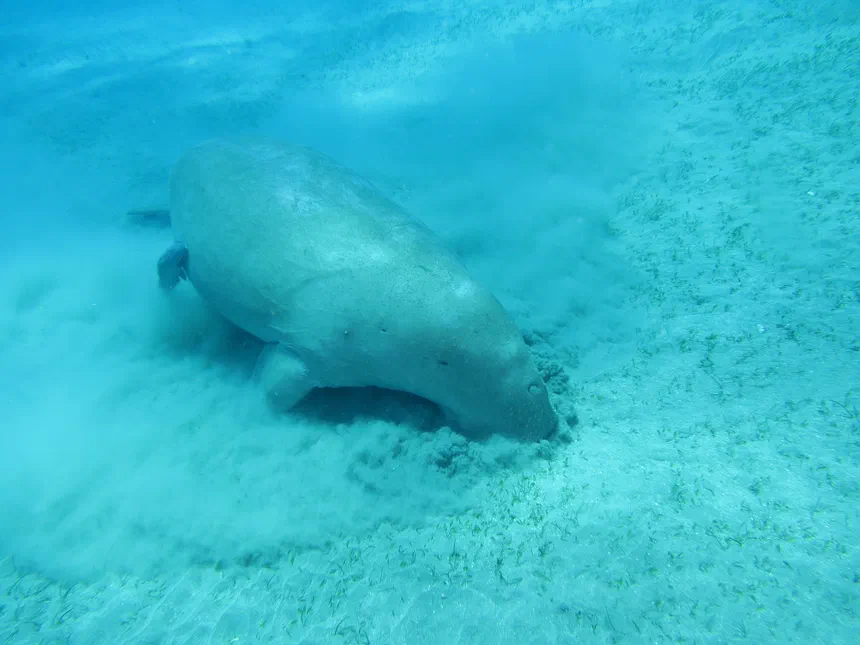
The dugong (Dugong dugon) is a large, slow-moving marine mammal and the only living member of the family Dugongidae. It belongs to the order Sirenia, which also includes the manatees, and it is the sole surviving sirenian that feeds almost entirely on seagrass in the sea rather than in fresh water.
Appearance and Identification
Dugongs have a rounded, torpedo-shaped body that tapers to a broad, fluked tail similar to that of a dolphin or whale, which distinguishes them at a glance from the paddle-tailed manatees. The skin is thick and smooth, ranging from gray to brownish, and is often paler on the belly. Adults typically measure about 2.5 to 3 meters long and weigh roughly 230 to 400 kilograms, with some individuals growing larger. The head ends in a broad, downturned snout and a fleshy, bristled upper lip well suited to grazing along the seabed. The forelimbs are short flippers, and there are no hind limbs. Males and older females may develop small tusks.
Habitat and Range
Dugongs live in warm, shallow coastal waters across a wide band of the Indo-Pacific, from the eastern coast of Africa and the Red Sea through the Persian Gulf, South and Southeast Asia, and out to northern Australia and Pacific island groups. They are strongly tied to seagrass meadows, which provide their food, and they favor sheltered bays, wide shallow shelves, mangrove channels, and the lee of large inshore islands. Northern Australian waters hold some of the largest remaining populations. Because they depend on seagrass, dugong distribution closely tracks the health and extent of these underwater beds.
Diet
Dugongs are almost exclusively herbivorous and are sometimes called “sea cows” for their grazing habits. They feed mainly on seagrasses, favoring softer, lower-fiber species rich in nutrients, and they often uproot whole plants, leaving distinctive feeding trails across the meadow. A dugong may consume large quantities of seagrass each day to fuel its bulky body. On occasion they will also take marine algae, and some populations ingest small invertebrates caught up with the vegetation, but seagrass remains the foundation of their diet.
Behavior
Dugongs are generally slow and placid, cruising near the bottom as they graze. They may be seen alone, in pairs, or in loose gatherings, and larger aggregations can form where seagrass is abundant. As mammals, they surface regularly to breathe, usually every few minutes, and can hold their breath longer while resting. They communicate through chirps, whistles, and other sounds, which help maintain contact and signal between individuals. Though not strongly territorial, dugongs may travel considerable distances between feeding areas, following the seasonal availability of seagrass.
Life Cycle and Reproduction
Dugongs are long-lived and reproduce slowly, which makes their populations sensitive to losses. Females typically give birth to a single calf after a gestation of around a year, and calves stay close to their mothers, nursing and learning to graze for well over a year. Individuals reach sexual maturity relatively late, often not until their late single digits or into their teens, and females may produce a calf only once every several years. This low reproductive rate means that populations recover very slowly from decline. In the wild, dugongs can live for many decades, with the oldest known individuals reaching around 70 years.
Conservation Status
The dugong is listed as Vulnerable on the IUCN Red List, and many regional populations are declining or already severely reduced. The greatest threats come from the loss and degradation of seagrass habitat through coastal development, pollution, and dredging, as well as accidental capture in fishing nets, boat strikes, and in some areas hunting. Their slow reproduction leaves little margin for added mortality. Conservation efforts focus on protecting seagrass meadows, reducing bycatch, managing coastal development, and monitoring populations, often with the involvement of local and Indigenous communities who have long-standing ties to the species.
Frequently Asked Questions
Are dugongs the same as manatees? No. Both belong to the order Sirenia and look similar, but dugongs have a fluked, dolphin-like tail and live only in marine seagrass habitats, while manatees have a rounded, paddle-shaped tail and often use fresh water.
What do dugongs eat? Dugongs are herbivores that feed almost entirely on seagrass, sometimes supplemented with marine algae.
Are dugongs endangered? They are classified as Vulnerable overall, though some regional populations are far more threatened, mainly because of seagrass loss, fishing-net entanglement, and boat strikes.