Mammals Guide
Dromedary Camel
What Is a Dromedary Camel? The dromedary camel (Camelus dromedarius), also called the Arabian camel, is a large, single-humped mammal supremely adapted to hot, arid environments. It is one of the most important …
At a glance
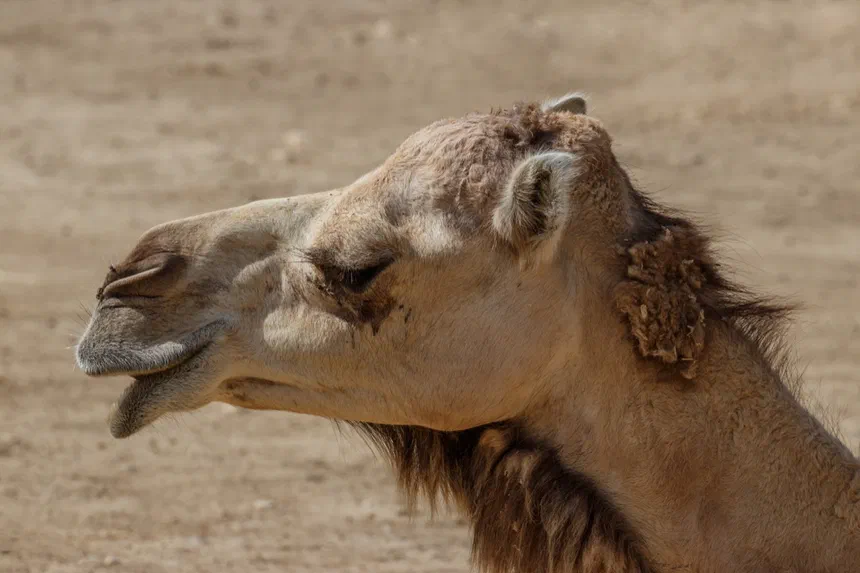
Image: H. Zell — CC BY-SA 3.0 · source
What Is a Dromedary Camel?
The dromedary camel (Camelus dromedarius), also called the Arabian camel, is a large, single-humped mammal supremely adapted to hot, arid environments. It is one of the most important domesticated animals of the desert world, valued for transport, milk, meat, and wool. Unlike its two-humped relative the Bactrian camel, the dromedary carries just one prominent hump.
Appearance and Identification
Dromedaries are tall, long-legged animals standing roughly 1.8 to 2 meters at the shoulder, with the top of the single hump rising higher still. Adults typically weigh between 300 and 600 kilograms. Their coat ranges from sandy brown and tan to cream or, occasionally, darker brown. The hump stores fat rather than water, serving as an energy reserve that shrinks and slumps when food is scarce. Distinctive adaptations include long eyelashes, sealable nostrils that keep out blowing sand, broad two-toed feet with leathery pads that spread weight on loose ground, and thick lips capable of handling thorny plants.
Habitat and Range
This species is native to the hot deserts and dry regions of North Africa, the Arabian Peninsula, and southwestern and southern Asia. It thrives in arid deserts, semi-arid plains, and dry scrubland where few large mammals can survive. Today almost all dromedaries are domesticated. A notable exception is Australia, where camels introduced in the 1800s established large free-ranging feral populations across the interior deserts.
Diet
Dromedaries are herbivores with a tolerance for coarse, dry, and thorny vegetation that other grazers avoid. They feed on grasses, leaves, and the tough shrubs scattered across desert landscapes, using their mobile lips and hardened mouth tissue to browse spiny plants. Like other camelids, they chew cud and rely on a chambered stomach to extract nutrition from fibrous forage. They can go for long periods without drinking, then rehydrate rapidly, taking in very large volumes of water in a single session when it becomes available.
Behavior
Dromedaries are generally social animals that in the wild or feral state form groups, often a dominant male with several females and their young. They are active mainly during the day and rest during the hottest hours. Their bodies tolerate wide swings in internal temperature, reducing the need to sweat and conserving water. Camels communicate through bellows, grunts, and moans, and they are known for a strong-willed temperament. When threatened or annoyed, they may spit a mix of saliva and stomach contents.
Life Cycle and Reproduction
Breeding is often tied to cooler seasons when forage is more available. After a gestation of roughly 13 to 15 months, a female usually gives birth to a single calf. The newborn can stand and walk within hours and follows its mother closely. Calves nurse for around a year or more and reach sexual maturity at about three to five years of age, with males generally maturing later than females. Well-cared-for dromedaries can live around 40 to 50 years.
Conservation Status
The dromedary is not assessed as a wild species by the IUCN because it survives essentially only as a domesticated animal; truly wild dromedaries are considered extinct. Domestic populations number in the millions and are not at risk. Australia’s feral camels, by contrast, are numerous enough to be managed as an environmental concern in some regions.
Frequently Asked Questions
Does a camel store water in its hump? No. The hump stores fat, which the animal metabolizes for energy when food is scarce. Camels manage water through efficient kidneys, tolerance of dehydration, and rapid rehydration.
How is a dromedary different from a Bactrian camel? The dromedary has one hump and lives in hotter deserts of Africa and Asia, while the Bactrian camel has two humps and is native to the colder deserts of Central Asia.
How long can a dromedary go without water? In cool conditions it may go for a week or more without drinking, and even in heat it can endure several days, then drink a very large amount at once to recover.